
Milan, late evening. A one-star Michelin restaurant with a month-long waiting list. The waiter places a plate the size of a wagon wheel in front of me. In the center, if you look closely, lie five ravioli. Not five portions. Five pieces. Around them, a pale green smear of sauce is spread, a few stems of microgreens are tossed, and oil is sparingly dripped. The bill for this contemplation: 30 euros.
A week later, I stood at an Asian market with a cardboard bowl of wontons. They floated in a broth that fogged my glasses. The steam smelled of ginger and melted pork fat. The bowl cost just over two dollars. I still remember that taste today, while the Milanese ravioli have already faded from memory.
We begin with this contradiction. Stuffed dough dishes were invented by dozens of cultures independently. Everywhere, people wrapped a piece of meat or vegetables in a thin layer of dough, preserving the juices and stretching an expensive ingredient to feed a large crowd. Yet, the status of these dishes diverged dramatically. Italian ravioli sit on white tablecloths and cost as much as a full dinner. Similar Asian, Caucasian, and Slavic dishes remained the food of markets, family feasts, and basement eateries. This article addresses that exact injustice.
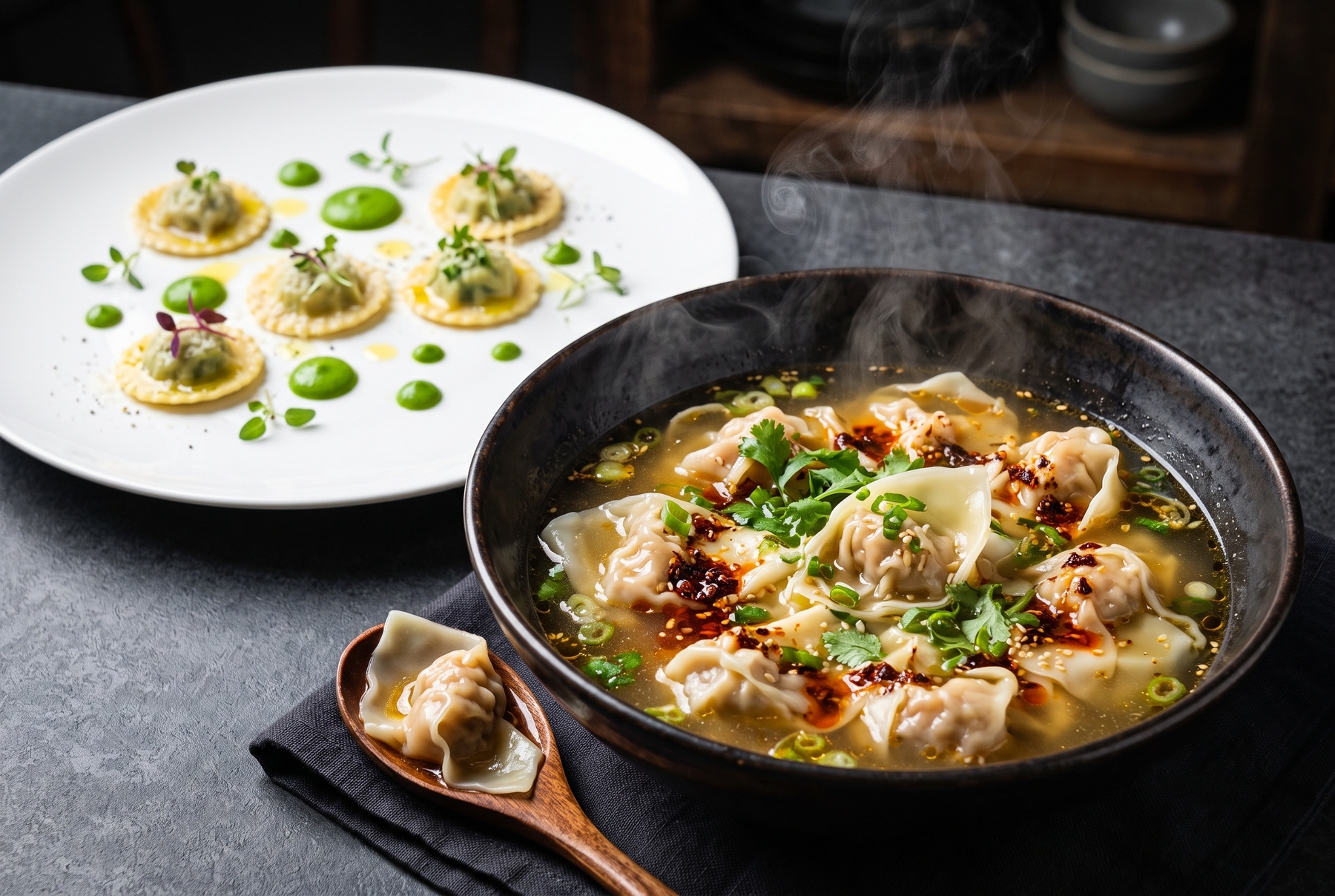
Italian ravioli in a restaurant presentation and hearty Asian wontons in a spicy broth: two opposing approaches to stuffed dough.
Table of Contents
- The Economics of Ravioli: How Meat and Dough Entered Haute Cuisine
- The Anatomy of a Bite: Where the Italian Classic Loses
- Asian Dumplings: Wontons, Shuijiao, and Mandu
- Khinkali and Kurze: Dough Dishes With Broth Inside
- European and Slavic: Maultaschen, Vareniki, and Pelmeni
- Where to Find Authentic Flavor
The Economics of Ravioli: How Meat and Dough Entered Haute Cuisine
Ravioli were allowed onto the white tablecloth for reasons far removed from the kitchen: restaurant arithmetic and reputation.
The word ‘Italy’ on a menu sells itself, backed by a century of clever marketing, cinema, glossy magazines, and a general consensus that Italian food is inherently noble. Ravioli are also convenient: they are easy to cook to perfection in a minute and plate beautifully before the pasta turns mushy, ensuring each portion looks uniformly neat on any white plate. Counting them individually is equally convenient.
Add to this the psychology of an empty plate. When a vast white expanse is placed before a guest, with a tiny island of food resting upon it, the brain interprets it as luxury. Less means more expensive. You cannot serve khinkali (Georgian soup dumplings) this way: they are large, they leak, they are eaten with the hands, and tweezers have no business here. Pelmeni (Russian meat dumplings) in sour cream on porcelain look like something you already make at home on Sundays. It is hard to sell them for the price of a dinner, even though their flavor often beats ravioli hands down.
I will be honest: good ravioli exist, and I love them. The problem lies not with the dish, but with its inflated status. We pay for the tablecloth, not the taste.
The Anatomy of a Bite: Where the Italian Classic Loses
Let us break down exactly what happens in your mouth when you bite into ravioli versus when you bite into, say, khinkali. The main difference is not in the shape or even the dough, but in what is hidden inside.
The filling of ravioli is often structured as a homogeneous mass: ricotta with spinach, pumpkin puree, finely ground meat. It is soft, even, and tidy. The flavor might be delicate and complex, but the texture barely changes from the first bite to the last. The filling does not crunch, does not fall apart into fibers, and does not release hot broth. It often has nothing to surprise the palate.
The best dishes similar to ravioli operate entirely differently. The filling is chopped rather than turned into a paste: pieces of meat, fat, vegetables, and herbs retain their structure and offer varying resistance to the teeth. Ice water or broth is worked into the minced meat, enough fat is added, and during boiling, a hot, aromatic liquid gathers inside. The first bite releases it onto the tongue. Ravioli almost never offer this experience.
A juicy filling is defined by three things. A distinct texture instead of a homogeneous puree. Sufficient fat, which carries the flavor and prevents the meat from drying out. And liquid trapped inside: broth, water, or the meat’s own juices.
Next, we will explore eight stuffed dough dishes that understand these rules far better than most Italian restaurants.
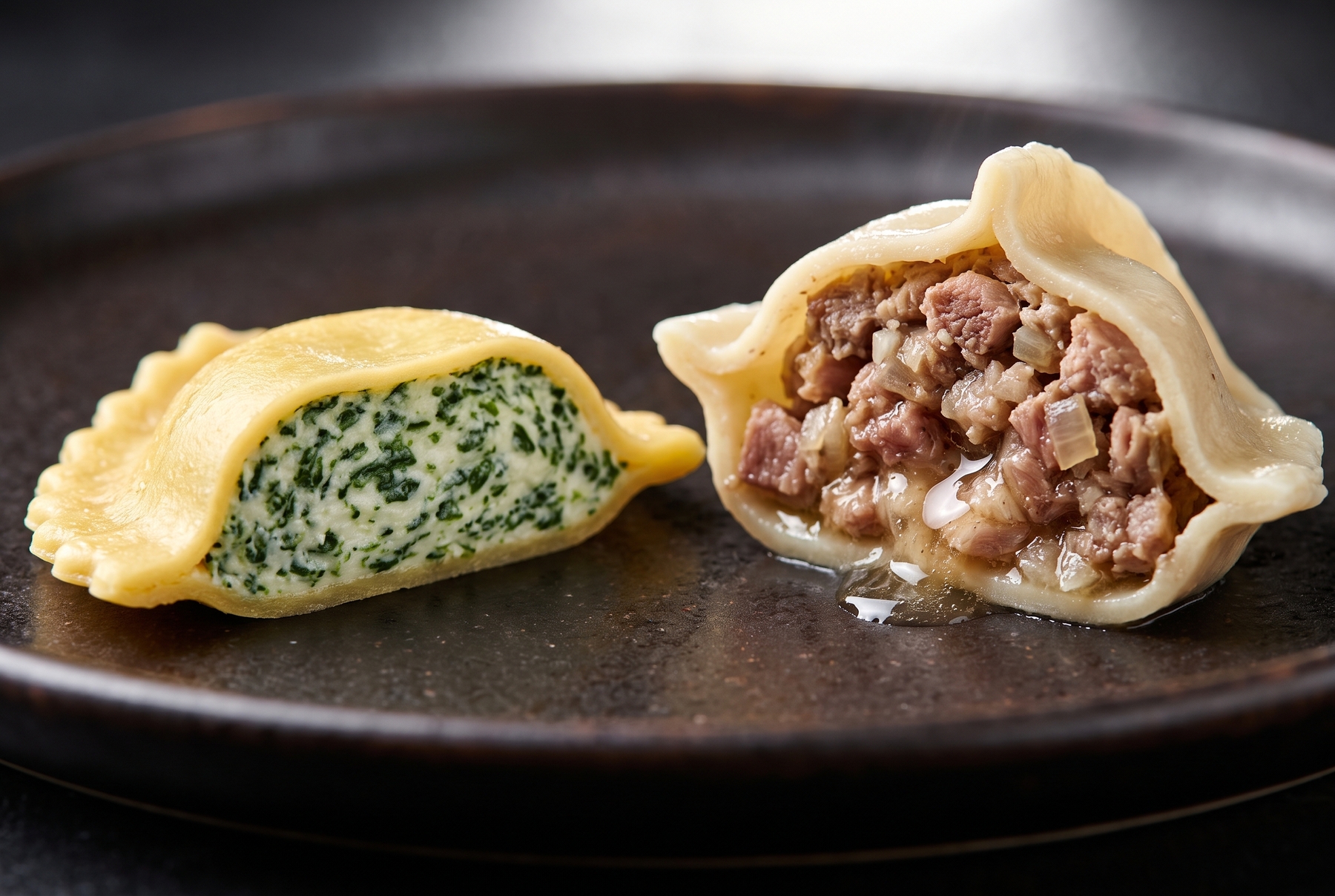
The anatomy of a bite: a somewhat dry paste-like filling of ricotta and spinach in ravioli versus juicy minced meat with hot broth.
Asian Dumplings: Wontons, Shuijiao, and Mandu
Wontons: Dough Thinner Than Paper
Wontons begin with a dough so thin that light almost shines through it. It is rolled so finely that after boiling, the tails become translucent and flutter in the broth like wet silk. The filling is restrained: minced pork, sometimes with chopped shrimp, a bit of ginger, a drop of sesame oil, and egg white for binding.
The essence of a wonton lies not only in the dumpling itself, but in what it is submerged in. In southern China, it is a transparent pork or shrimp broth, essentially boiling water with character. In Sichuan, the scenario changes: boiled wontons are drenched in spicy red oil with garlic, soy sauce, and vinegar, setting the palate on fire while the dough slips through smoothly. They are usually overcooked due to inexperience; the thin dough only needs a couple of minutes, as holding it longer in boiling water turns it to mush and tears it right in the skimmer.
Shuijiao: Northern Character
If the southern wonton is elegant, the northern shuijiao is substantial. The dough here is thicker and more honest; it holds its shape and stretches pleasantly under the teeth. The classic filling is brilliantly simple: pork, Chinese cabbage or green onions, ginger, soy sauce, and sesame oil. No gimmicks.
Balance does the work here. The cabbage is salted and squeezed to remove excess water, but not bone-dry: the remaining moisture, combined with the pork fat, creates a deep meat flavor during boiling that lingers in the mouth after the bite. Northerners often boil shuijiao, but the best variation, in my opinion, is guotie (potstickers): the same dumplings, pan-fried until they form a crispy, lacy bottom. A soft top, a brittle crust underneath, and a hot filling inside.
Mandu: Kimchi, Tofu, and Glass Noodles
Korean mandu feature the most complex filling of all. Inside goes kimchi (squeezed, otherwise it will leak), crumbled tofu, sweet potato glass noodles, minced pork, and green onions. Each component does its job: kimchi provides acidity and heat, tofu mellows the spice and adds softness, while the noodles absorb the juices and prevent the filling from falling apart.
Mandu are versatile in their cooking methods. Boiled ones (mulmandu) are delicate and belong in broth. Fried ones (gunmandu) develop a taut, crunchy crust while remaining hot inside. Steamed versions come out moist with a clean flavor. When making them at home, squeezing the kimchi almost dry by hand and tasting the filling for salt before shaping is essential: tofu mutes the flavor, and an under-salted filling will turn out bland.
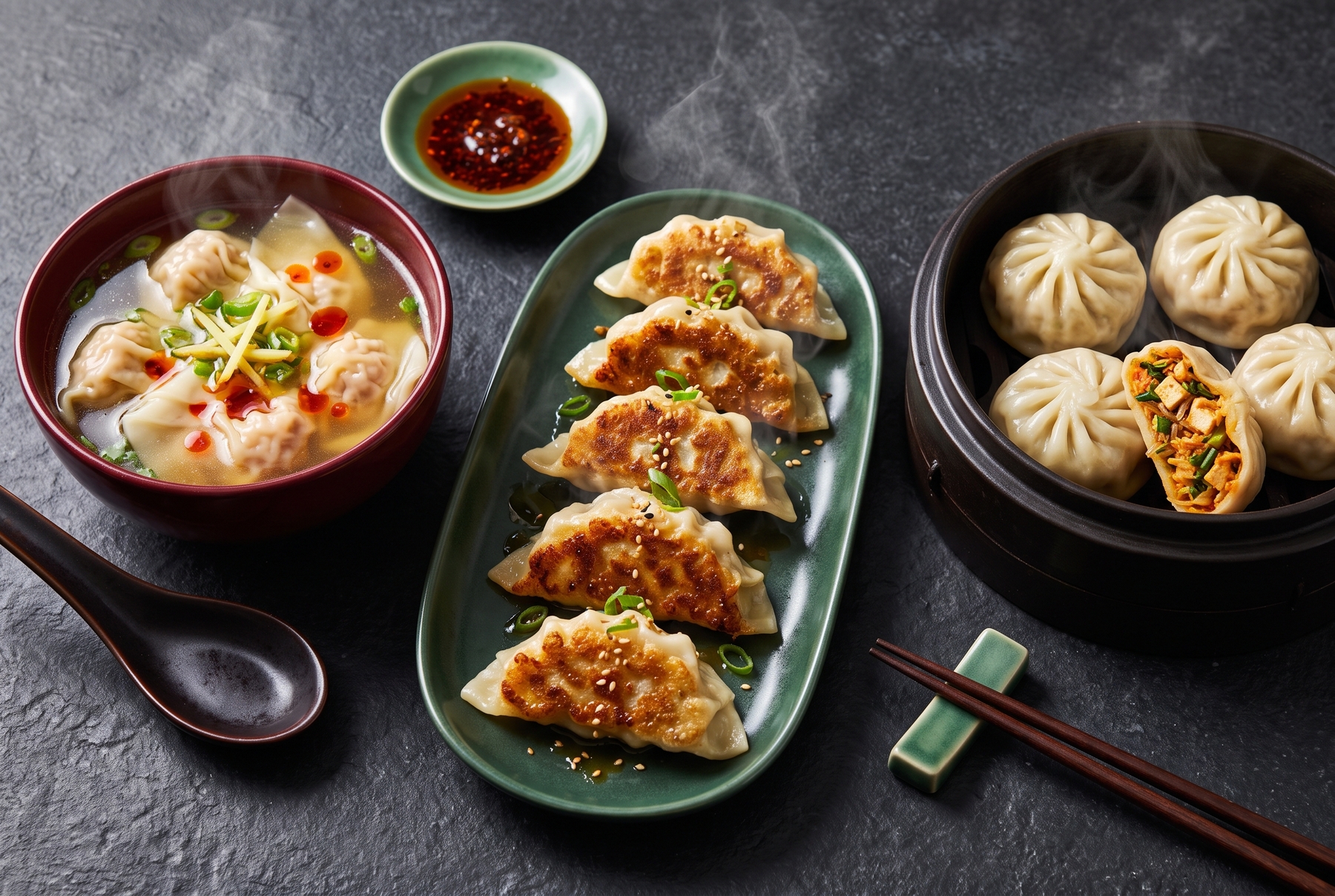
Variety of Asian dumplings: delicate wontons in broth, crispy shuijiao, and steamed Korean mandu.
Khinkali and Kurze: Dough Dishes With Broth Inside
Khinkali: Soup Inside the Dough
Khinkali (Georgian soup dumplings) are an engineering marvel masquerading as food. Chopped (not ground) meat with generous amounts of black pepper, herbs, and onions is wrapped in dense dough. Before shaping, ice water or broth is beaten into the minced meat and kneaded until viscous. During boiling, this liquid transforms into a hot, rich soup inside.
In Georgia, everyone knows the rules of eating them. Khinkali are eaten by hand, held by the pleated tail. The first bite is taken carefully from the side, drinking the broth first before it spills onto the plate and your lap. Forks are strictly avoided: piercing the dumpling drains its entire purpose into a puddle. The tail, a twisted crown of numerous pleats, is usually not eaten but left on the edge of the plate. It serves as the handle. Skimping on water in the filling is a mistake, and the sealing must be airtight: a single hole in the seam sends the soup into the cooking pot.
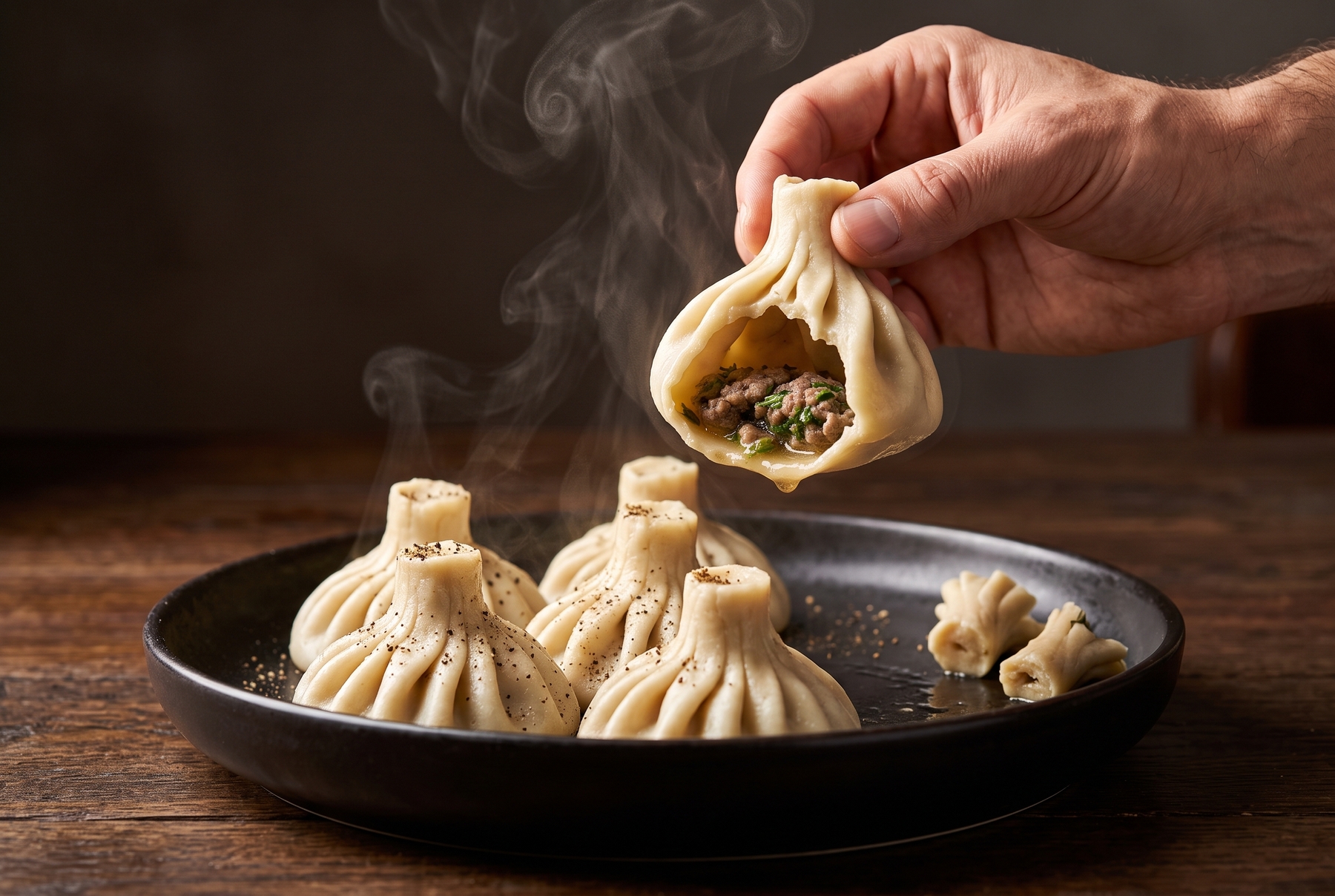
Juicy Georgian khinkali: the proper technique of eating by hand from the tail to avoid spilling a single drop of rich broth.
Kurze: The Braid That Holds the Juice
Dagestani kurze look similar to standard dumplings but reveal themselves through their seam. The edges here are braided. A braid holds tighter than a simple pinch, trapping the juice inside.
The fillings for kurze are broader than what we are used to. Meat versions include herbs and spices, with pepper and onions added generously. Alongside them are curd cheese variations. In the most unexpected version, a liquid egg-and-onion mixture is poured into the dough, which sets into a delicate cream upon boiling. Kurze are often served with sour cream or a fermented milk sauce, sometimes utilizing whey. The dairy element on the plate makes the flavor milder and tarter than that of Russian pelmeni. The braid, much like the tail of khinkali, is shaped by hand, and a beginner’s first few attempts always come out crooked. This is completely normal.
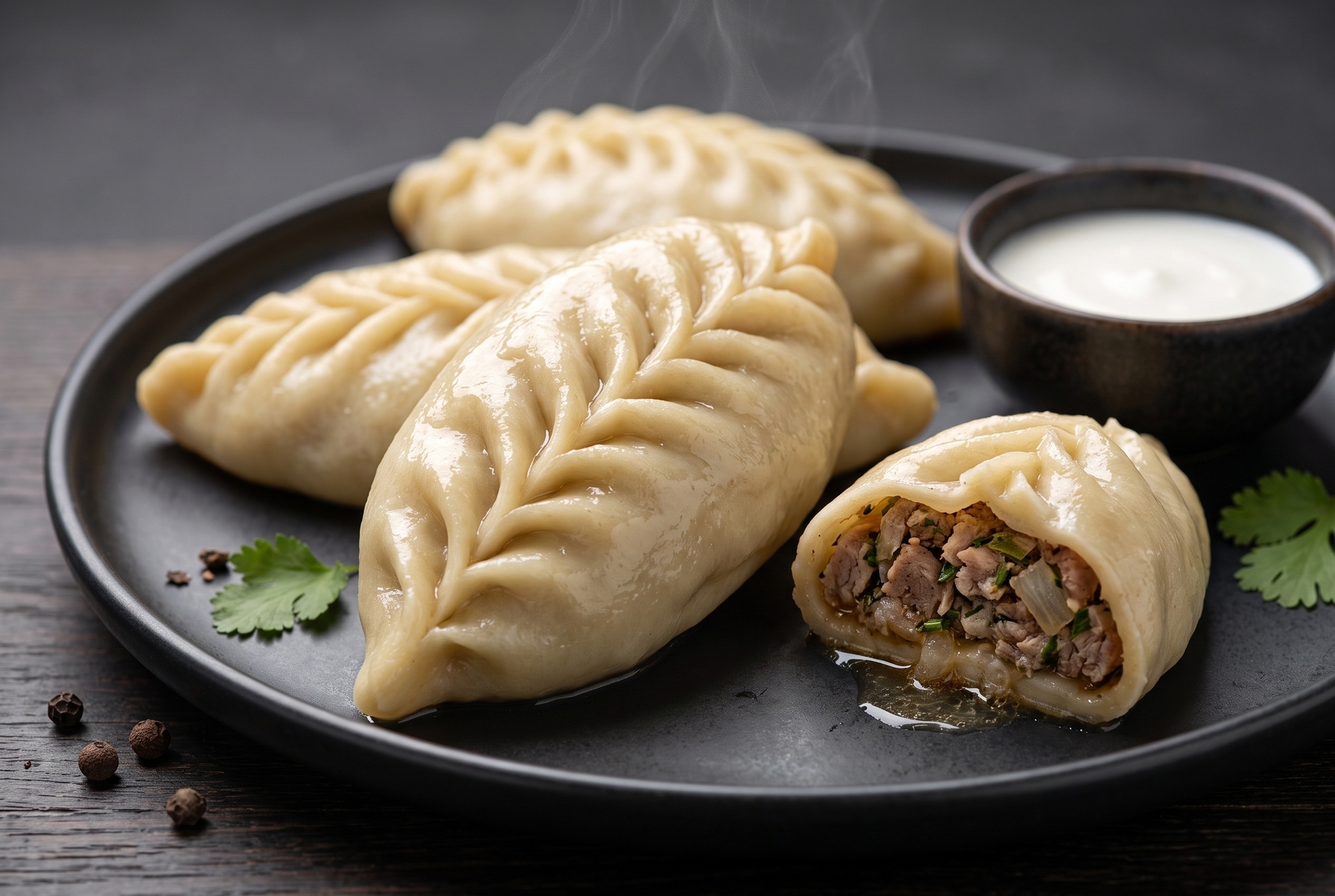
Traditional Dagestani kurze: the braided seam securely traps meat juices and spices inside.
European and Slavic: Maultaschen, Vareniki, and Pelmeni
Maultaschen: How Swabians Deceived God
Swabian maultaschen (large German meat-filled pasta) stem from German cunning. Legend has it that monks hid meat inside dough and spinach so it would not catch the eye during Lent (hence the popular nickname translated as ‘deceive God’). Whether this is true or just a beautiful tall tale is hard to judge, but the filling reveals the intent: minced meat, spinach, soaked breadcrumbs, and onions, all mixed together.
Maultaschen are large and brutal, the size of a palm. The breadcrumbs here work on texture: they absorb the meat juices and hold them inside, preventing the filling from drying out. Classically, they are served in a rich beef broth, which is their best form: the envelope slowly releases its flavor into the liquid, while the liquid softens the dough. Leftovers the next day are sliced and pan-fried with an egg, which is arguably even more delicious than on the first day.
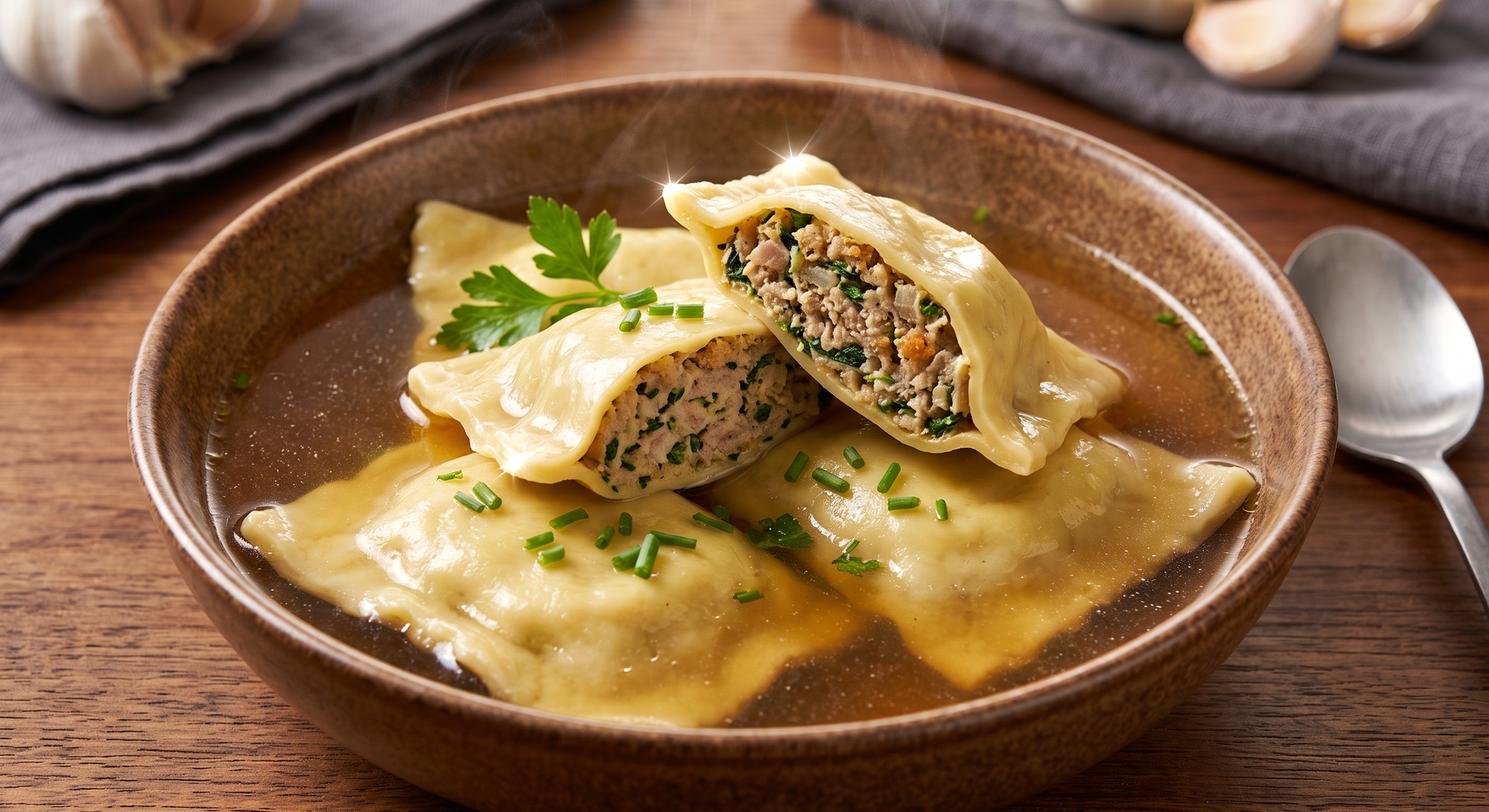
German maultaschen in hot broth: hearty dough envelopes filled with minced meat, spinach, and breadcrumbs.
Vareniki: Not Just Sweet
Vareniki (Slavic filled dumplings) are unfairly pigeonholed as a dessert, yet the savory versions outshine many. With potatoes and cracklings, with salted curd cheese, with braised cabbage: the dough is the same, but the character is completely different. The same principle applies to Polish pierogi: similar envelopes of unleavened dough filled with potatoes, cabbage, meat, or cheese.
Everything relies on fat and onions. Cracklings (rendered pieces of pork fat) and lard coat the filling, ensuring it never goes dry. The onions must be caramelized, brought to the color of burnt sugar over low heat, steadily, for about twenty minutes. This process extracts flavor from simple potatoes, making you reach for a second portion without thinking. The curd filling is lightly salted and not overpowered with sugar; otherwise, it results in a childish dessert flavor, which the savory version actively avoids.
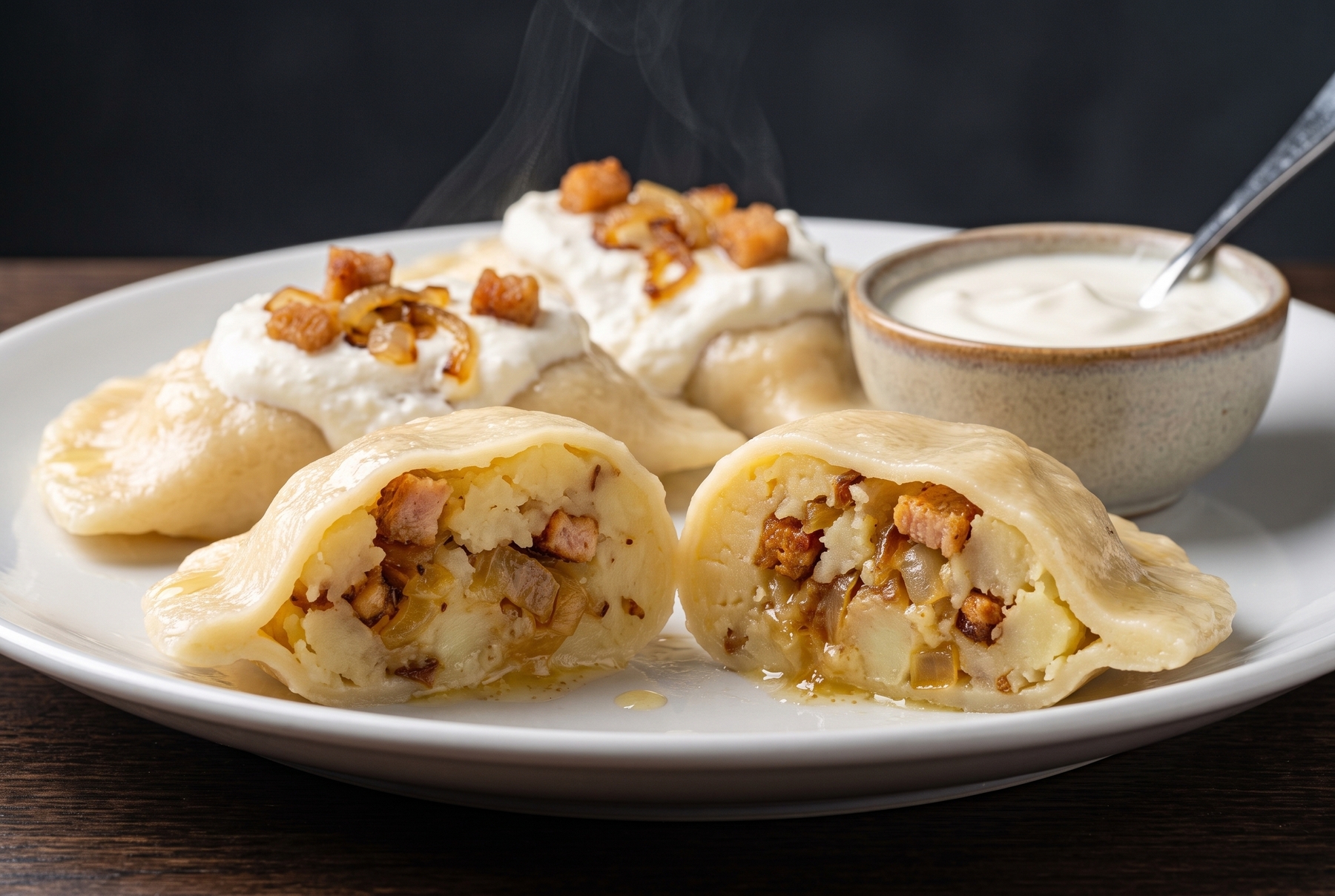
Appetizing vareniki with potatoes, golden caramelized onions, and crispy cracklings topped with sour cream sauce.
Pelmeni: Cult Minimalism
Pelmeni (Siberian meat dumplings) triumph by doing nothing superfluous. A mixed mince (beef and pork, sometimes with added lamb), onions, salt, pepper, ice water, and thin dough. That is all.
The strength here lies in a combination of simple elements that works deeper than any truffle sauce. Hot meat juice, butter, a spoonful of sour cream, a sharp drop of vinegar, a sting of freshly ground pepper. Salt, fat, acid, and umami converge at a single point, and the body responds unconditionally. The fat percentage decides everything: lean mince yields dry pelmeni. Using pork with good marbling is essential, and beating a little ice water into the mince ensures broth gathers inside during boiling. They are boiled in salted water and removed just as they float and simmer for a couple of minutes, no longer.
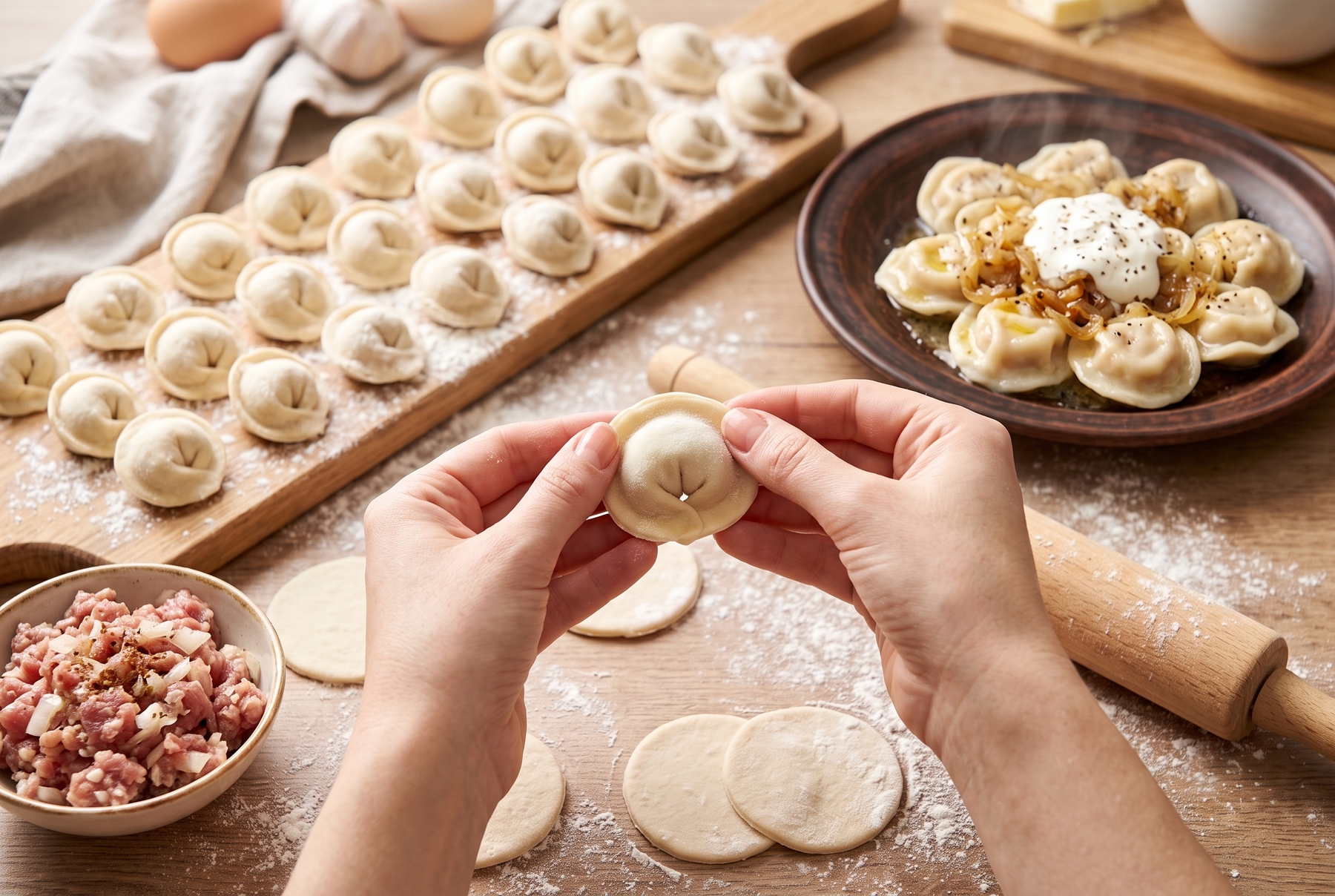
Classic handmade pelmeni: thin dough, juicy minced meat, and a perfect balance of simple ingredients.
Where to Find Authentic Flavor
Finding delicious wontons, khinkali, and pelmeni does not require visiting an expensive restaurant. Most often, they reside where the signboard is humbler and the prices are lower; these places simply do not advertise themselves.
Look toward simpler establishments. Authentic Chinese eateries with bilingual menus and paper napkins in a glass. Georgian khinkali spots ‘for locals’ where taxi drivers stop for lunch. Korean market stalls where kimchi stands in buckets. Craft pelmeni shops where the dough is shaped by hand in front of you, not pulled from an industrial bag.
Here is a quick cheat sheet on how to identify the right place:
- Smell. The entrance smells of broth, spices, and fat, not air freshener. This means the kitchen is working.
- Crowd. Inside sit people of the culture whose food is being prepared. If Georgians are dining in a Georgian khinkali shop, you are in the right place.
- Menu. It is short and focused on one or two dishes. An establishment making pizza, sushi, and khinkali rarely does any of them well.
- Price and Presentation. The food is served in simple dishes, the portion is large, and the bill is modest. No one plates five pieces on an enormous dish with a drop of sauce.
- Hands. They fold the dough in front of you or at least behind a glass window. Industrial frozen bags reveal themselves through identical, carbon-copy edges.
- Steam. The dish is placed before you scalding hot, emitting steam, forcing you to blow on your first bite. Cooled stuffed dough forgives nothing.
You can verify all this in a minute while still standing in the doorway. A good khinkali shop usually features a large pot in plain view, and the water in it has been boiling continuously since lunch.
0 comments