
Gluten-free shortcrust pastry usually fails for one reason: bakers swap wheat flour for rice flour in a one-to-one ratio and expect everything to follow the familiar scenario. It will not. Under the rolling pin, such dough cracks at the edges, falls apart when transferred to the pan, and the sides slump down during the first 10 minutes in the oven. The baked crust either crumbles into dry sand in the mouth or unpleasantly springs back.
Shortcrust pastry relies on a balance of three things: fat, starch, and a binder holding them together. In the wheat version, gluten does part of the binding work invisibly. Removing the wheat does not eliminate this task; it simply redistributes it among other components. A crumbly texture in gluten-free dough happens effortlessly. The real battle is for plasticity, ensuring the rolled sheet holds together on the rolling pin and does not fall apart in your hands.
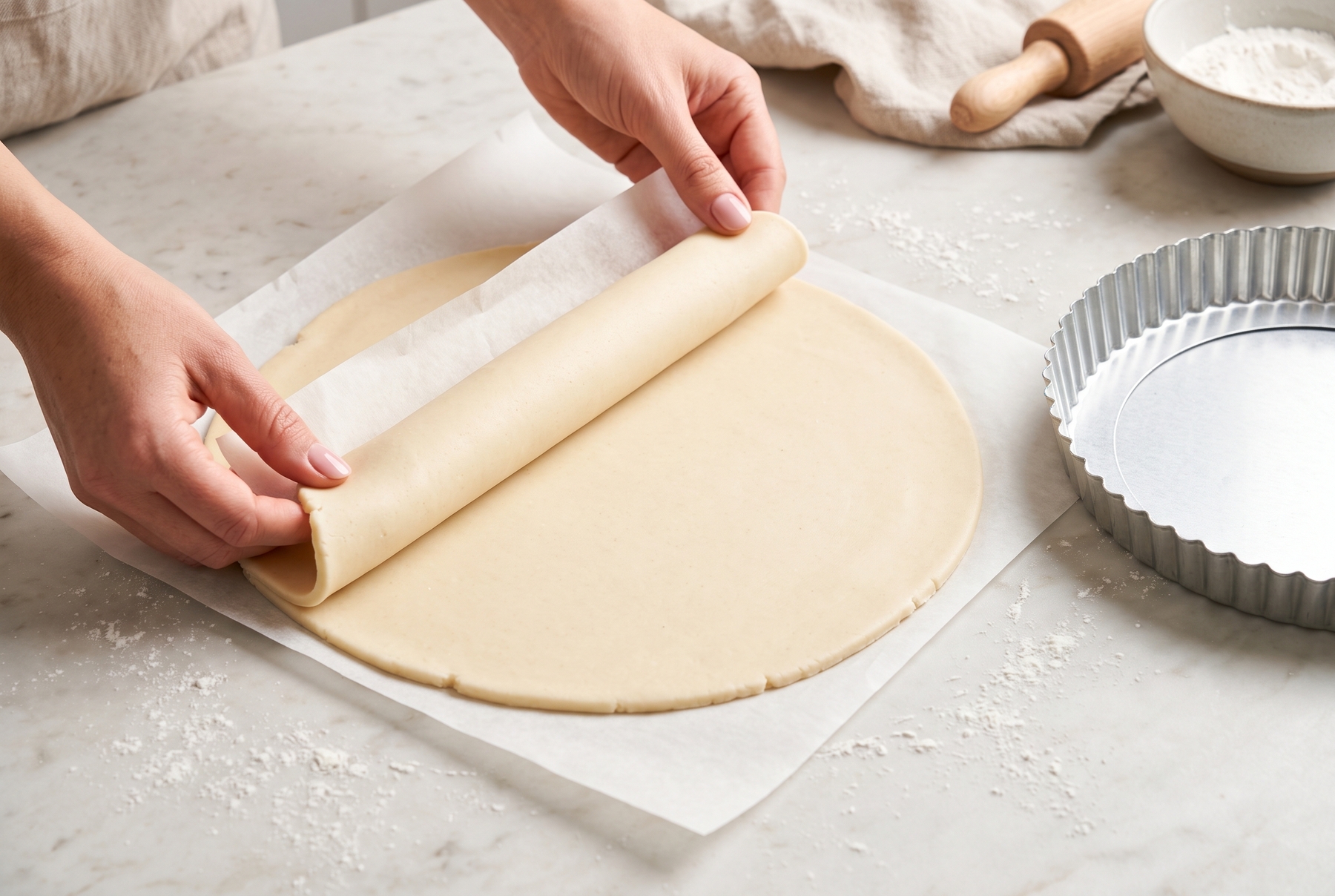
Properly mixed gluten-free shortcrust pastry rolls easily onto the rolling pin along with the parchment and does not tear when transferred to the pan.
Table of Contents
- What Makes Shortcrust Pastry Truly Short
- Flours and Starches: A Comparative Table
- Formula 1. Universal Shortcrust Pastry
- Formula 2. Crumbly Cookie Dough
- Formula 3. Dough for Tarts and Galettes
- Formula 4. Almond Shortcrust Pastry
- Why Identical Gluten-Free Shortcrust Recipes Yield Different Results
- Advice From My Experience
- Troubleshooting Common Issues
- How to Store Gluten-Free Shortcrust Pastry
- How to Formulate a Gluten-Free Shortcrust Flour Blend
What Makes Shortcrust Pastry Truly Short
Why Wheat Dough Needs Gluten and What Breaks Without It
When wheat flour meets water, its two proteins (gliadin and glutenin) combine into an elastic network. This network stretches, holds shape, and prevents the dough from tearing. In bread, bakers develop it through long kneading. In shortcrust pastry, conversely, they suppress it with all their might: the butter coats the flour particles and physically prevents the proteins from reaching the water. This explains the cold butter rule and the prohibition against long kneading.
In classic shortcrust pastry, gluten works at a quarter of its strength. It provides just enough structure to allow the dough to be rolled out and transferred to a pan, but not enough to make the baked good tough.
Without wheat, this quarter of strength drops to zero. Rice, corn, and buckwheat flours provide starch and protein, but their protein is different and does not form a network. The dough turns into wet sand: it can be molded but not rolled. This means plasticity must be rebuilt from scratch, using hydrocolloids, egg yolk, and the correct amount of moisture.
Which Ingredient Does What
Rice flour serves as the base in almost any blend. Its flavor is neutral, its color is light, it is high in starch, and it is low in protein. Its main problem lies in the grind. Coarse rice flour leaves a noticeable sandy grit on the tongue that remains even after baking. A fine grind eliminates this sensation.
Cornmeal (specifically fine corn flour, not cornstarch) adds a yellow tint and a recognizable sweet dryness. It works perfectly in cookies, though it might seem too rustic for delicate tarts.
Gluten-free oat flour provides softness and a light nutty flavor, while retaining moisture well. Facilities often process oats on the same equipment as wheat, so individuals with celiac disease must look for a certified gluten-free label.
Almond flour introduces fat to the dough, and fat directly creates tenderness. The baked good turns out moister and softer, but it also browns noticeably faster in the oven. Building a structure entirely on almond flour is pointless, as it cannot hold a shape on its own.
Buckwheat flour is dark, carrying a dense, earthy flavor that people either love or cannot stand. It is excellent in chocolate and berry tarts. In a light vanilla cookie, it overpowers everything else. Keeping it to no more than 20–25% of the total flour weight yields the best results.
Tapioca starch gives the dough stretch and helps the rolled sheet resist tearing. It also adds crispness to the edges, although crispness relies on many factors: the amount of fat and sugar, the moisture level, and the baking temperature and time.
Potato starch contributes to the tenderness and softness of the crumb, holding moisture effectively.
Cornstarch is the most neutral of the three and maximizes crumbliness. It is also the easiest to overdo: an excess makes the baked good brittle, causing it to shatter at the slightest touch.
Psyllium husk absorbs water and turns into a gel. This is what makes gluten-free dough truly rollable. It works in very small quantities: 3–5 grams (0.1–0.17 oz) per 200 grams (7 oz) of flour blend. An overdose results in a rubbery density and a slimy mouthfeel.
Xanthan gum solves the same problem but differently: it thickens moisture and binds particles together without affecting the taste. For shortcrust pastry, 2–3 grams (0.07–0.1 oz) per 200 grams (7 oz) of the blend is sufficient. Doubling this amount makes the dough stretchy and destroys the very crumbliness the recipe aims to achieve.
Butter acts as a separator in the dough. Cold pieces of butter between layers of flour melt during heating, leaving voids, and these voids create a crumbly texture. The colder the butter at the start, the larger and flakier the structure.
Sugar affects more than just flavor. Powdered sugar dissolves instantly and yields a smooth, fine crumb. Granulated sugar melts in the oven, leaving microscopic cavities, making the cookies more fragile and slightly caramelized around the edges.
Eggs bring both moisture and protein. The yolk provides fat and lecithin (a natural emulsifier), making the dough more plastic and softer. The egg white sets during baking and acts as a framework, but an excess turns the shortcrust base into a hard rusk.
Flours and Starches: A Comparative Table
| Ingredient | Flavor and Properties | Application and Limitations |
|---|---|---|
| Rice Flour | Neutral, light. Provides volume and crumbliness, works as a blend base. | Suitable for tarts, cookies, and bases. A coarse grind leaves a sandy mouthfeel. |
| Cornmeal | Sweet, yellow. Adds density and crunch. | Great for cookies and rustic galettes. Can be too coarse for delicate desserts. |
| Gluten-Free Oat Flour | Soft, nutty, beige. Retains moisture and softens the crumb. | Suitable for cookies, crumbles, and tart bases. Requires certified gluten-free labeling for celiac disease. |
| Almond Flour | Creamy-nutty, pale. Adds fat, tenderness, and aroma. | Great for berry, fruit, and chocolate tarts. Browns quickly and holds shape poorly on its own. |
| Buckwheat Flour | Earthy, dark gray. Adds depth and a pronounced flavor. | Pairs well with chocolate, berries, and savory tarts. Can overpower delicate, light flavors. |
| Tapioca Starch | Neutral, white. Adds elasticity and a crispy edge. | Useful in rollable dough. Excess causes stickiness. |
| Potato Starch | Neutral, white. Provides tenderness and helps retain moisture. | Suitable for soft cookies and bases. Excess makes the dough too loose. |
| Cornstarch | Neutral, white. Maximizes crumbliness. | Great for classic shortbread cookies. Excess makes the baked good brittle. |
| Psyllium Husk | Neutral, gray-beige. Adds plasticity and helps roll out the dough. | Suitable for deep-dish tarts. Overdosing creates a rubbery texture. |
| Xanthan Gum | Flavorless, white. Binds the blend and improves stability. | Works almost universally. Excess makes the dough stretchy. |
A single gluten-free flour rarely yields a good result; a blend of two or three works much more consistently. A reliable ratio for gluten-free shortcrust pastry requires 60–70% base flour, 15–25% starch, and 10–20% of a fatty or aromatic addition like almond or buckwheat flour.
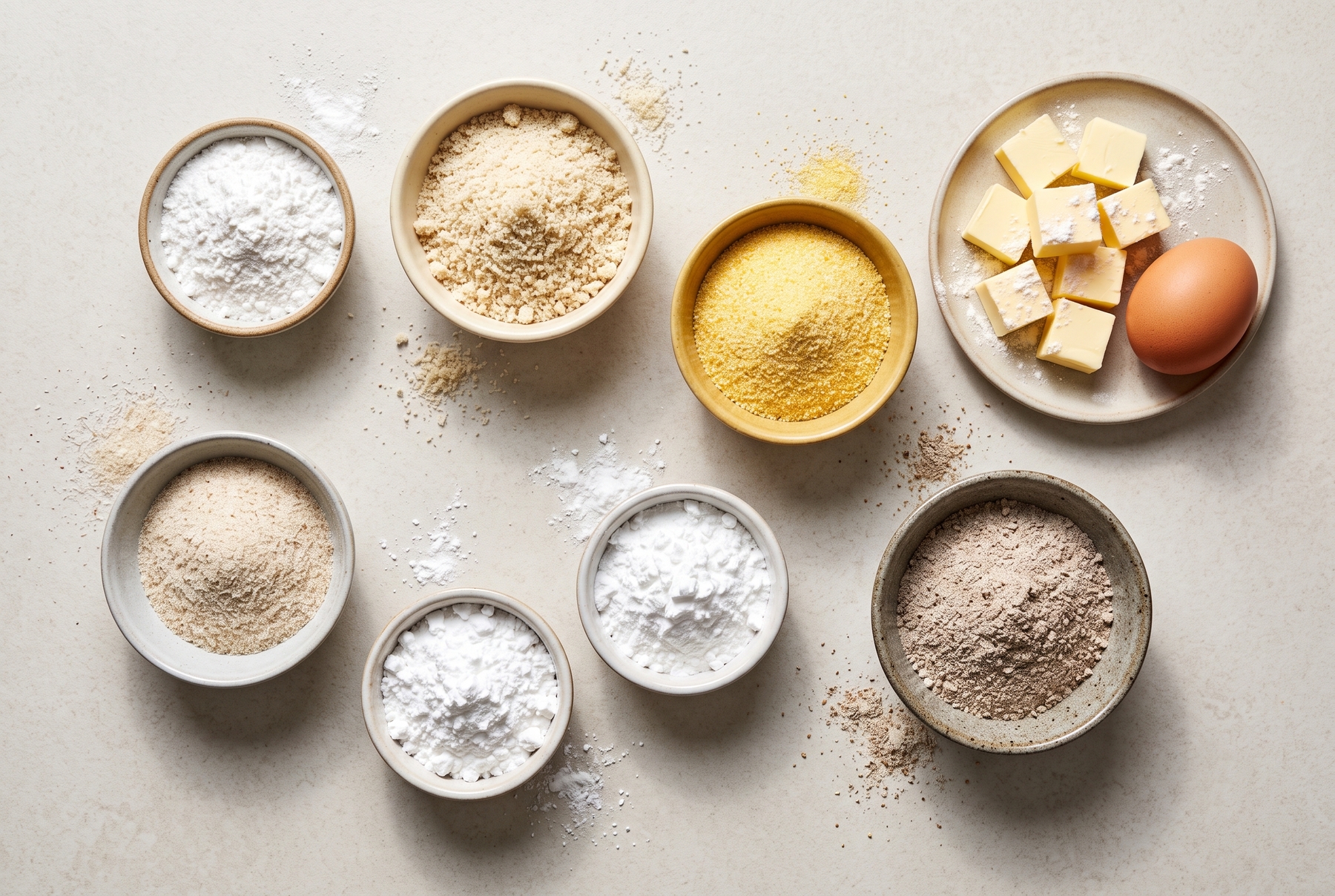
For consistent results, bakers mix gluten-free flour with starches, binding agents, and butter.
Formula 1. Universal Shortcrust Pastry
This recipe serves as the foundation for tartlets, open pies, and any baked good requiring an even, stable crust.
Ingredients:
- 100 g (3.5 oz) fine rice flour
- 40 g (1.4 oz) cornstarch
- 30 g (1 oz) almond flour
- 50 g (1.7 oz) powdered sugar
- 100 g (3.5 oz) cold butter
- 1 egg yolk
- 15–20 ml (1 tbsp) ice water
- 2 g (about 1/2 tsp) xanthan gum
- 2 g (about 1/2 tsp) salt
Preparation:
- Whisk all dry ingredients together: both flours, starch, powdered sugar, xanthan gum, and salt. Ensuring the xanthan gum distributes evenly prevents chewy lumps from forming in the dough.
- Cut the cold butter into 1 cm (1/2 inch) cubes and rub them into the dry mixture using your fingertips or a food processor with short pulses. Stop when the crumbs resemble the size of lentils and begin to clump slightly in your hand.
- Whisk the egg yolk with 15 ml (1 tbsp) of ice water, pour it into the crumb mixture, and bring the dough together with your hands in 4–5 gentle motions. Avoid kneading.
- Flatten the dough into a disk about 2 cm (3/4 inch) thick, wrap it in plastic wrap, and refrigerate for at least 1 hour.
- Roll the dough between two sheets of parchment paper to a thickness of 3–4 mm (1/8 inch). Line the pan, trim the edges, and prick the bottom with a fork.
- Place the pan with the dough in the freezer for 15 minutes.
- Blind bake with pie weights at 180 °C (350 °F) for 15–18 minutes, then remove the weights and bake for another 5–8 minutes until the crust turns the color of light sand.
What to Watch for in This Recipe
The most common mistake here involves water. Gluten-free flour absorbs moisture slower than wheat flour, making the dough feel too dry for the first half-minute. Resisting the temptation to add another spoonful of water remains crucial. Letting the crumbs rest briefly and pressing them together again usually allows the dough to set on its own after 30–40 seconds.
Straight out of the refrigerator, the correct dough feels firm and cold. Pressing a finger into it leaves an indentation with smooth edges, rather than radiating cracks. The dough behaves quietly under the rolling pin, resisting slightly and expanding evenly. Cracks running along the edges indicate a lack of water or xanthan gum. However, the cause might also lie elsewhere: rolling the dough too cold, resting it too little in the refrigerator, using coarsely ground flour, or rolling the sheet thinner than necessary.
Color and surface texture reveal the doneness of the crust. The edges bake to a light sand color, while the top remains dry and matte, without a wet sheen. Tapping with a fingernail offers a subjective guide: a fully baked crust produces a short, dry sound, whereas a raw one sounds dull.
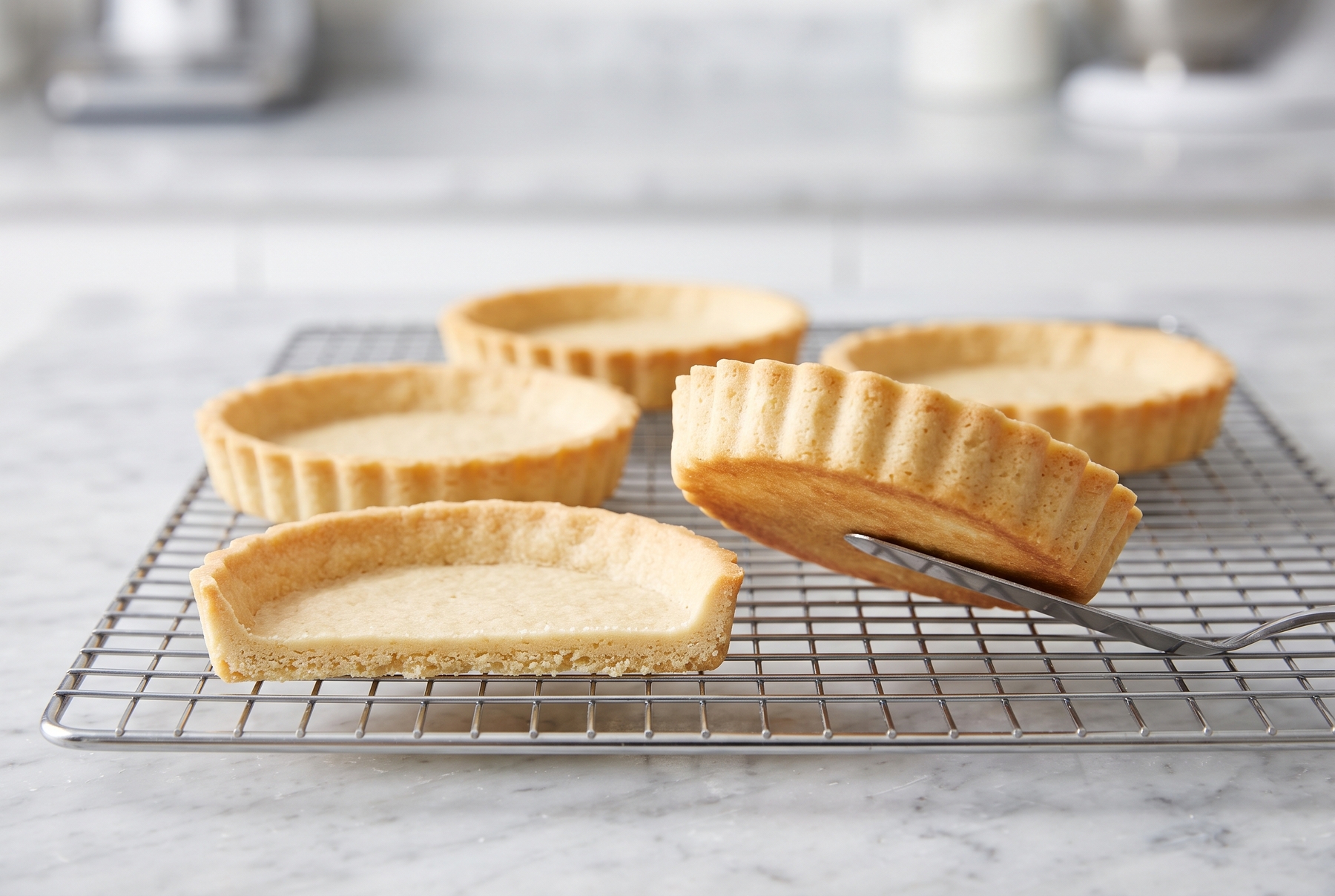
A universal gluten-free dough holds its shape perfectly after blind baking and serves as a sturdy base for any filling.
Formula 2. Crumbly Cookie Dough
Plasticity is almost completely unnecessary here. Bakers shape the cookies by hand or slice them from a log, allowing the recipe to focus entirely on crispness.
Ingredients:
- 80 g (2.8 oz) rice flour
- 40 g (1.4 oz) fine cornmeal
- 30 g (1 oz) potato starch
- 60 g (2.1 oz) powdered sugar
- 110 g (3.9 oz) softened butter
- 1 egg yolk
- Zest of half a lemon or 5 g (1 tsp) vanilla sugar
- 2 g (about 1/2 tsp) salt
Preparation:
- Beat the softened butter with powdered sugar and salt for 2–3 minutes until it becomes a light, smooth cream.
- Stir in the egg yolk and zest.
- Add the dry mixture and fold with a spatula until uniform. Stop as soon as the dry pockets disappear.
- Roll the dough into a log 4 cm (1.5 inches) in diameter, wrap it in parchment paper, and chill for 2 hours (or leave overnight).
- Slice into rounds 7–8 mm (1/4 inch) thick and arrange them on a baking sheet with a 3 cm (1 inch) gap between them.
- Bake at 170 °C (340 °F) for 12–15 minutes. The center should remain pale, while the edges turn barely golden.
Why This Blend Yields a More Fragile Structure
Using softened, whipped butter means it distributes as an ultra-thin film over every flour particle, almost entirely blocking contact with moisture. The blend contains a lot of starch and no binder at all. Liquid stays at an absolute minimum, relying solely on the yolk.
Consequently, the finished cookies break with a dry snap and leave a light dust on the fingers. Taking them out of a hot oven, they feel almost raw to the touch, which is perfectly normal. Shortcrust pastry fully sets upon cooling, when the sugar crystallizes and the fat solidifies. Letting the cookies rest on the baking sheet for 10 minutes prevents them from crumbling right on the spatula.
This blend works exceptionally well for tea cookies, bases for truffle creams, and anything eaten by hand. It proves completely unsuitable for tarts with wet fillings, as the bottom will become soggy in an hour.
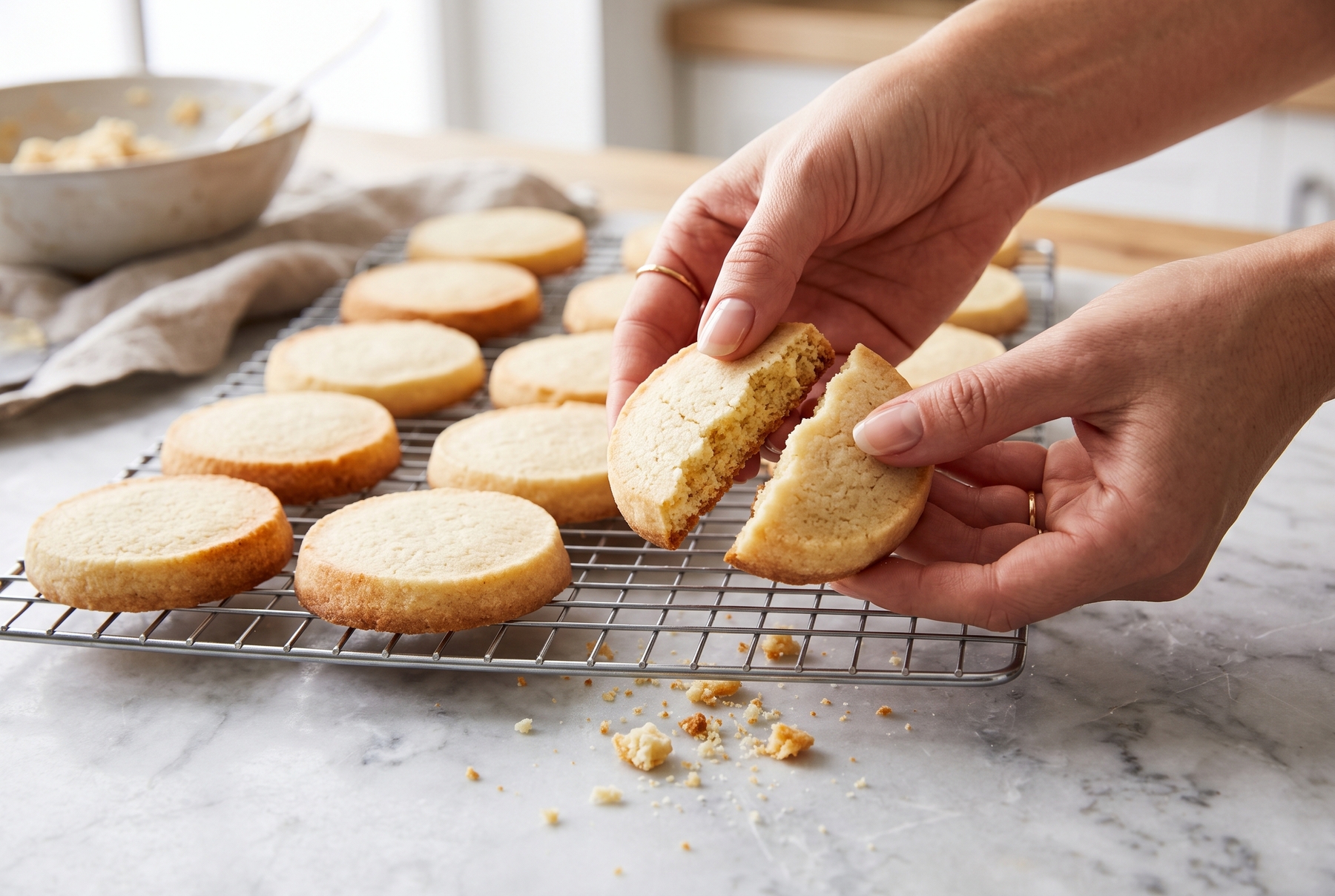
Gluten-free shortbread cookies should break easily with a dry snap and feature a tender, crumbly texture.
Formula 3. Dough for Tarts and Galettes
The goal shifts here: achieving high sides, a neat edge, and resistance to wet fillings.
Ingredients:
- 120 g (4.2 oz) rice flour
- 30 g (1 oz) buckwheat flour
- 30 g (1 oz) tapioca starch
- 4 g (about 1 tsp) fine psyllium husk
- 40 g (1.4 oz) sugar
- 90 g (3.2 oz) cold butter
- 1 whole egg
- 3 g (about 1/2 tsp) salt
Preparation:
- Combine the dry ingredients, including the psyllium, and whisk thoroughly.
- Rub the cold butter into the flour until coarse crumbs form.
- Lightly beat the egg with a fork and add it to the crumbs. Bring the dough together and immediately stop working it.
- Wrap in plastic wrap, press into a disk, and chill for at least 2 hours. Psyllium needs time to absorb water; right after mixing, the dough feels loose, but after two hours, it becomes noticeably more plastic.
- Roll the dough to 3 mm (1/8 inch) between sheets of parchment paper, line the pan, and firmly press the dough against the sides without leaving air pockets.
- Trim the edge and place the pan in the freezer for 30 minutes.
- Blind bake with pie weights at 180 °C (350 °F) for 20 minutes, remove the weights, and bake for another 8–10 minutes.
What Keeps the Sides From Slumping
The crust slumps for one mechanical reason: the butter melts before the proteins and starches manage to set. The dough loses its rigidity and slides down under its own weight. Therefore, the butter must melt as late as possible, and the framework must set as early as possible.
Cold delays the melting effectively. A frozen crust holds up substantially better than a chilled one. Thickness plays a decisive role too. A crust thinner than 2 mm (1/16 inch) fails to support its own height, while one thicker than 5 mm (1/4 inch) bakes unevenly. The ideal working range stays around 3–4 mm (1/8 inch). Ceramic pie weights, dried beans, or rice placed over parchment paper press the dough against the walls until the structure solidifies. Paying close attention to the fit is essential; if an air pocket remains between the dough and the pan wall, the crust will inevitably collapse in that spot.
For liquid fillings, adding another step prevents sogginess. Brushing a thin layer of lightly beaten egg white over the hot, baked bottom and returning it to the oven for 2–3 minutes sets the egg white into a protective film, sealing the crust against moisture from the filling.
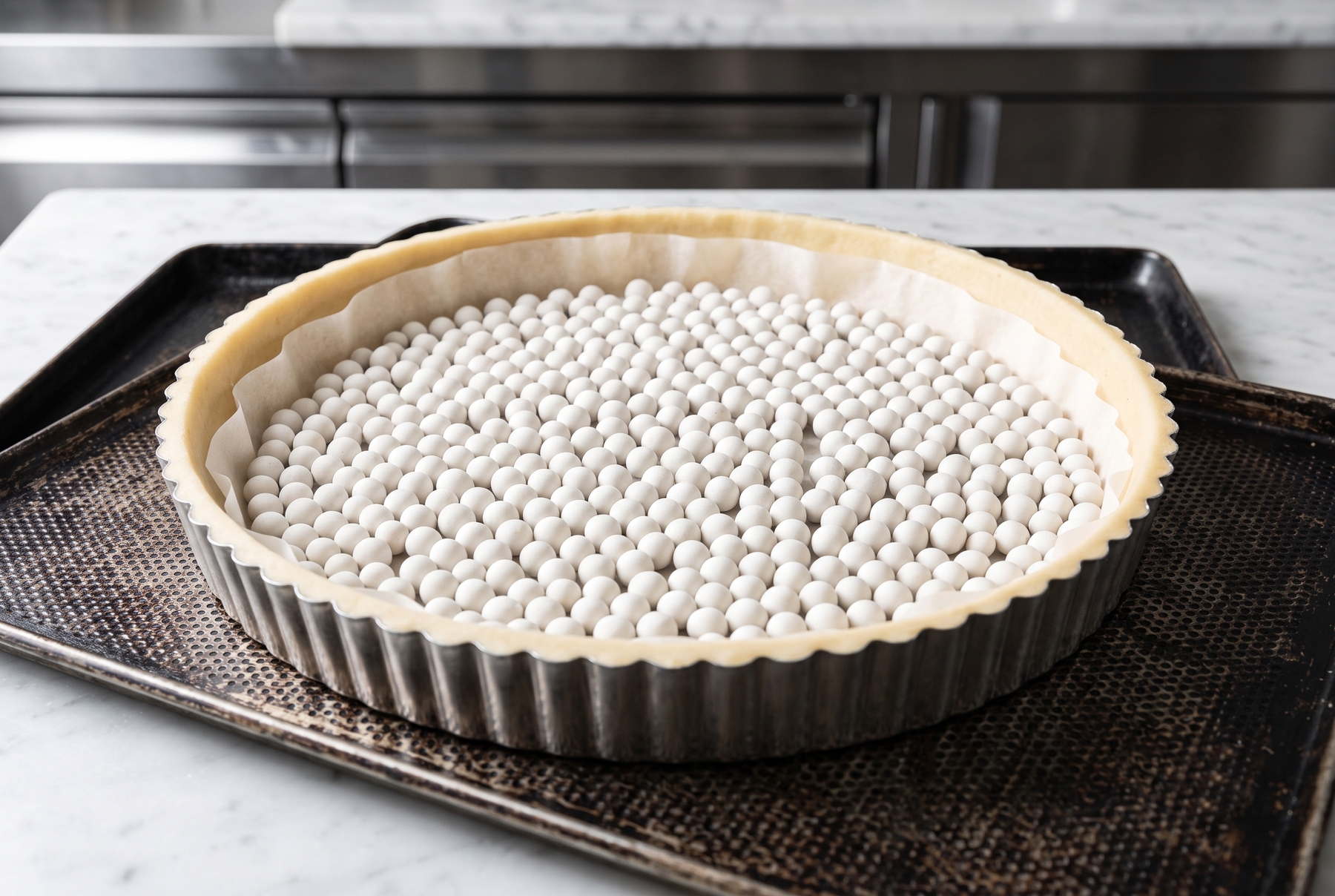
Baking with weights and freezing the pan beforehand prevents the sides of gluten-free pastry from slumping.
Formula 4. Almond Shortcrust Pastry
Ingredients:
- 100 g (3.5 oz) almond flour
- 70 g (2.5 oz) rice flour
- 20 g (0.7 oz) cornstarch
- 60 g (2.1 oz) powdered sugar
- 90 g (3.2 oz) cold butter
- 1 egg yolk
- 2 g (about 1/2 tsp) xanthan gum
- 2 g (about 1/2 tsp) salt
Preparation:
- Sift the rice flour, cornstarch, powdered sugar, xanthan gum, and salt together. Add the almond flour and mix well.
- Rub in the cold butter until the mixture resembles wet sand.
- Add the egg yolk and quickly bring the dough together.
- Chill for at least 1 hour. Because of its high fat content, this dough is softer than the others, and working with it warm proves useless.
- Roll it out to 4 mm (1/6 inch), line the pan, and freeze for 20 minutes.
- Bake at 160–170 °C (320–340 °F) for 18–22 minutes, judging by color.
Where Almond Pastry Excels
Above all, it excels in flavor and texture. Almond fat gives the crust a soft, slightly moist crumb that never dries out the mouth. A distinct nutty aroma, with a light milky undertone, begins to fill the kitchen by the eighth minute of baking.
This dough pairs beautifully with sharp and vibrant fillings: lemon curd, sour cherries, raspberries, and blackcurrants. Pairing it with chocolate feels a bit heavy, as the almond and cocoa begin to compete for attention.
Because of its natural sugars and fat, almond flour browns faster than any other flour. Baking at the standard 180 °C (350 °F) produces over-browned edges with a raw center. Dropping the oven temperature to 160–170 °C (320–340 °F) and increasing the time solves this issue. Achieving a warm, toasted-milk color determines doneness better than strictly watching the timer.
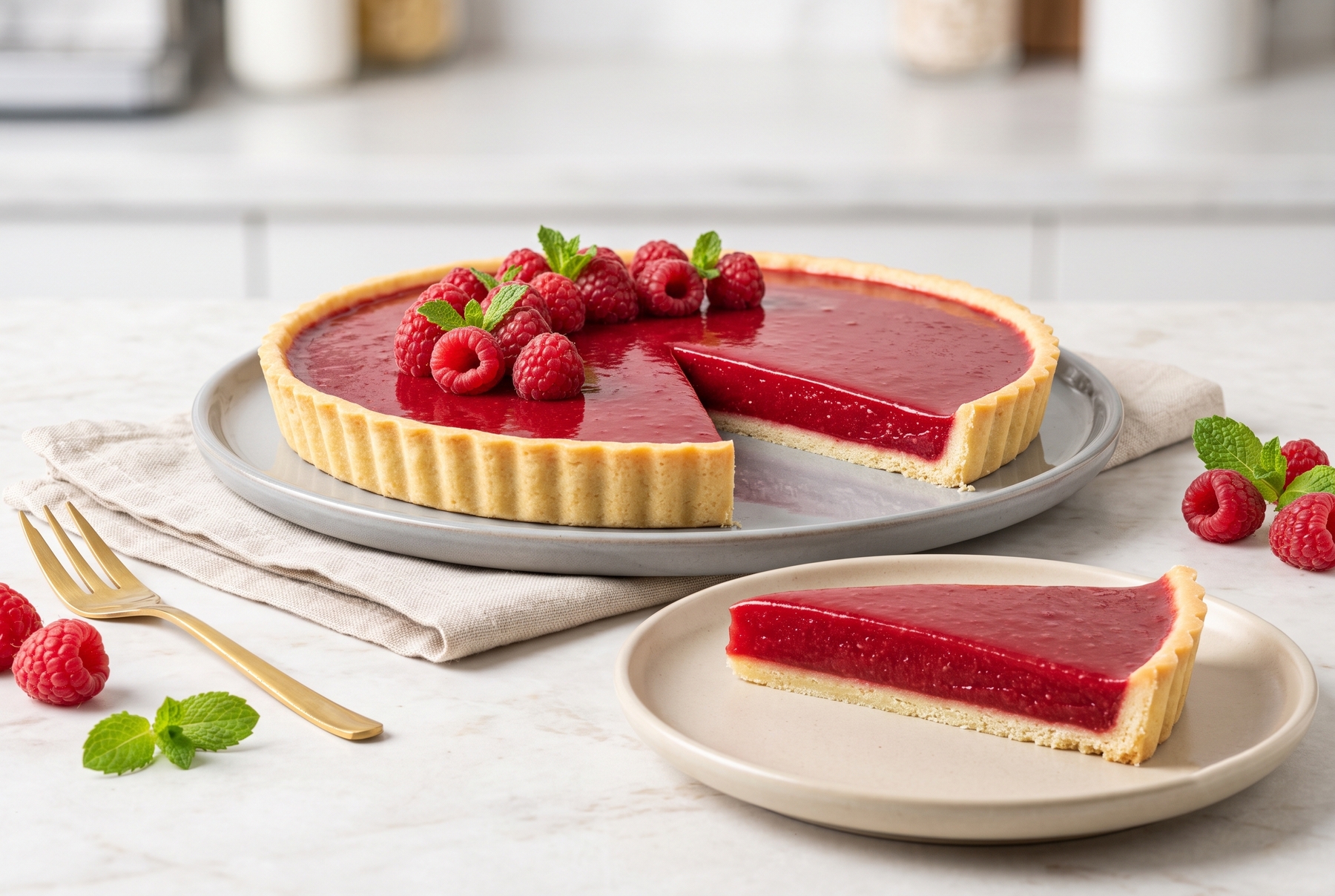
Almond shortcrust pastry pairs beautifully with tart berries and holds juicy fillings without becoming soggy.
Why Identical Gluten-Free Shortcrust Recipes Yield Different Results
Butter Temperature
Cold butter from the refrigerator remains in the dough as distinct pieces. As it heats up, it melts and leaves voids. This process creates a coarse, flaky, and crumbly crumb. Soft butter smears over the flour particles like a film, resulting in a uniform, fine structure that feels denser and more tender. Both methods work perfectly, but mixing them guarantees failure. If a recipe starts with cold butter, keeping it from melting under the warmth of your hands remains crucial.
Pressing cold butter with a knife crumbles it and leaves a matte fracture. If the knife slides in smoothly and leaves a shiny trail on the blade, the butter has grown too warm and requires 15 minutes back in the refrigerator.
Flour Grind
Two bags of rice flour from different manufacturers can vary significantly in particle size. A coarse grind absorbs water slowly, leaves a sandy mouthfeel, and requires a longer resting time for the dough. A fine grind works faster and produces a smooth texture.
Judging the grind by eye proves difficult, but feeling it is easy. Rubbing a pinch between the thumb and index finger reveals the truth: finely ground flour feels like powder, while coarsely ground flour feels like sand.
Amount of Liquid
Gluten-free dough diverges most sharply from wheat dough regarding hydration. Starches absorb water with a delay, and hydrocolloids take even longer. Dough that feels dry immediately after mixing becomes normal after 40 minutes in the refrigerator, and might even seem sticky after two hours.
Adding liquid 5 ml (1 tsp) at a time and pausing yields the best results. Compensating for excess water requires additional flour, which fundamentally alters the recipe.
Kneading Time
Wheat dough cannot endure long kneading because of gluten development. Gluten-free dough avoids this danger, but introduces another: extended handling warms the butter and ruins its ability to create flaky voids. The resulting baked good turns out dense and slightly tough. Adhering to the rule of stopping the moment dry pockets disappear saves the crust.
How Long to Chill the Dough
In the cold, butter hardens, moisture distributes evenly among the starches, and the hydrocolloid fully absorbs the water. The absolute minimum for dough with xanthan gum is 1 hour, and for dough with psyllium, 2 hours. An overnight rest in the refrigerator almost always improves the outcome, making the rolled sheet noticeably more compliant and less prone to tearing at the edges.
Why the Timer Lies
Home ovens routinely miss their target temperatures by 10–20 °C in either direction, rendering any recipe’s exact timing unreliable. Bakers must look elsewhere for cues. The edges of the crust should darken to a light caramel color before the center does, the perimeter should bake evenly, and the surface must look matte, lacking any wet sheen. A dry snap when tapping the bottom serves as an additional sign, but relying on sound alone is risky. When in doubt, extending the baking time by 3 minutes while dropping the temperature by 10 °C proves wise, as fixing underbaked shortcrust pastry is impossible.
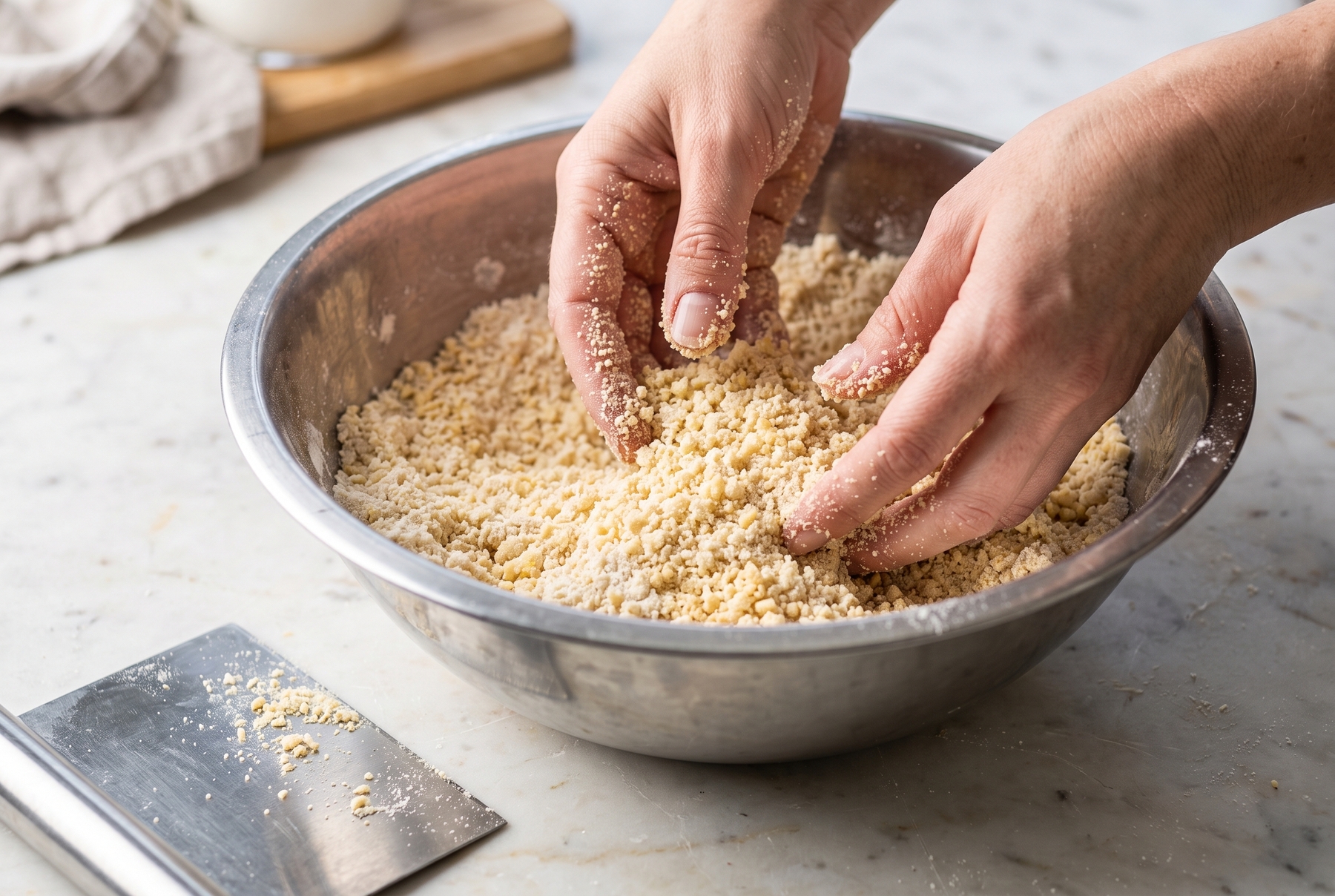
Quickly rubbing cold butter into the flour preserves the dough's structure and guarantees a crumbly finished product.
Advice From My Experience
Always build a blend from at least two types of flour. A single flour provides only one set of properties, leaving its weaknesses entirely uncompensated. Rice flour holds structure but dries out the palate. Almond flour moisturizes but cannot hold a shape. Together, they seamlessly cover each other’s flaws.
Psyllium is essential when rolling and transferring dough. It works wonders for tarts, galettes, and intricately shaped tartlets. However, for slice-and-bake cookies shaped into a log, psyllium is excessive and will only weigh down the structure. A rubbery chew in shortbread cookies almost always points to a psyllium overdose.
Avoiding an excess of starch maintains the structural integrity of the bake. It maximizes crumbliness but provides zero structural strength. A blend where starch makes up more than a third will fracture during the transfer to the pan, and the baked crust will disintegrate under a knife. For home recipes, keeping starch at roughly 25–30% of the total flour blend weight is optimal. Blends with a higher starch ratio can still remain stable, but they require a significantly larger dose of binders.
A long rest in the cold often rescues problematic dough. If the rolled sheet tears at the edges despite accurate proportions, returning the dough to the refrigerator for a couple more hours often helps. Usually, the flour simply needed more time to absorb the moisture.
Testing a new bag of flour on a small batch prevents disasters. The hydration capacity of rice flour varies noticeably between brands, and the same recipe might demand 10 ml more or less water with a new bag. Mixing a quarter batch and observing the dough’s behavior before committing to the full recipe remains a smart strategy.
Adjusting hydration with an egg yolk should always be the first choice. Extra water dilutes the dough and makes the finished product tough. A yolk adds both moisture and fat, ensuring the structure remains tender. For a standard 200 g (7 oz) batch of flour blend, one extra yolk provides more than enough moisture. Adding a little water remains acceptable, and with certain brands of flour, bringing the dough together without it is impossible. The hydration capacity of gluten-free flour fluctuates widely, and sometimes five milliliters is simply not enough.
Troubleshooting Common Issues
The gluten-free dough crumbles and refuses to form a ball. It lacks moisture or a binder. Adding 5 ml (1 tsp) of ice water, bringing it together again, and letting it rest for 10 minutes before adding more works best. Next time, increasing the xanthan gum by 1 gram will help.
The dough is impossible to roll out and cracks at the edges. The dough is either too cold or lacks sufficient hydrocolloids. Letting it sit at room temperature for 10 minutes and rolling it strictly between two sheets of parchment paper usually solves the problem.
The dough sticks to hands and parchment. The butter has warmed up, or the mixture contains too much moisture. Chilling it in the refrigerator for 30 minutes, working faster afterward, and dusting the parchment with rice flour restores control.
The finished baked good is tough. An excess of liquid or protein usually takes the blame. Swapping a whole egg for an egg yolk and reducing the water by a third corrects the texture.
The crust turned out like a hard rusk. It lacked fat or spent too long in the oven. Increasing the butter to 55–60% of the flour weight, lowering the temperature by 10 °C, and adding 3–4 minutes to the baking time improves the outcome.
The crust falls apart after cooling. The recipe contains too much starch and not enough binder. Reducing the starch by 10 grams and adding 1 gram of xanthan gum restores structural integrity.
The tart sides slumped. The dough entered the oven warm, or it baked without weights. Placing the lined pan in the freezer for 20–30 minutes right before baking resolves this issue almost every time.
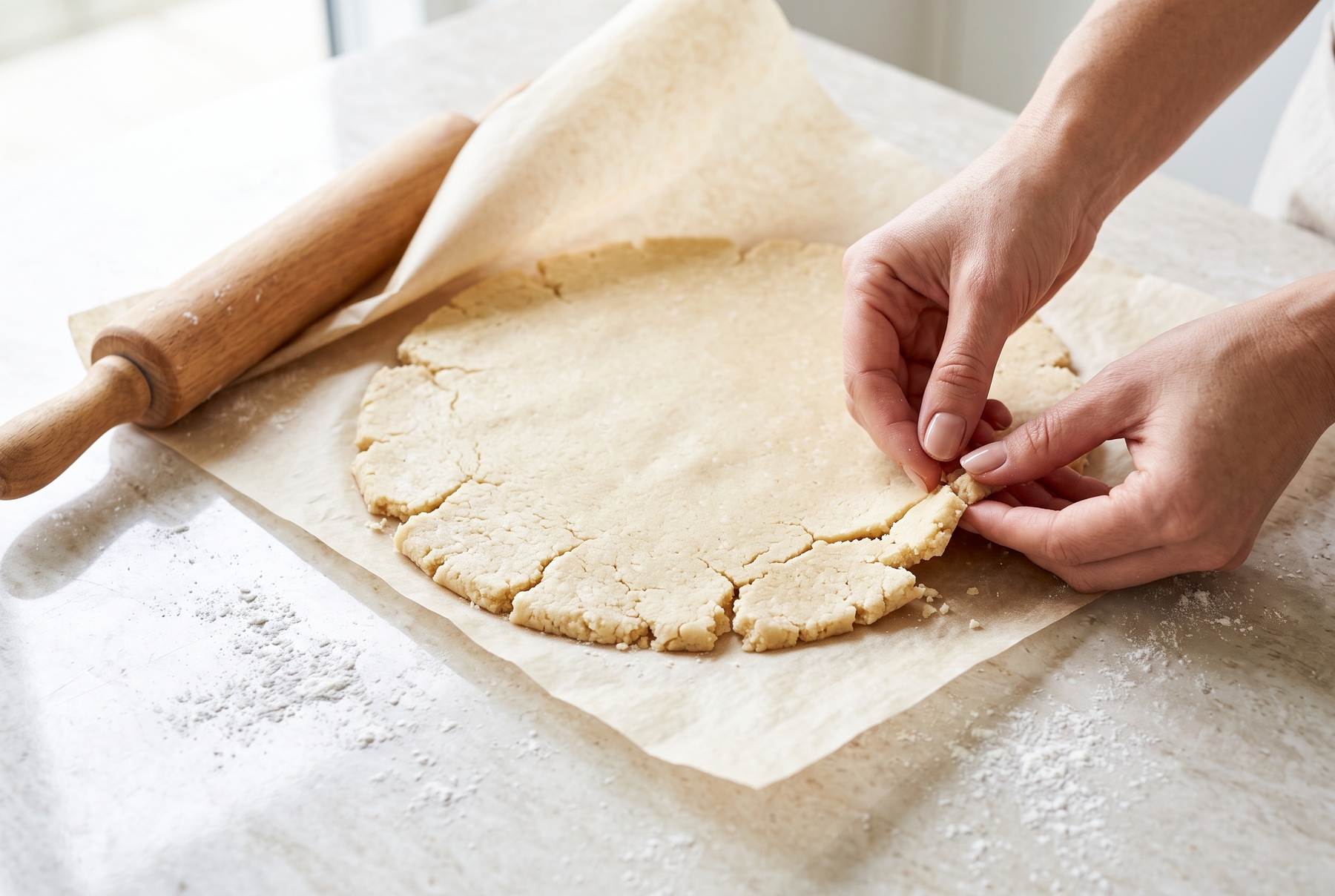
If the dough cracks during rolling, it lacked cold resting time, moisture, or binding agents like xanthan gum or psyllium.
How to Store Gluten-Free Shortcrust Pastry
Raw shortcrust pastry made with butter and egg stays fresh in the refrigerator at temperatures below 4 °C (39 °F) for about 2–3 days when tightly wrapped in plastic. Storing it longer is ill-advised: the butter starts absorbing stray odors, and the raw egg in the composition limits its safe shelf life. For the same safety reasons, tasting raw dough remains a bad idea.
Freezing works exceptionally well. A disk of dough, wrapped in plastic and placed in a freezer bag, rests comfortably for 1–2 months without losing quality. Freezing it already rolled out or fitted into a tart pan proves even more convenient. Such a prepared base can go straight into the oven without thawing, simply requiring an extra 5 minutes of baking time.
Thawing the dough requires an overnight stay in the refrigerator. Left on the kitchen counter, it will melt on the outside before thawing on the inside, resulting in an uneven structure. Dough that thaws in the refrigerator and does not sit in a warm kitchen for too long can safely undergo a second freezing. However, a second freeze cycle noticeably damages the structure, rendering the baked good less crumbly than it should be.
After 24 hours in the refrigerator, the dough grows firmer and rolls out better than it did initially, as the starches and hydrocolloids manage to fully hydrate. Freezing might cause a slight loss in crumbliness because ice crystals disrupt the fat distribution. The difference remains minor; it goes almost unnoticed in cookies, though it occasionally makes itself felt in a delicate, thin tart.
How to Formulate a Gluten-Free Shortcrust Flour Blend
Cookies broken by hand demand a high starch content and almost no binder. A tart holding lemon curd or pastry cream requires the exact opposite: psyllium, a whole egg, a thin crust, preliminary blind baking, and a protective egg-white film on the bottom. Berry tarts benefit immensely from almond flour, while chocolate tarts shine with buckwheat. A universal base for any purpose comes together perfectly using rice flour, cornstarch, and a modest amount of almond flour, relying on xanthan gum as the binder.
Beyond that, four numbers decide everything: 3–4 mm (1/8 inch) for the rolled thickness, 2 grams of xanthan gum per 200 grams (7 oz) of flour blend, 1 hour of chilling as an absolute minimum, and 180 °C (350 °F) for standard blind baking. Bakers adjust everything else to suit the specific flour at hand.
Correctly mixed dough reveals its quality even before it reaches the oven. Trimming the excess from the rim of a tart pan with a knife leaves a clean, solid scrap without any crumbling, and the cutting board holds only a thin streak of pale flour that brushes away effortlessly with a single sweep of the hand.
0 comments