
The fine print on a bag of chips reveals the flavor enhancer E621 (MSG), and the hand instinctively returns it to the shelf. Meanwhile, soy sauce, a wedge of aged cheese, an open jar of tomato paste, and a bottle of apple cider vinegar wait quietly on the refrigerator door. Each of these ingredients amplifies the flavor of a dish just as effectively as E621. The only difference is that the refrigerator door does not come with an ingredient list.
The very phrase ‘flavor enhancer’ has become almost a taboo. Yet a person who swears off enhancers likely salted their soup a minute ago, dropped a spoonful of tomato paste into a sauce, or browned onions until they released a sweet aroma. All of this constitutes flavor enhancement. Without it, home cooking quickly falls flat, whether it is a rich borscht (a traditional Eastern European beet soup) or a simple salad dressing. Viewing ingredients through the lens of a food technologist simplifies things: it is all about how salt, acids, sugars, fats, and amino acids behave in the pot. Almost everything described as the secret to good flavor comes down to these fundamental reactions.
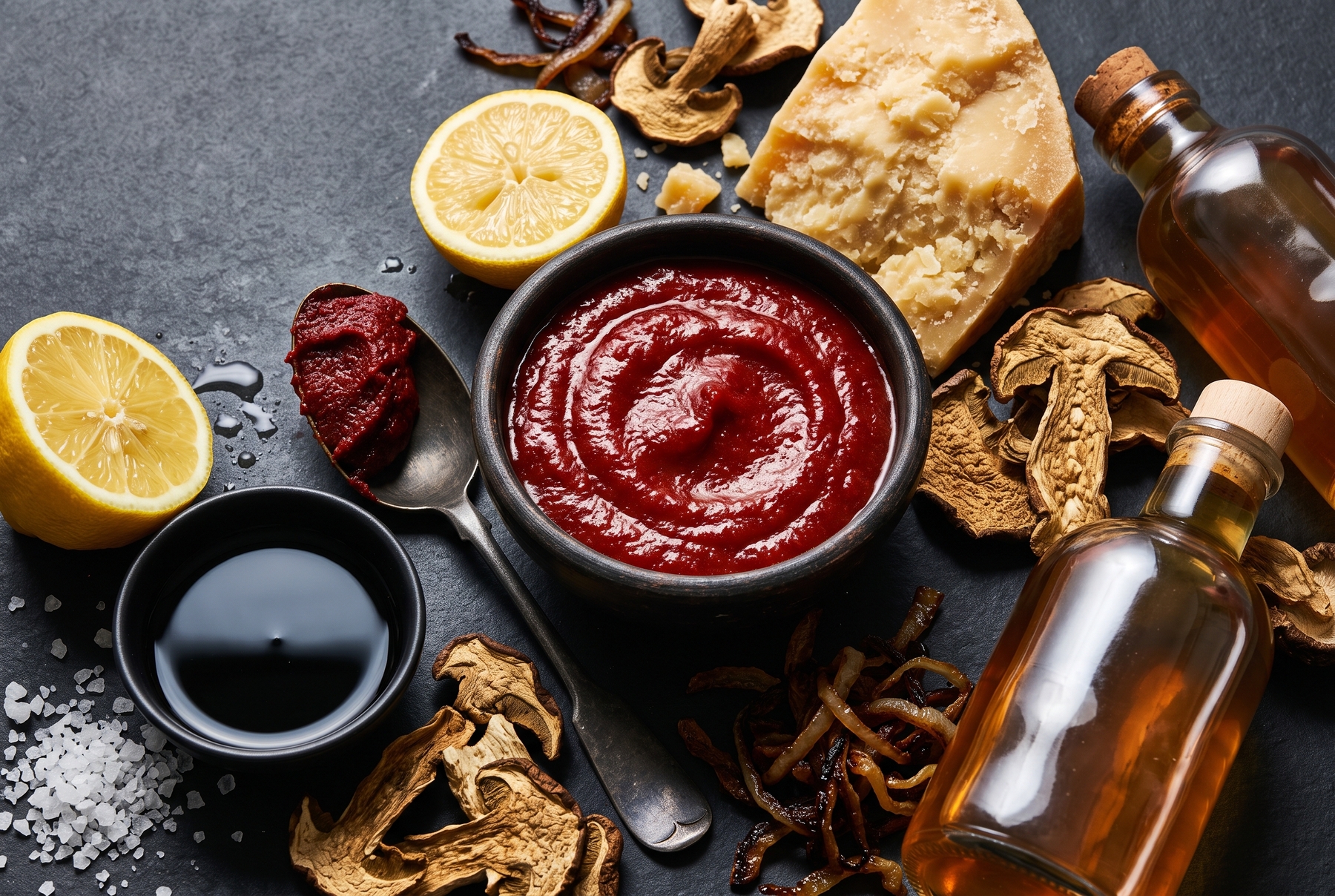
Ingredients rich in umami, salt, and acid possess the ability to transform the flavor of any dish without relying on artificial additives.
Table of Contents
- What It Actually Means to Enhance the Flavor of a Dish
- Salt: The Most Familiar Enhancer That Gets Misunderstood
- Acid: How to Restore Sharpness and Volume to a Dish
- Sweetness Beyond Sugar and Desserts
- Fat: The Carrier of Aroma and the Source of Satiety
- Umami: The Richness Often Confused With 'Chemicals'
- Fermentation and Aging: When Time Becomes the Enhancer
- Browning: The Enhancer You Cannot Buy in a Jar
- Garlic, Onions, Spices, and Herbs Behave Differently
- Concentrates and Pre-Made Products That Honestly Save Time
- How to Enhance a Dish When It Tastes Bland
- 5 At-Home Formulas for Flavor Enhancement
- Precision, Not Secret Ingredients, Amplifies Flavor
What It Actually Means to Enhance the Flavor of a Dish
There is a distinct difference between an ingredient with its own bold character and one that elevates the flavor of others. Fresh basil provides its own unmistakable aroma. A drop of fish sauce in that same dish barely announces its individual presence: instead, it draws out the meatiness and depth of everything else.
Flavor enhancement takes several paths. Salt rounds out the palate: sweetness rings clearer, while bitterness fades into the background. Acid introduces freshness and cuts through heaviness. Fat dissolves and binds certain aromatic compounds, altering how they unfold and extending the finish on the palate. Heat and fermentation trigger chemical reactions that transform simple molecules into dozens of new aromatic compounds. Sometimes it is purely about concentration: a broth reduced by half hits the palate with significantly more force. Almost all of these tools are already sitting on the pantry shelf.
Why Food Tastes Bland and Does Not Always Need More Spices
It happens often. Tasting a soup reveals a pale flavor profile, and the hand reaches for pepper, garlic, or a pre-made spice blend. A minute later, five different spices are simmering in the pot, yet the flavor still fails to harmonize.
The fundamental issue is that blandness and a lack of aroma are two entirely different problems. A dish might simply be missing salt, acid, fat, a roasted note, or basic concentration. Spices offer no salvation here: they introduce a new aroma but fail to bind the existing flavors into a cohesive whole.
Before reaching for another seasoning, it is wiser to ask what exactly is missing. It could be richness, freshness, aroma, contrast, or a finish that drops off too quickly. The answer almost always dictates which ingredient to reach for next. Rarely is that answer pepper.
Salt: The Most Familiar Enhancer That Gets Misunderstood
Salt accomplishes far more than simply making food taste salty. In moderate doses, it mutes bitterness, highlights sweetness, draws out aromas, and forces individual flavors to merge into a unified profile. A tomato without salt tastes tart and hollow. A pinch of coarse salt pulls out its hidden sweetness. Salt does not sit on top of the food: it reveals what is already present within.
When to Salt: Sometimes Timing Matters More Than Grams
The exact same amount of salt behaves differently depending on when it enters the cooking process.
Salt applied to meat early on has time to penetrate the interior, slightly alter the protein structure, and retain moisture during searing. Salt added at the very end remains on the surface and hits the tongue with a sharper, saltier bite. Vegetables behave similarly: early salting draws out water (which is why cucumbers for salads are sometimes salted in advance to drain the juices), while late salting leaves them crisp. Broth benefits from being salted toward the end of cooking because it reduces as it simmers, meaning what tasted perfect initially will become overly salty by the final reduction.
No universal rule applies here. The moment of salting depends entirely on the ingredient and the desired outcome: juicy meat, crisp cucumbers, or a clear, perfectly balanced broth.
How to Tell if Salt Is the Missing Element
This becomes apparent during tasting. A dish might possess a strong aroma and distinct individual ingredients, but the flavor feels fragmented: short, disjointed, and lacking a center. Adding just a tiny amount of salt suddenly pulls the flavor together, making it longer and more cohesive, without necessarily making the dish taste saltier. That moment of harmonization is the precise indicator that salt was the missing link.
Testing this on a small sample is the best approach. Pouring a spoonful of soup into a small bowl and adding a few grains of salt allows for a direct comparison with the main pot. This method prevents ruining the entire batch and helps pinpoint the exact threshold before the dish becomes overly salty.
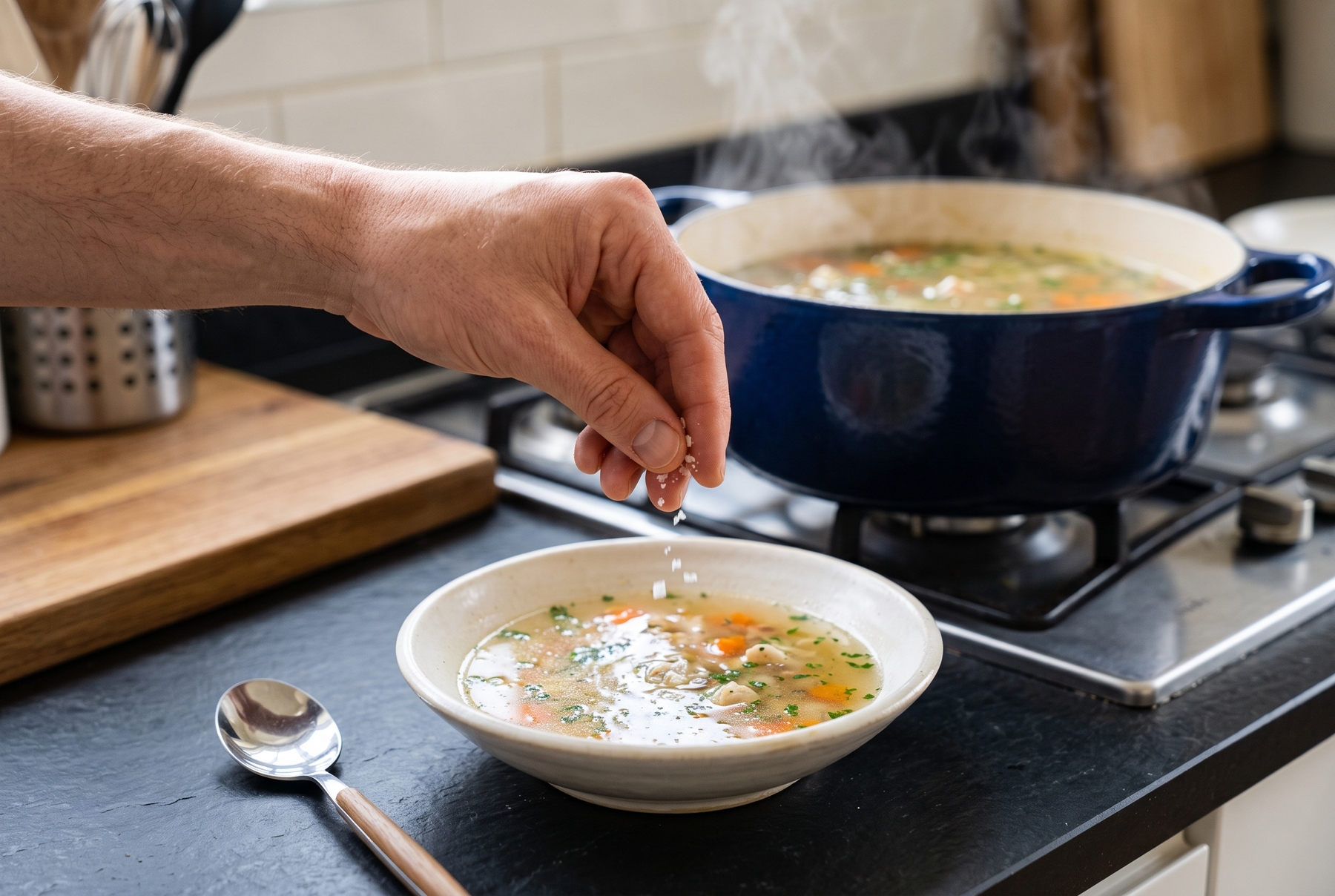
Salt does far more than simply make a dish salty; it unifies all the ingredients and forces their natural flavors to fully open up.
Acid: How to Restore Sharpness and Volume to a Dish
Acid acts as a counterbalance to fat and sweetness: it refreshes, lightens, and sharpens the flavor profile. The sources are abundant. Lemon juice, various vinegars, dry wine, tomatoes, kefir, sour cream, pickle or sauerkraut brine, and nearly any fermented product perform this role beautifully.
Acid proves especially vital when a flavor profile has become heavy. In a rich, slightly sweet, starchy, or long-braised dish, acid cuts right through the weight, ensuring every subsequent bite remains appealing. A robust borscht lacking a splash of vinegar or naturally sour beets ends up tasting flat, regardless of how much salt is added.
Choosing the Right Acid
Different acidic ingredients are not perfectly interchangeable: each carries its own aroma and intensity.
Lemon delivers a clean, fresh sharpness that pairs beautifully with fish, chicken, and vegetables. White vinegar is harsh and direct, securing its place in canning and spicy dishes. Apple cider and wine vinegars offer a softer, more aromatic profile. Tomatoes introduce acidity alongside umami, pulling a sauce into a deeper savory realm rather than just providing freshness. Kefir (a cultured, fermented milk drink) and sour cream bring acidity wrapped in fat and smoothness, explaining their essential role in cold soups and dressings. Dry wine contributes acid and tannins that unfold fully during cooking. Brine acts as a ready-made salty-sour mixture, accomplishing half the seasoning work instantly in hearty meat stews or traditional soups like solyanka.
Russian and post-Soviet cuisines have relied on these techniques for generations. Vinegar balances borscht. Brine and capers define solyanka (a thick, spicy, and sour meat soup). A sour note elevates braised cabbage. Barberries or tart pomegranate accents cut through the richness of plov (pilaf). Lemon accompanies fried fish, while vinegar dresses dumplings. A tart vinaigrette brightens a beet salad. Adding a spoonful of vinegar, brine, or dry wine to a thick meat gravy prevents it from becoming cloyingly rich.
Where Acid Begins to Hinder
An excess of acid is just as detrimental as an excess of salt. An overly sour dish becomes sharp and flat, making the jaw tense up while masking all other underlying flavors behind that aggressive sharpness. Walking it back is considerably more difficult than adding it in.
There is another critical factor: prolonged heat alters the aroma of many acidic ingredients. The bright freshness of lemon or a high-quality vinegar evaporates on the stove, leaving behind only an odorless acidity. Consequently, reserving a portion of the acid for the very end proves wise: allowing one spoonful of vinegar to simmer in a stew builds depth, while stirring in a second spoonful right before turning off the heat preserves freshness. Well-integrated acidity does not stand out as an isolated flavor. Its sole purpose is to compel the palate to crave the next bite.
Sweetness Beyond Sugar and Desserts
A touch of sweetness softens sharp edges. It mellows acidity, mutes bitterness, rounds out spiciness, and even evens out saltiness. Sugar is far from the only source here: honey, naturally sweet carrots and onions, roasted vegetables, fruits, and any form of caramelization play the exact same role.
When a Pinch of Sugar Works Wonders
Certain situations call for a quarter teaspoon of sugar to save a dish. It rescues an overly tart tomato sauce made from out-of-season tomatoes. It fixes a bitter vinaigrette suffering from too much mustard or zest. It balances a harsh marinade. It mellows braised cabbage that leans too heavily on the sour side. It maintains harmony in a spicy Asian sauce, holding the line against chili and salt.
However, sugar cannot magically repair poor-quality tomatoes, nor should it transform a savory dish into a dessert. The moment sweetness registers as an independent flavor on the palate, the dish has crossed the line. Its job is balance, not masking.
Natural Sweetness Outperforms Added Sugar
The most important sweetness in the kitchen does not come from a sugar bowl. It is born directly in the skillet. Onions cooked slowly until they reach a dark caramel color release hidden sugars, developing a thick, slightly sweet flavor that bears no resemblance to their raw state. Carrots roasted at high temperatures concentrate their juices, becoming almost candy-like around the edges. Tomatoes reduced down to a thick paste lose water, gaining profound sweetness and depth. While granulated sugar delivers only pure sweetness, deeply browned vegetables provide aroma, color, and textural richness.
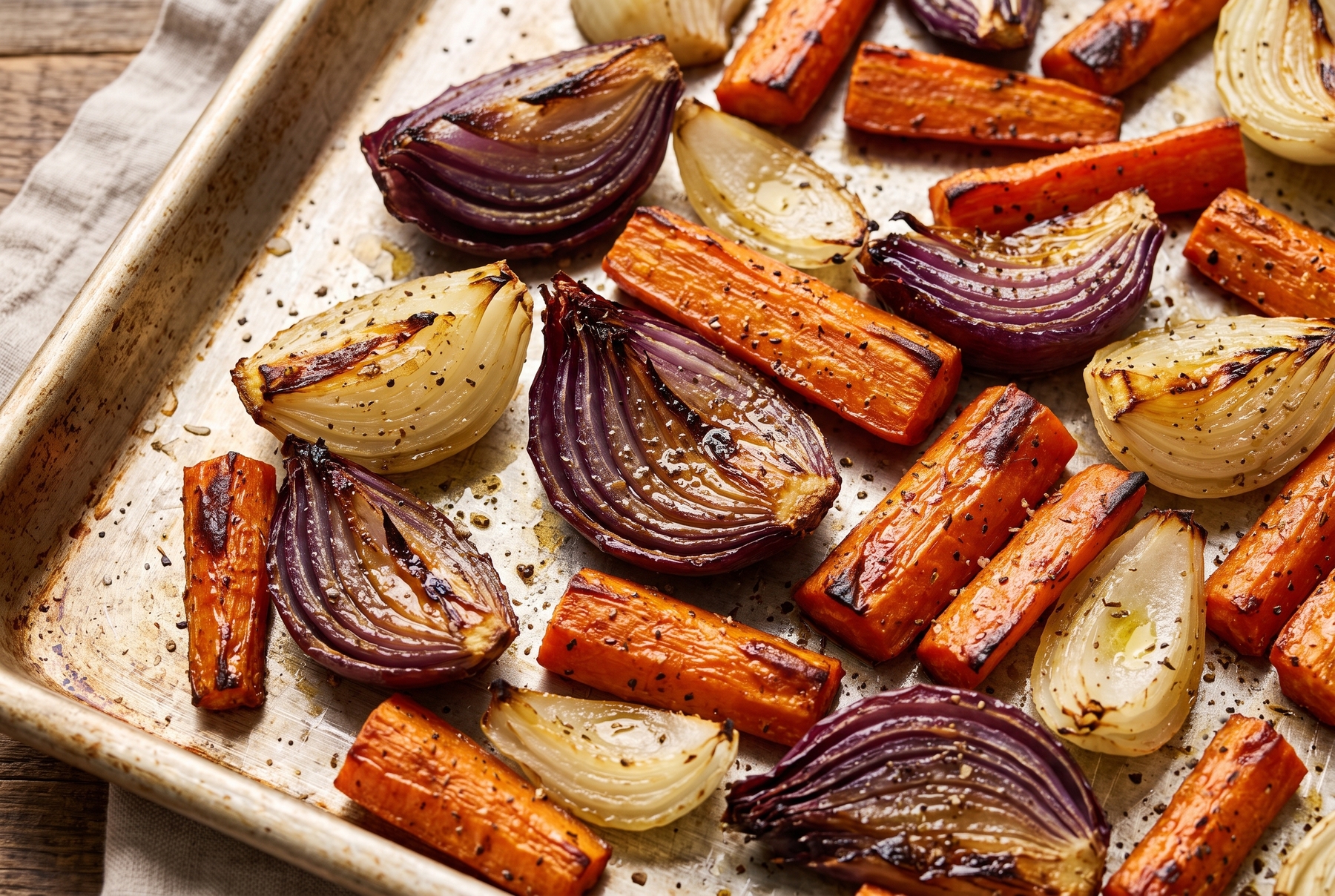
Slow roasting and browning vegetables releases their natural sugars, building a deeply sweet and complex flavor profile.
Fat: The Carrier of Aroma and the Source of Satiety
Many aromatic compounds are fat-soluble. Fat dissolves and binds them: it sometimes subtly mutes the initial burst of aroma but stretches the sensation significantly over time. This explains why a fat-free dish often tastes like cardboard, even with adequate salting: a portion of the aromatics behaves entirely differently, and the flavor simply drops off too early. Fat provides texture and a feeling of fullness: soups become softer, sauces grow thicker, and the finish lingers much longer.
Different fats perform different functions. Butter offers a milky aroma and a velvety mouthfeel. The performance of vegetable oil depends entirely on its type: fresh refined oil withstands high heat and provides a neutral background for searing, while unrefined oil carries its own robust flavor and requires gentle handling. Cream rounds everything out. Sour cream introduces fat alongside acidity. Cheese delivers fat, salt, and umami in one single package. Nuts contribute fat with a textural crunch and their own unique aroma. Meanwhile, the rendered fat from searing meat carries the entirety of the roasted meat flavor straight into the sauce. Fat contributes more than just calories: it dictates texture, aroma, and the length of the finish on the palate.
Why Fat Requires Balancing
Fat without a counterweight quickly exhausts the palate. An excess is easy to identify: the flavor coats the tongue for a long time but becomes monotonous and heavy, making a third spoonful unappealing. This is exactly where acidity, bitterness, fresh herbs, or a crisp textural contrast must step in.
A rich cream sauce comes to life with a few drops of lemon juice. A heavy meat stew or hearty soup finds its salvation in a handful of fresh herbs and a bright acidic note. Fatty cuts of pork practically demand something pickled or spicy alongside them. The underlying logic remains constant across the board: the heavier the dish, the greater the need for acidity, herbs, or crunch.
Umami: The Richness Often Confused With ‘Chemicals’
Umami delivers a meaty, brothy, profound flavor that is typically described as ‘savory’ or ‘rich.’ It is primarily driven by glutamic acid and its salts, along with certain nucleotides found in meat, fish, and mushrooms. There is nothing exotic about it: free glutamate exists naturally in tomatoes, cheese, and soy sauce, long before any industrial processing. The human tongue is hardwired to perceive it as a distinct, fifth basic taste.
Umami-Rich Foods: What Is Already in a Standard Kitchen
The lineup is entirely familiar. Aged cheeses. Tomatoes, and especially concentrated tomato paste. Mushrooms, both fresh and dried. Meat and meat broths. Fish, anchovies, and fish sauce. Soy sauce. Seaweed. Yeast extracts. And a vast array of fermented products.
In traditional home cooking, the heaviest lifting is done by dried porcini mushrooms, sauerkraut and other fermented vegetables, tomato paste, aged cheese, cured and salted fish, and deeply reduced meat broths. A single spoonful of any of these ingredients injects a dish with what professional tasters call depth, and what a home cook simply calls a ‘rich, hearty flavor.’
Why Combinations Work Exponentially Better
The most fascinating reactions occur when different umami sources combine. Glutamates and nucleotides amplify one another, resulting in a paired flavor that is significantly more powerful than the sum of its parts. This explains the classic flavor combinations that global cuisines discovered long before food science existed.
Meat and mushrooms. Tomatoes and cheese. Chicken and soy sauce. Broth and a handful of dried porcini. Every single one of these pairings resonates more deeply than either ingredient acting alone. This synergy is exactly why dropping a couple of dried mushrooms into a meat gravy achieves more than doubling the spices.
A Calm Look at Monosodium Glutamate
Now, regarding the infamous E621. Monosodium glutamate is a specific compound, the salt of the exact same glutamic acid that naturally resides in tomatoes and Parmesan cheese. It is not a catch-all term for ‘chemicals’ nor is it a poison conjured in a test tube. On the palate, it performs the exact same function as aged cheese or soy sauce: it amplifies umami.
Major food safety authorities worldwide consider monosodium glutamate safe for general consumption. In some regions, a daily limit has never even been established. This does not mean it should be consumed by the spoonful: it simply means that in standard culinary doses, authorities found no reason for restriction. In 2017, the EFSA established an acceptable daily intake for glutamic acid and glutamates at 30 mg per kilogram of body weight, which translates to about 2.1 grams for an adult weighing 70 kilograms.
Setting medical claims aside—certain individuals may be sensitive to glutamate—moderation remains key, just as it does with ordinary table salt.
For a cook, a different truth matters more. Glutamate cannot build a spectacular dish out of thin air. It amplifies a specific flavor profile but absolutely cannot replace the aroma of toasted spices, the texture of well-cooked meat, the brightness of fresh herbs, or the execution of proper culinary technique. If the underlying base is weak, the enhancer will merely make it louder, not better.
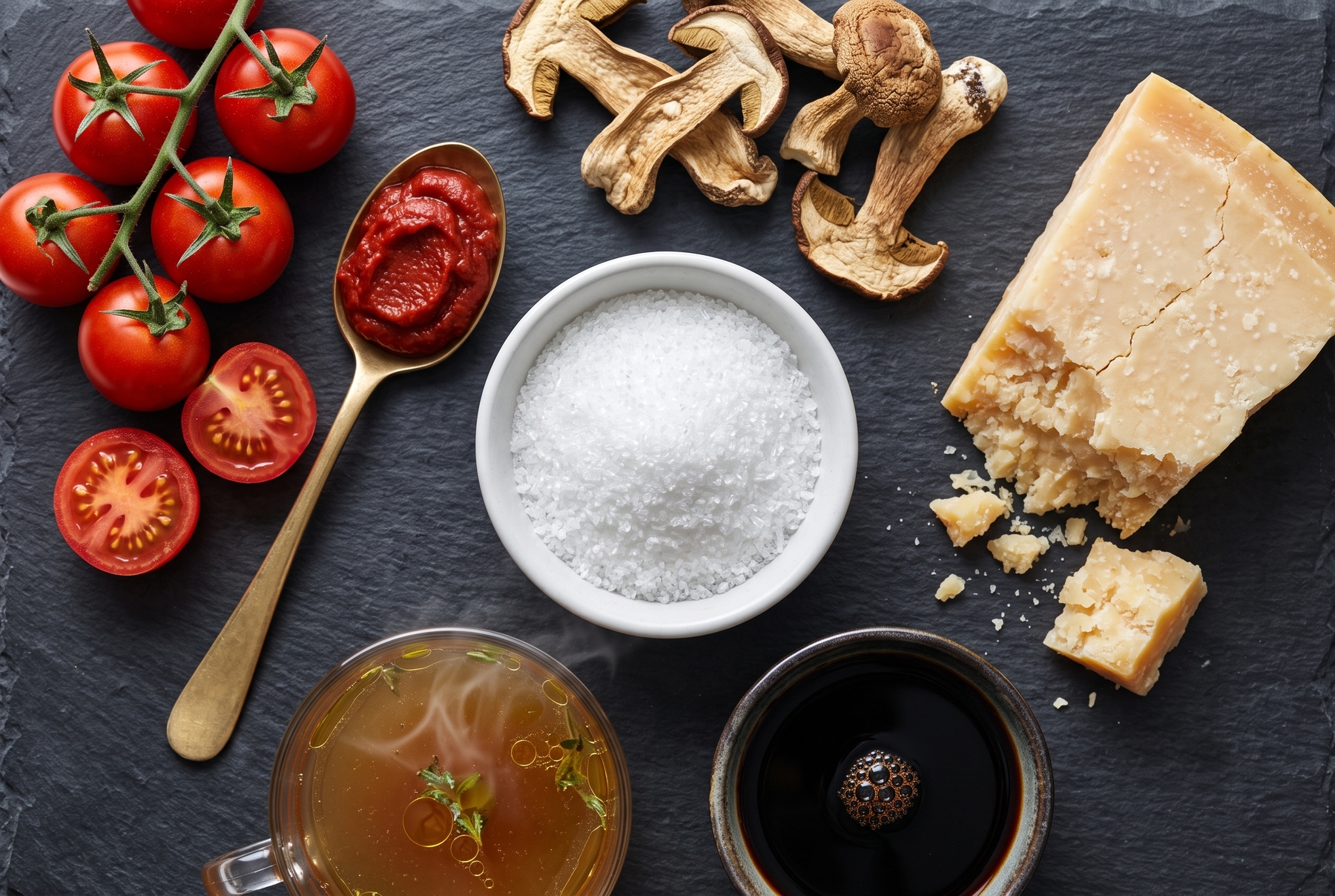
Combining ingredients packed with glutamates and nucleotides (such as tomatoes, cheese, and mushrooms) mutually amplifies their rich, meaty taste.
Fermentation and Aging: When Time Becomes the Enhancer
Soy sauce, miso, aged cheese, sauerkraut, fish sauce, cured meats, and fermented pastes. All of these products boast complex, concentrated flavors, despite originating from incredibly simple raw materials. The active ingredient here is time.
Bypassing the deep microbiology, the core process is straightforward. As a product ferments or ages, microorganisms and inherent enzymes break down large protein and carbohydrate molecules into smaller fragments. Free glutamic acid (the umami factor) emerges, alongside new acids, alcohols, and dozens of aromatic compounds that never existed in the fresh ingredients. Young cheese tastes soft and milky. That exact same cheese, after a year of aging, becomes sharp, salty, and packed with umami. Over that year, it simply accumulated more free amino acids, salt, and intense aromas.
How to Use Fermented Products Unconventionally
These ingredients do not have to remain confined to their traditional roles. Swapping a portion of salt for a spoonful of soy sauce in a meat gravy contributes deep color and savory depth. Mixing a couple of tablespoons of pickle brine into a salad dressing introduces a salty-sour punch that a lemon simply cannot replicate. A teaspoon of miso paste stirred into a creamy white sauce gives it remarkable body. Grated aged cheese melted into a soup or blended into breading acts simultaneously as seasoning and an umami bomb.
It is crucial to remember one detail: soy sauce, fish sauce, miso, pickles, and certain cheeses already pack a significant amount of salt. When incorporating these ingredients, salting the dish should always happen last and only after tasting, otherwise oversalting creeps in unnoticed.
Browning: The Enhancer You Cannot Buy in a Jar
The golden-brown crust on a seared steak, roasted vegetables, baked bread, sautéed mushrooms, or deeply caramelized tomato paste delivers a flavor profile that no bottled condiment can replicate. It is born directly in the hot skillet from two distinct chemical processes that are frequently confused.
The Maillard reaction occurs between amino acids and sugars at high temperatures, producing a deep brown color alongside hundreds of complex roasted, nutty, and meaty aromas. Caramelization strictly involves sugars, which darken under intense heat and turn bittersweet. Slowly sautéed onions benefit from both processes simultaneously, which perfectly explains their rich, intoxicating aroma.
What a Proper Crust Looks Like
Judging browning requires looking and smelling, rather than watching a clock. The surface of the ingredient must be completely dry. Contact with the pan should be aggressive and confident, producing an even sizzle reminiscent of water hitting a hot stone. The color should land on a rich golden-brown—neither pale nor charred black. The aroma must be deeply roasted and nutty, entirely free from acrid, bitter smoke.
Several common mistakes guarantee the crust will fail. Overcrowding the pan forces ingredients to release water, resulting in steaming rather than searing. A wet surface on meat blocks browning; patting it thoroughly dry with paper towels is essential. Constant stirring prevents the food from catching the heat, leaving it sad and gray. Dropping food into an underheated pan just generates steam. Finally, attempting to rush the process on maximum heat guarantees the outside burns to a crisp while the inside remains entirely raw.
The Fond at the Bottom of the Pan
After searing meat, a layer of browned, sticky bits remains stuck to the bottom of the pan. Too often, these are mistakenly scrubbed away and discarded. This is a tragic waste: those bits are pure, concentrated flavor. Splashing a little water, broth, or wine into the hot pan and scraping the bottom with a wooden spatula dissolves these particles, transferring all that accumulated roasted flavor straight into the liquid. This simple technique, called deglazing, creates a spectacular sauce base out of nothing.
The only difference between culinary gold and burnt trash is color. Deep brown, aromatic particles constitute the fond, the essential foundation of a pan sauce. Black, charred residue delivers only bitterness and has no place in the sauce. Trusting the nose is critical: if it smells deeply roasted, keep it; if it smells like acrid smoke, wash the pan and start over.
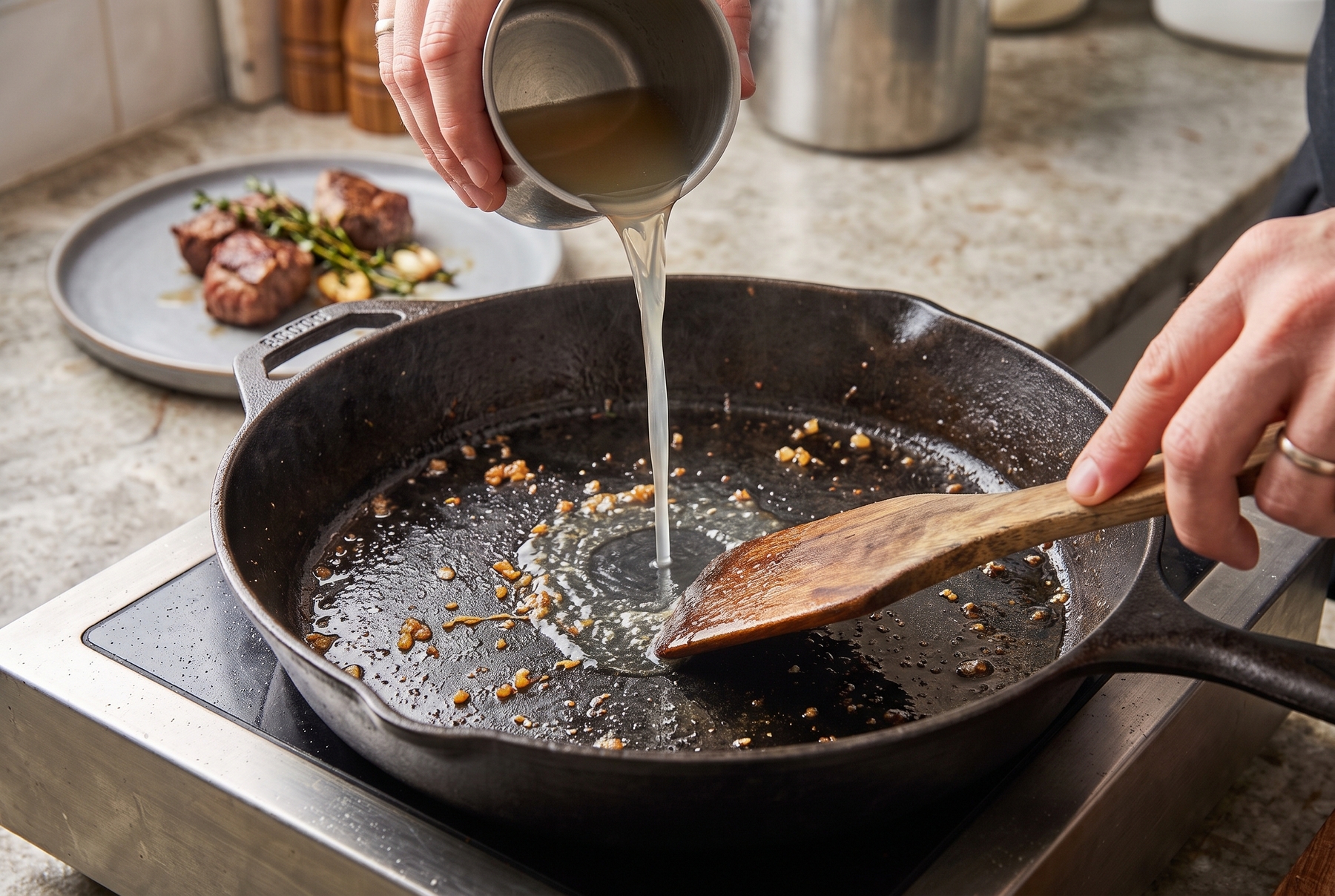
Dissolving the browned bits (fond) stuck to the bottom of the pan with a liquid helps build an intensely flavorful foundation for a sauce.
Garlic, Onions, Spices, and Herbs Behave Differently
Aromatic ingredients do not merely ‘add a smell.’ They transform entirely depending on how they are chopped, the temperature they face, and their duration in the pot, and a single ingredient can yield several radically different results.
One Garlic Clove, Multiple Effects
Raw garlic grated into a dressing is sharp, aggressive, and slightly fiery. That exact same garlic, dropped into hot oil for mere seconds, releases a bright, fast-acting aroma. However, leaving it in that hot oil for just ten seconds too long produces an acrid bitterness that cannot be masked. Slowly braised garlic softens significantly, turning sweet and losing all its harsh edges. Roasting a whole head of garlic transforms the cloves into a creamy, spreadable paste with zero sharpness and profound sweetness.
Onions follow a similar trajectory: ranging from a sharp raw bite to a sweet, dark jam after a long, slow sauté. Spices typically bloom best in fat, making a brief sizzle in warm oil at the start of cooking ideal, but they burn instantly on high heat and turn aggressively bitter. As for fresh herbs, splitting them into two batches works best: tossing one half into the pot during cooking to build a background flavor, and stirring the remaining half in right before serving to preserve the bright, volatile aromas that boil away in seconds.
Concentrates and Pre-Made Products That Honestly Save Time
Tomato paste, bouillon concentrates, soy sauce, mustard, anchovies, cheese, dried mushrooms, fermented pastes, and high-quality spice blends all have a place in a working kitchen. Dividing them into ‘virtuous homemade’ and ‘evil store-bought’ categories is a pointless exercise. A spoonful of premium commercial tomato paste is significantly more honest and flavorful than many ‘homemade’ sauces crafted from watery, out-of-season tomatoes.
What truly matters is the ability to read an ingredient label and understand exactly what is going into the pot. Concentrates share three universal traits that require attention: they carry heavy salt loads, frequently hide added sugar and fat, and possess intense flavor. This dictates a strict rule: always add the concentrate first, and season with salt last. Keeping allergens in mind is also crucial when cooking for others, as soy, fish, dairy, and nuts routinely hide in unexpected jars.
When a Concentrate Helps, and When It Hides a Problem
The dividing line comes down to culinary honesty. Intentional enhancement happens when the base of a dish is already solid, and a concentrate simply adds depth: whisking a spoonful of miso into a well-crafted broth, or grating fresh Parmesan over a beautiful soup.
Masking, on the other hand, occurs when a concentrate is deployed to save a dish that is already beyond saving. Drowning old ground meat in soy sauce to kill the smell. Dumping a handful of bouillon powder into a watery, tasteless soup to fake a proper broth. Burying burnt, bitter aromatics under a mountain of heavy spices. Flavor cannot be fixed this way. The underlying flaw remains trapped beneath a loud, aggressive additive, and by the second spoonful, the palate always knows the truth.
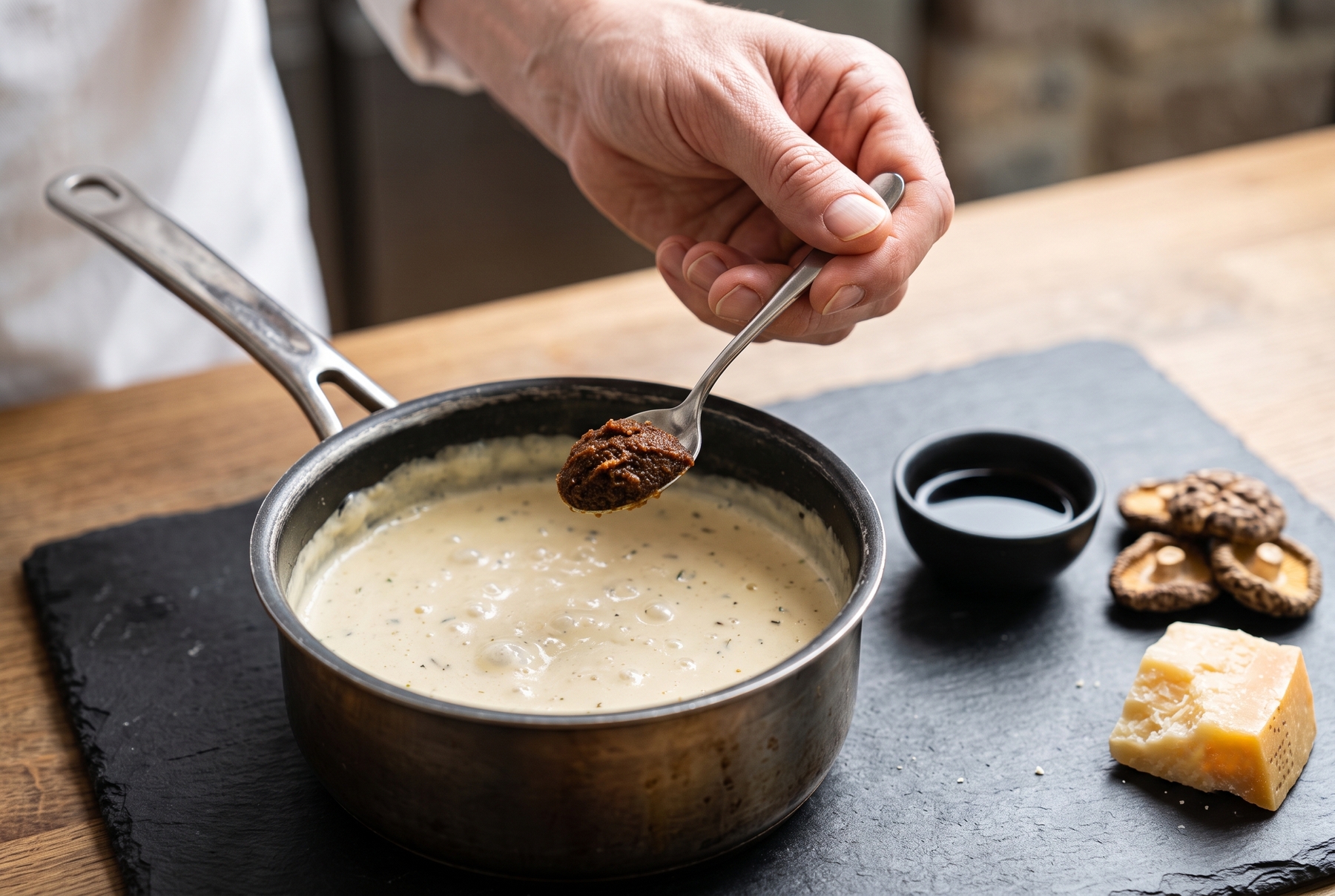
A spoonful of fermented miso paste or soy sauce introduces density, deep savory notes, and a pleasant saltiness to creamy dishes.
How to Enhance a Dish When It Tastes Bland
When a flavor profile fails to come together, reaching for everything in the pantry is a mistake. Taste thoughtfully, making one small adjustment at a time.
- Check the temperature. Heat dramatically alters both taste and aroma, and it affects different flavor profiles in different ways. Always taste the food at a temperature close to how it will be served. Adjusting the seasoning of a boiling sauce blindly is a gamble; letting a small spoonful cool slightly provides a much more accurate read.
- Check the salt. Pull a spoonful out, drop in a few grains of salt, and compare it to the main pot. Nine times out of ten, this is exactly what is missing.
- Introduce contrast. If the salt levels are correct but the flavor remains flat, try adding a few drops of acid, a hint of sweetness, or a fresh aromatic element, depending entirely on the character of the dish.
- Evaluate richness and texture. Determine what feels absent: is it fat, an umami component, the depth of reduction, or a roasted base? Conversely, if the dish tastes overly concentrated, a splash of water might be its exact salvation.
- Know when to stop. An overdose of enhancers turns a flavor profile into loud, chaotic noise where no individual element can be appreciated.
Here is a compact cheat sheet for troubleshooting specific disasters at the stove.
| The Problem | Possible Cause | What to Try |
|---|---|---|
| Bland, fragmented flavor | Lacking salt | Test salt on a small sample, then add to the dish |
| Too sour | Excessive acidity | Introduce slight sweetness, fat, or an unsalted base; increase total volume |
| Too sweet | Excessive sugar or sweet vegetables | Add a drop of acid, a pinch of salt, or a spicy element |
| Heavy and greasy | Excess fat without a counterbalance | Introduce acid, fresh herbs, or a crisp textural contrast |
| Bitter | Burnt spices, garlic, or over-seared aromatics | Add slight sweetness and acid; in severe cases, start a new base entirely |
| Flat flavor, but properly salted | Lacking umami and depth | Stir in a spoonful of tomato paste, soy sauce, dried mushrooms, or cheese |
| Aroma disappears after a few seconds | Missing a fat carrier or a fresh finish | Swirl in a little butter or cream; add fresh herbs right before serving |
| Overly salty | Too much salt added | Increase the volume with an unsalted base (water, grains, vegetables, or potatoes in a soup); serve alongside a completely unseasoned side dish |
Addressing an oversalted dish requires absolute honesty, entirely free from kitchen myths. The miraculous trick of a raw potato ‘drawing out the salt’ is largely a fiction, offering negligible help even in heavily diluted soups. Only one strategy legitimately works: increasing the overall volume of the dish with an unsalted base, or altering the presentation by serving the salty main component alongside a massive portion of an entirely unseasoned side dish.
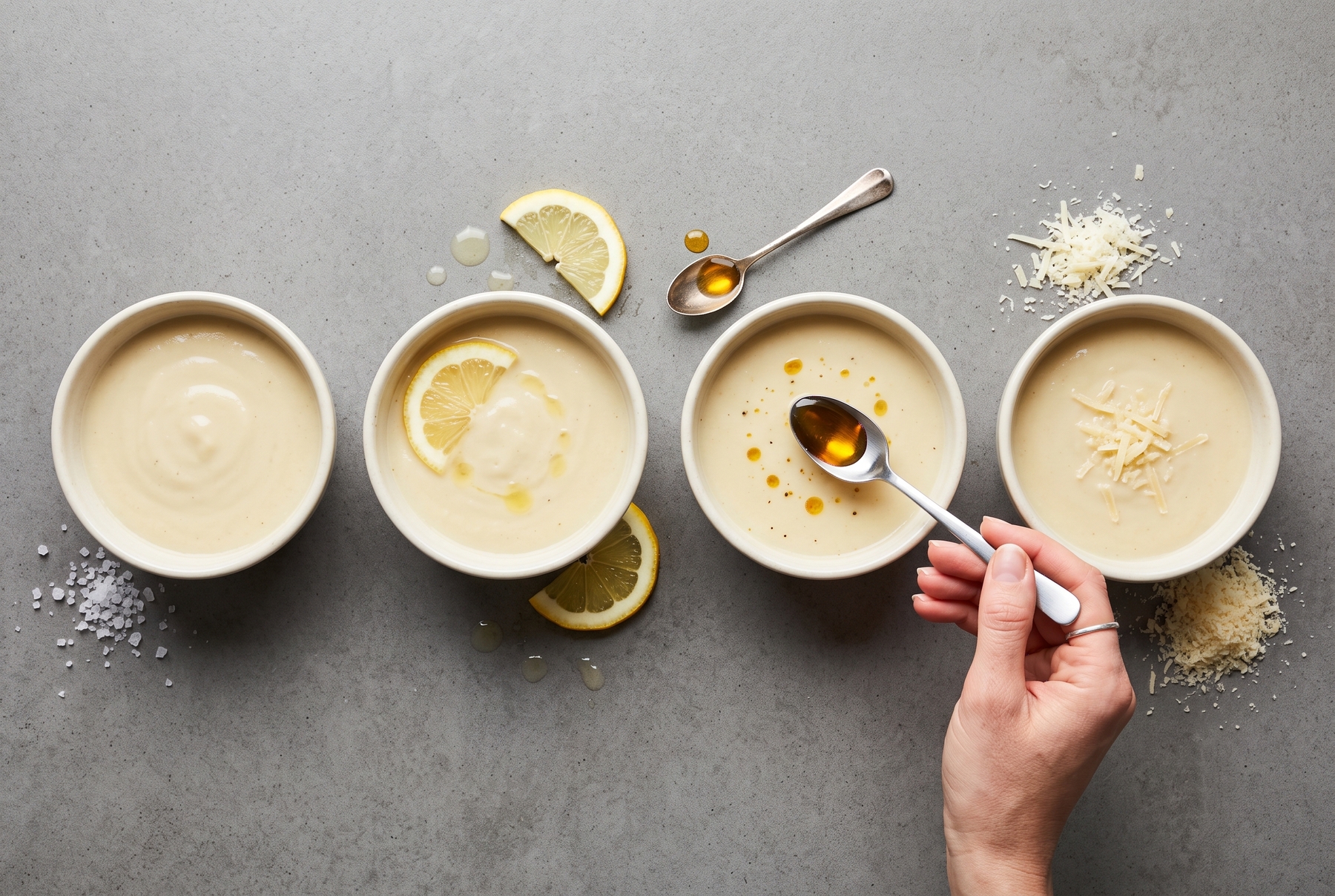
To rescue a flat flavor profile, try introducing contrasting elements in small increments: a drop of acid, a touch of fat, or a pinch of salt.
5 At-Home Formulas for Flavor Enhancement
These are not about precise grams, but about functional relationships: identifying what provides the salt, what brings the acid, and what builds the body.
Tomato Sauce
Tomato paste sautéed until deeply darkened (the Maillard reaction and caramelization build profound depth), paired with salt, a tiny pinch of sugar to balance highly acidic tomatoes, a splash of its own natural acid, and fat to provide body. If paste is unavailable, high-quality canned tomatoes, reduced slowly over low heat, make an excellent substitute.
Mushroom Soup or Sauce
Fresh mushrooms aggressively seared until deeply browned (never just boiled in their own water), combined with a handful of rehydrated dried porcini for a concentrated umami punch, a heavy cream component for a rounded mouthfeel, and a sharp acidic note introduced right at the end to prevent the cream from feeling excessively heavy. The dried mushrooms can easily be swapped for a commercial mushroom broth concentrate.
Roasted Vegetables
High heat (200–220 °C (390–430 °F)), a perfectly dry surface to ensure a roasted crust, generous salt, oil acting as the aroma carrier, a hit of acid immediately after pulling them from the oven, and fresh herbs right before serving. A simple squeeze of fresh lemon effortlessly handles the acid requirement here.
Meat Gravy or Pan Sauce
Deeply seared meat (the absolute primary source of flavor), aromatic vegetables, the dissolved fond scraped from the bottom of the skillet, broth to provide volume and body, and a subtle umami accent like a spoonful of soy sauce or tomato paste. A commercial concentrate easily replaces homemade broth, provided the cook monitors the sodium levels on the label.
Salad Vinaigrette
Fat serving as the lush foundation, acid cutting through for brightness, salt, a touch of sweetness for necessary balance, and an emulsifying agent like Dijon mustard that binds the oil and acid into a thick, uniform emulsion. A spoonful of mayonnaise, miso, or tahini can step in to handle the emulsifying duties just as well as mustard. Honey provides beautiful sweetness and viscosity, which slows down the separation process, but it cannot bind oil and acid on its own.
Every single one of these five formulas demonstrates the exact same principle. The elements do not fight for the spotlight; they support one another entirely. Furthermore, almost any component can be swapped for a standard grocery store alternative without compromising the underlying culinary logic.
Precision, Not Secret Ingredients, Amplifies Flavor
Returning to the initial premise: true flavor enhancers are not locked away in industrial laboratories. They are sitting on the pantry shelf, waiting in the refrigerator, and being created right in the skillet when onions slowly turn the color of dark caramel and roasted brown bits stick to the bottom of the pan.
Excellent cooking does not begin with a frantic attempt to make a flavor as loud as possible. It begins with the quiet ability to identify exactly what a dish is missing: salt, acid, sweetness, fat, umami, aroma, or a deeply roasted note. The purpose of these seven fundamental tools is never to shout over the primary ingredient, but to help it speak more clearly. A professional flavor profile is rarely built on a rare, exotic additive. It is constructed from a series of minor, precise adjustments executed at exactly the right moment. A spoonful of vinegar stirred into a simmering borscht sixty seconds before the heat goes off. A few drops of lemon juice squeezed into a rich cream sauce. A couple of dried porcini mushrooms dropped into a simmering gravy right at the start.
0 comments