
We have mastered the art of squeezing avocados and tapping watermelons to determine their ripeness. Yet, when it comes to potatoes for mashing or frying, we still often grab a bag at random, choosing whichever looks cleanest. The price tag simply states ‘Washed Potatoes’, offering no hint about the variety, its intended use, or what will happen once it hits the hot skillet.
The results become glaringly obvious in the pan. Expecting a golden, crispy crust, you cut the potatoes into batons and drop them into the oil. Ten minutes later, you find a sticky, disintegrated mass clinging to the bottom of the skillet. This familiar disappointment rarely stems from a lack of culinary skill or the wrong oil; rather, the tuber simply contained too much moisture or the wrong type of starch for the task.
Understanding what lies beneath the skin reveals why one potato yields perfectly smooth mash while another maintains its sharp cubes in a salad.
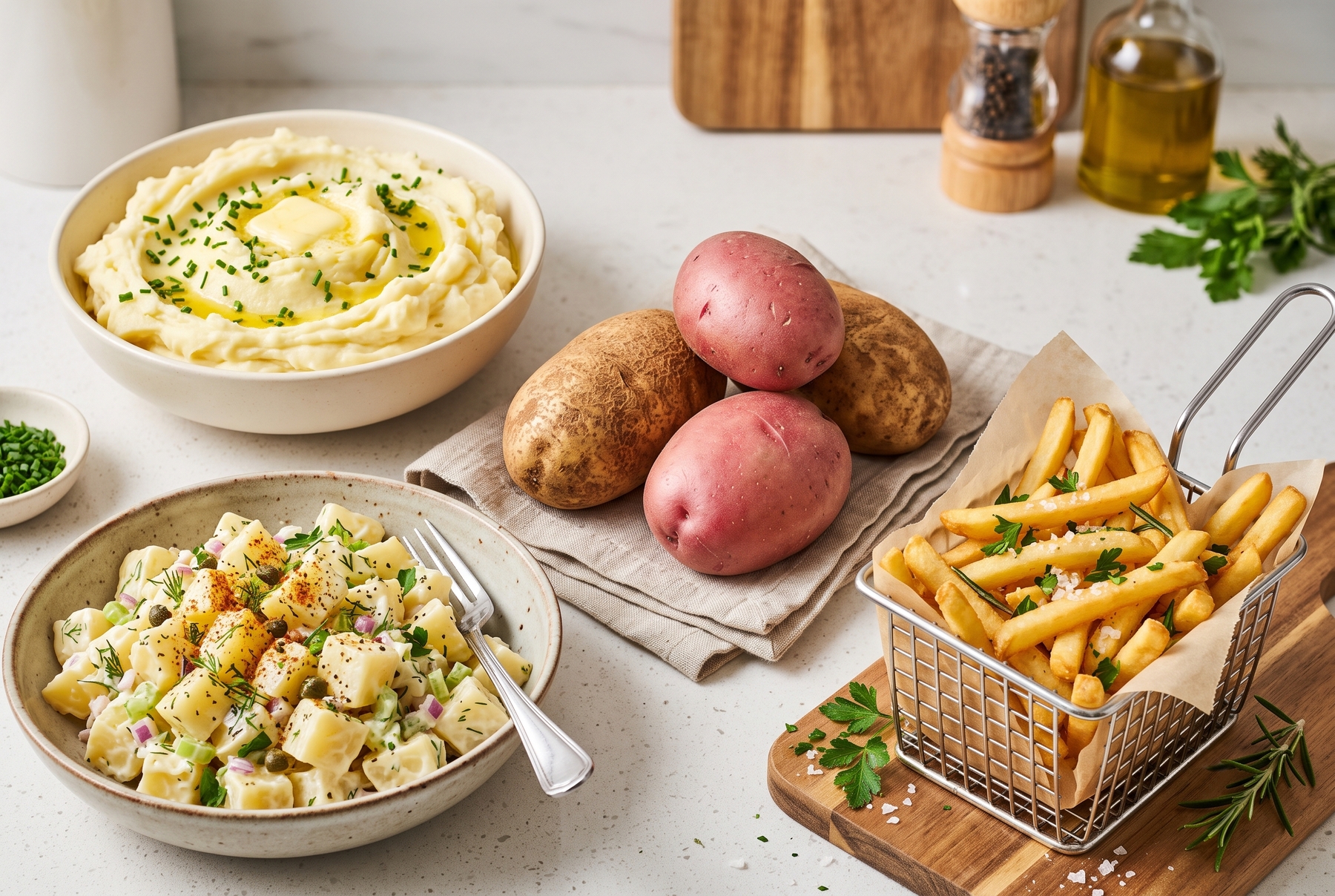
Choosing the correct potato variety guarantees the perfect texture for any dish, from fluffy mash and crispy fries to firm cubes in a fresh salad.
Table of Contents
What Hides Beneath the Skin: Water Versus Starch
A tuber serves as a biological storage facility. The plant stores its winter energy reserves inside it as starch, in the form of microscopic granules packed tightly within the cells. Water surrounds these granules, and the ratio between the two dictates exactly how the potato will behave in a pot or on a skillet.
Potatoes generally fall into two categories based on their starch content. Waxy varieties contain little starch and plenty of water, featuring dense flesh that feels slightly damp when sliced. Starchy varieties, on the other hand, are packed to the brim with starch and have lower water content, yielding a drier, matte surface when cut.
The science behind this is quite fascinating. A starch granule acts much like a sponge. When heated to around 60–70 °C (140–160 °F), it absorbs water and swells, causing the cells to expand from within. Starchy potatoes possess an abundance of these storage cells; they balloon up, lose their grip on one another, and separate easily. This process creates the dry, fluffy texture that is highly prized for mashed potatoes. Conversely, waxy potatoes have far less starch, and their cells remain tightly bound by pectin—a natural biological glue found in the cell walls. This allows the tuber to stay dense, slice cleanly, and hold its shape without falling apart.
This dual nature makes starch both a culinary friend and a foe. That loose texture works wonders in a mash, but the exact same force will turn perfectly diced potato salad into a mushy paste. As for hot oil, starch has an entirely different reaction, which deserves its own explanation.
How to Choose Potatoes When the Variety Is Not Listed
When supermarket labels offer no guidance, examining the tuber itself—its skin, weight, and a fresh cut—can reveal its nature. While no single feature provides an absolute guarantee, observing them together paints a fairly accurate picture.
Skin: Smooth or Netted
A thin, smooth, and slightly glossy skin usually conceals a moist, waxy interior. A thick, coarse skin featuring a distinct netting pattern—reminiscent of parched earth—often hints at a dry, starchy potato. This is merely a preliminary filter, suggesting the texture rather than guaranteeing it.
Weight in the Hand
Comparing two potatoes of identical size can also be revealing. The one that feels noticeably heavier and denser leans toward the starchy side, as it contains more dry matter, which carries more weight than water. The difference is subtle, but hands can easily learn to detect it.
A more precise test involves a heavy brine. Dissolving a large amount of salt in water and dropping the tuber in yields immediate results: a starchy potato sinks, while a waxy one floats or hovers near the surface. Density indicates the flesh’s properties far more honestly than the skin does.
The Color of the Skin Is Deceiving
A nearly universal myth claims that red-skinned potatoes are meant for frying and white ones are best for mashing. This is entirely unfounded. A potato’s color is determined by its specific variety and skin pigments, not by its internal starch content. Red waxy potatoes exist alongside white starchy ones, and vice versa. Trusting the internal texture and the weight yields much better results than relying on skin color at the market.
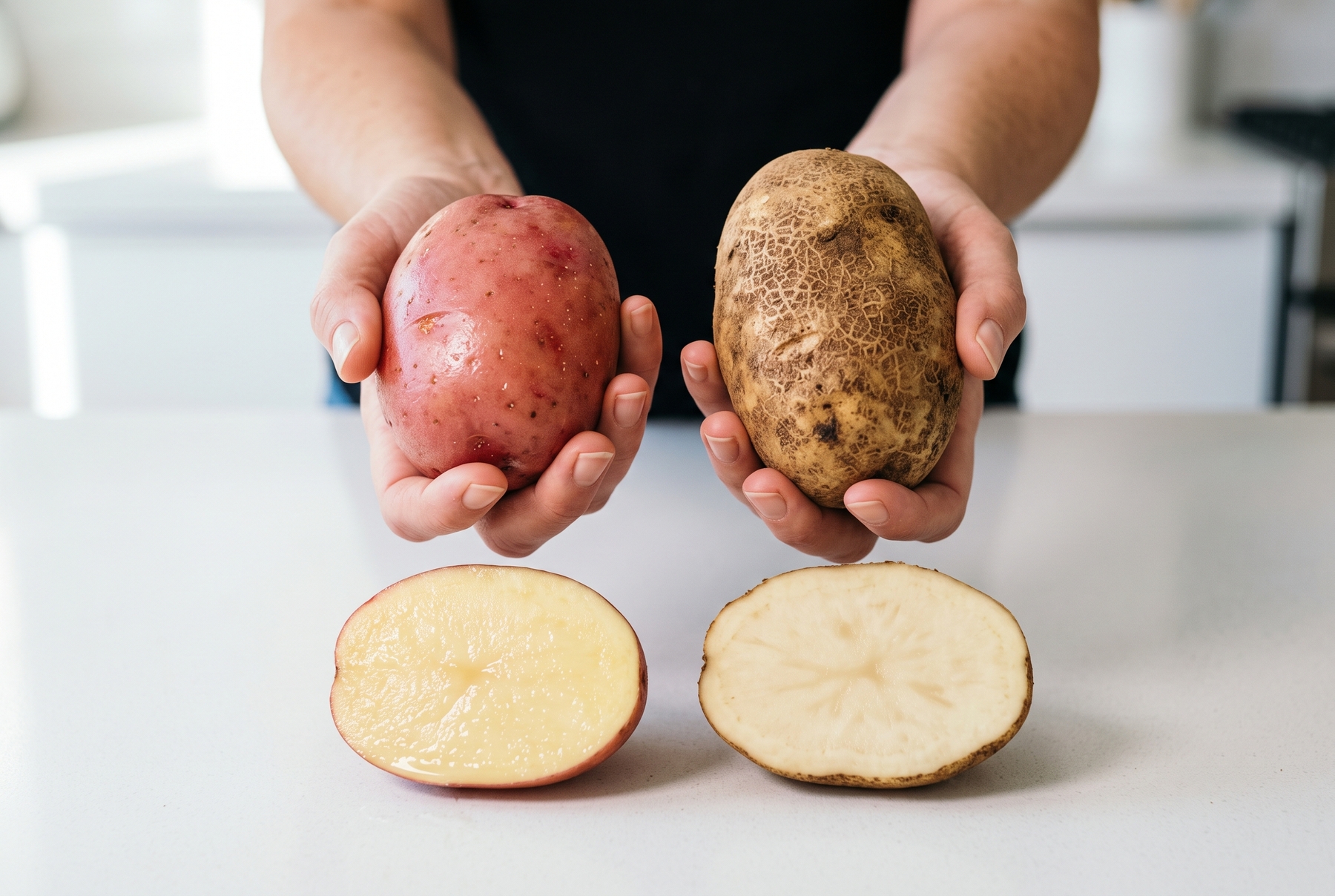
On the left is a waxy variety with a moist, glossy cut that holds its shape when boiled. On the right is a starchy variety with dry, matte flesh, making it ideal for mashing.
A Ten-Second Starch Test at Home
Once the bag is in the kitchen, a quick method exists to determine exactly what is inside.
Slicing the potato in half crosswise and rubbing the two cut surfaces together with gentle pressure for a few seconds reveals its nature. Pulling the halves apart slowly shows the difference.
A starchy tuber gives itself away instantly: a cloudy white film, almost resembling foam, appears on the surface, and the halves stick and string together as if coated in paste. Running a finger across the cut reveals a distinct tackiness. A waxy potato behaves completely differently. Its cut surface remains wet and clean, showing plenty of moisture but almost no white residue or stickiness, allowing the halves to separate effortlessly without resistance.
This simple trick requires only a knife, two hands, and ten seconds, offering the vital information missing from the store’s price tag.
Which Potato to Choose
Which Potato to Choose for Frying and Crispy Fries
A starchy or medium-starch tuber is essential here. The interior needs to feature somewhat dry, crumbly flesh; this ensures the exterior crisps up beautifully while the center remains fluffy rather than turning into a soggy mass.
An important technique for perfect fries involves thoroughly washing the cut potatoes. Tossing the batons into a bowl of cold water and rinsing them until the water runs clear removes the surface starch, after which they must be patted completely dry with a towel. If loose starch remains on the surface, it burns instantly in the scorching oil, leaving dark scorch marks and gluing the fries together. Washing away this starch guarantees an even golden color and a genuine crunch.
The second crucial technique is the double-fry method. The batons first cook gently in oil at 150 °C (300 °F) for about five minutes until the insides are soft but the outsides remain pale. Taking them out and letting them cool prepares them for the second plunge, this time at 175–180 °C (350–360 °F), which develops the browned, crispy exterior. The first stage cooks the core, while the second creates the crust. Attempting this in a single step inevitably results in burnt exteriors and raw interiors.
Which Potato to Choose for Boiling and Salads: Olivier, Vinegret
Salads demand the exact opposite approach. A waxy tuber with high moisture content is required—the kind that resolutely holds its shape. The pectin in the cell walls keeps the flesh dense, preventing the cells from separating, which ensures that a diced cube remains perfectly intact even after boiling and aggressive mixing. A starchy potato fails miserably in this role, as it swells, bursts, and turns a classic Vinegret (a traditional Eastern European salad of diced boiled vegetables and beets) or Olivier (a festive Russian potato salad with meat and peas) into a mushy puree.
Boiling these potatoes in their skins without overcooking them is vital. A knife blade should pierce the flesh with slight resistance rather than sliding right through. Overcooking ruins the structural integrity, putting the salad at risk before the chopping even begins.
Which Potato Is Best for Silky Mashed Potatoes
Securing the starchiest potatoes available yields the fluffiest results. The looser the raw flesh, the more airy the final dish becomes.
Many home cooks ruin their mash by reaching for a blender or a hand mixer. The rapid blades tear through the potato cells en masse, releasing all the neatly packed starch, which immediately swells into a sticky mucilage. This transforms the mash into a stretchy, gummy substance resembling wallpaper paste, an irreversible mistake since the starch cannot be put back into the cells.
Pressing hot potatoes through a ricer or mashing them with a traditional manual masher delivers much better results. The gentle downward motion crushes the cells delicately, keeping the majority of the starch safely contained and resulting in a smooth, non-gummy texture. Incorporating warmed milk and melted butter is equally important, as cold dairy tightens the starch, making the mixture denser and stickier.
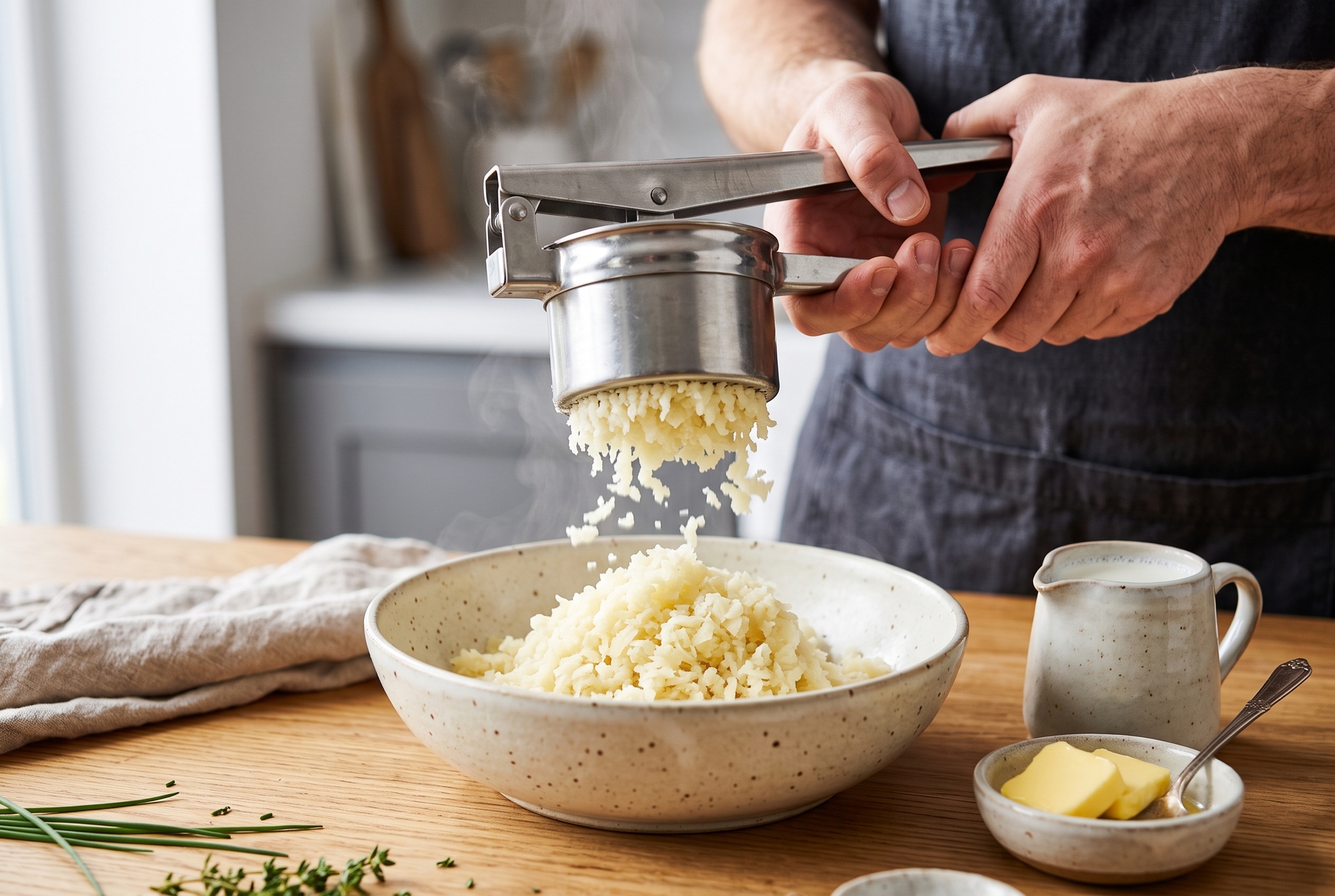
Using a specialized potato ricer or a manual masher instead of a blender keeps the starch confined within the cells, resulting in a delicate, silky puree.
Plan B: What to Do If You Bought the Wrong Potatoes
The ideal potato is not always at hand, and dinner often needs to be salvaged with whatever is available.
In the first scenario, a salad requires dense potatoes, but only crumbly, starchy ones are available, threatening to fall apart in the pot. Acid offers a clever solution. Adding a spoonful of vinegar or the juice of half a lemon to the cooking water before turning on the heat reinforces the pectin in the cell walls. This slows down their breakdown, allowing even a starchy variety to hold up much better. Cooking them at a gentle, barely perceptible simmer rather than a rolling boil prevents the tubers from smashing against one another and chipping their edges.
The second scenario involves needing frying potatoes when only moist, waxy tubers are in the pantry. The goal here is simple: eliminate excess water. After slicing, rinsing off the surface starch, and drying them, two paths emerge. Soaking the batons in cold water for half an hour before drying them completely helps pull out free sugars that would otherwise brown too quickly in the hot oil. Alternatively, drying the cut potatoes in the oven for about 15 minutes at 90–100 °C (195–210 °F) evaporates surface moisture. A dry surface hits the oil without aggressive splattering and develops a crust much faster.
The third, somewhat resigned scenario occurs when boiled waxy potatoes must be used for a mash. The result naturally leans toward dense and slightly gummy, but warmth and fat can partially mask this flaw. Mashing them by hand and aggressively folding in generous amounts of warm butter, hot milk, and perhaps a spoonful of sour cream improves the texture. While the gummy consistency will not completely disappear, the dish remains highly enjoyable.
Interestingly, the water used to rinse the cut fries will separate by morning, leaving a dense white layer at the bottom of the bowl. This is the very starch washed away from the potatoes. It can be dried and utilized in recipes as a perfect substitute for store-bought potato starch.
0 comments