
Four numbers look entirely too neat. It is as if a child’s diet can be assembled like unlocking a suitcase: dial 5-5-3-2 for the day, and your child is scientifically fed. I have three children, and not a single one of them has ever eaten ‘by the code’. A child is not a spreadsheet. They are teething, their mood swings, and today’s broccoli is ‘gross’ even though yesterday it was ‘more, please’. The ‘5532’ rule in child nutrition works perfectly as long as it remains a guideline. The moment it turns into a daily sentence, the benefits end. That is where the anxiety begins. We are going to discuss this fine line.
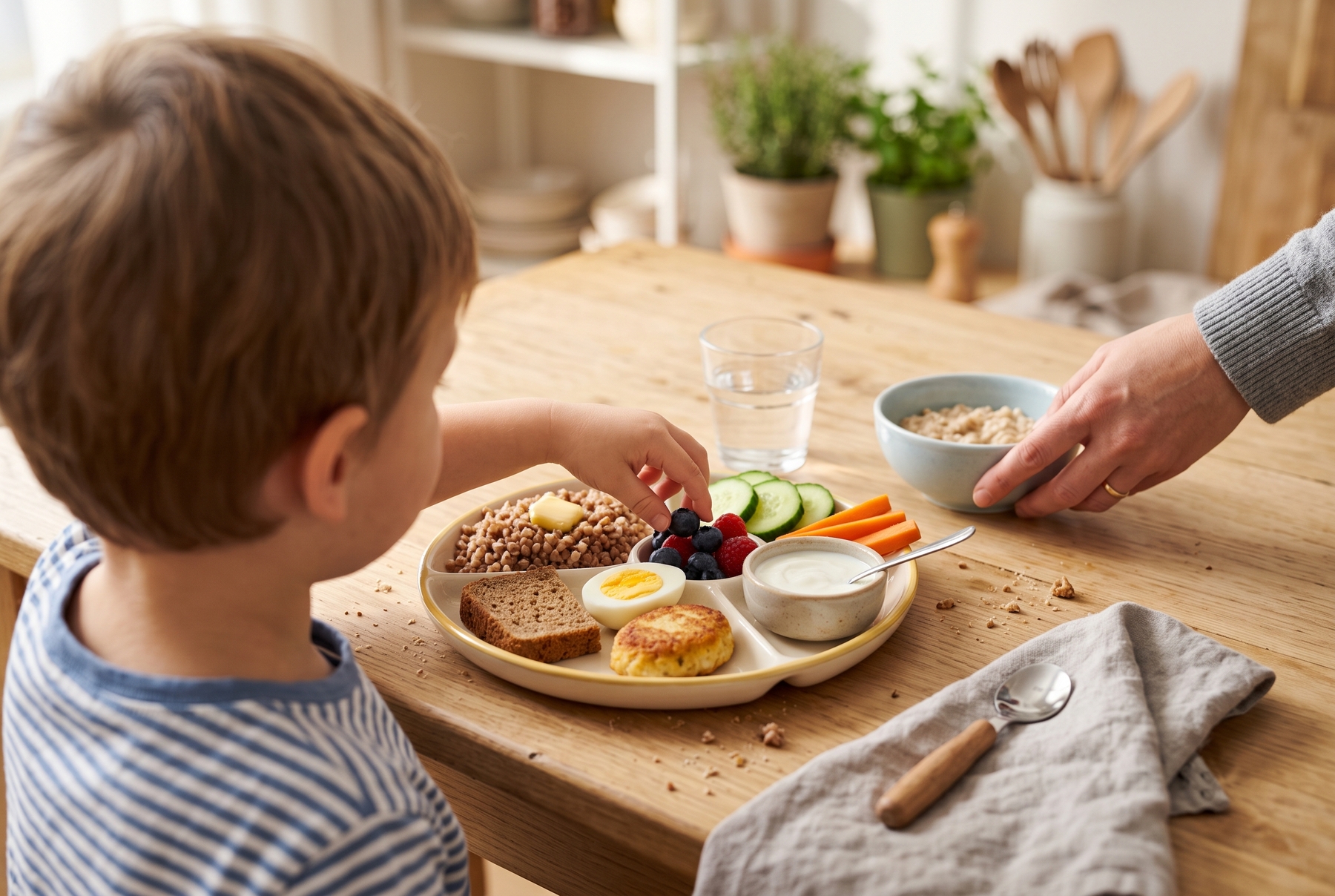
A sectioned plate helps parents visually separate portions: here we have complex carbohydrates, protein, and fresh vegetables alongside berries.
Table of Contents
- What Does the 5-5-3-2 Rule Mean in Child Nutrition?
- Why Parents Fell in Love With These Four Numbers
- Where the Rule Makes Perfect Sense
- Where the Medical Caveats Begin
- Where the Rule Stumbles in an Average Family
- In Short: Where the Rule Helps and Where It Fails
- How to Use the Rule Without Fanaticism: 3 Approaches
- A Child Nutrition Cheat Sheet: 6 Questions Instead of Counting Grams
- When It Is Time to Drop the Numbers and Talk to a Doctor
- The Rule Is Good as Long as It Helps
What Does the 5-5-3-2 Rule Mean in Child Nutrition?
Bloggers did not invent this rule. The British Nutrition Foundation developed it as a portion and daily diet guide for children aged 1 to 4 years. The breakdown is as follows:
- 5 portions of starchy carbohydrates: porridge, bread, pasta, potatoes;
- 5 portions of fruits and vegetables, or more (berries and leafy greens belong here too);
- 3 portions of dairy products: milk, yogurt, farmer’s cheese or cottage cheese, hard cheese;
- 2 portions of protein foods: meat, fish, eggs, legumes (3 portions are recommended for vegetarian children).
Two things did not make it into the numbers, but the diet remains incomplete without them: water and fats. It is best for a child to drink water and milk, while small amounts of butter and vegetable oil fit naturally into a normal menu; they simply lack a designated number.
Portions the Size of a Child’s Fist: What That Looks Like on a Plate
An everyday guideline: a child’s portion roughly equals the size of the child’s own fist or palm. Not yours. This clarifies why a two-year-old’s portion differs from a five-year-old’s, which is perfectly normal: as a child grows, the portion grows with them. This is why the British guide provides ranges like ‘2–4 tablespoons of pasta’: the lower limit suits a one-year-old, while the upper limit is closer to four years of age.
In practice, a portion looks simpler. A couple of spoonfuls of buckwheat (a toasted grain widely eaten in Eastern Europe), a slice of bread, half a banana or a whole one depending on the eater. An egg, a meatball, a small cup of yogurt. Another easily forgotten detail: ingredients within mixed dishes also count. Carrots in soup count as a vegetable, an egg in a casserole remains an egg, and tomatoes in pasta sauce honestly earn their tally. You do not need to separate all portions into neat little piles like in a cafeteria.
Why Parents Fell in Love With These Four Numbers
Because keeping track of protein, calcium, iron, fiber, and energy every single day is nearly impossible. Especially when you have more than one child. My eldest, at 14, eats like an adult with strong opinions, my middle child at nine acknowledges pasta and bread, and the youngest recently declared yogurt ‘too wet’. In such an environment, a mental framework that fits entirely in your head actually helps.
The ‘5532’ nutritional scheme genuinely lifts some of the burden. You do not have to count grams (or ounces) and calories. You simply run through the day mentally in the evening: grains were there, vegetables were there, dairy was there, protein was there. Five seconds, and the picture is clear. For an exhausted parent, that means a lot.
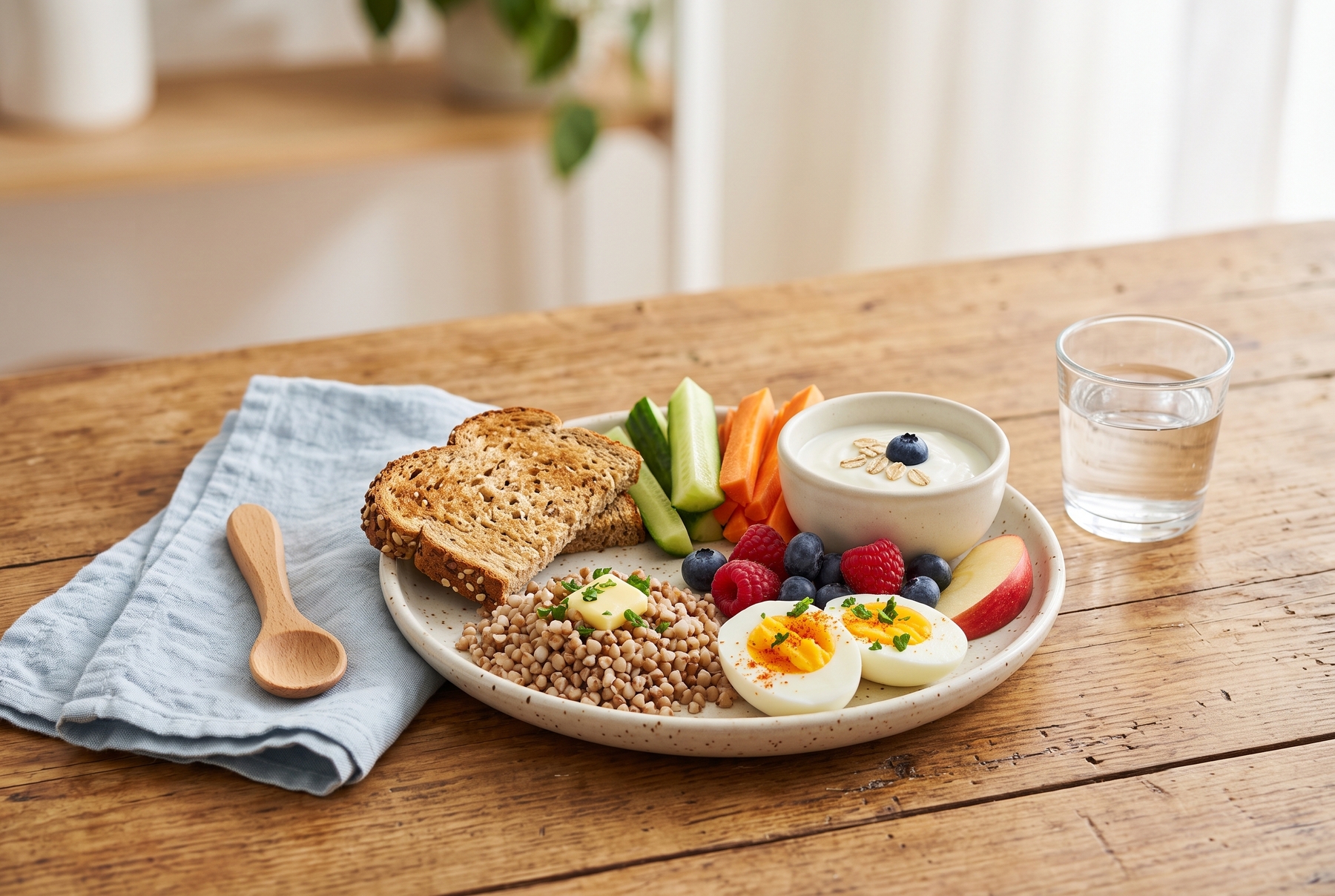
A simple example of a healthy plate: whole grains, protein sources, healthy fats, and fiber in the form of seasonal vegetables and berries.
Where the Rule Makes Perfect Sense
It Gathers All Essential Food Groups
The foundation of the rule is straightforward: a growing child needs sources of energy, protein, fiber, calcium, iron, fats, and hydration. The connection is simple: grains and potatoes provide energy. Fruits and vegetables bring fiber and vitamins. Dairy products cover a significant portion of the calcium requirement. Meat, fish, eggs, and legumes offer protein and iron. The rule does not require a parent to possess a nutritionist’s expertise, but it forces you to cover all groups at once.
It Keeps Vegetables From Falling Out of the Diet
Fruits and vegetables are usually the first to vanish from a child’s menu, especially for picky eaters. Five plant-based portions a day initially sound terrifying until you remember mixed dishes. Vegetables exist in soups, stews, omelets, sauces, meatballs with grated zucchini, and casseroles. A perfect salad is not mandatory here. You just need a cucumber slice next to a sandwich and a spoonful of berries in oatmeal.
It Catches the Skew Toward Childhood Favorites
The typical picture: pasta, bread, cookies, sweet yogurt, sausages, juice. The child is full, there are no tantrums, and the plates are empty. Yet the diet is standing on two legs out of four. The rule reveals this quickly: grain portions add up to eight, vegetable portions sit at zero, and protein is represented by a sausage. Sometimes this evening tally sobers you up better than any lecture.
Where the Medical Caveats Begin
Age Alters the Calculation
The 5-5-3-2 nutrition scheme was designed for children aged 1–4. You cannot hand the same blueprint to a one-year-old, a schoolchild, and a teenager: they have different energy, protein, and calcium needs, different routines, and different stomach capacities. For schoolchildren, the guidelines shift toward the balanced plate principle rather than counting child-sized fist portions. So, if your child is ten, ‘5532’ serves more as a general logic than a working instruction.
Standard Groups Do Not Suit Everyone
Cow’s milk protein allergy, lactose intolerance, celiac disease, iron deficiency anemia, gastrointestinal diseases, underweight or overweight issues, or a vegetarian household. In each of these cases, one of the groups stops working according to the standard scheme, and replacing it at random is unwise. Menus are then built with a pediatrician or pediatric dietitian, not from an internet cheat sheet. The scheme works well for a healthy child with free access to all food groups. In all other scenarios, it is better to assemble the menu alongside a doctor.
The Scheme Counts Groups, Not Quality
Five grain portions can mean buckwheat, oatmeal, and whole-grain bread. They can also mean sugary cereals, a sweet bun, and cookies. Technically, both are ‘grains’. Three dairy portions could turn out to be natural yogurt and cheese, or they could be a dessert with sugar as the primary ingredient. Interestingly, in recent versions of their guide, the British explicitly warn: choose unsweetened options, and dilute juice, serving it only with meals. The numbers alone do not show this. You still have to read the ingredient lists.
It Can Amplify Parental Control
There is a quiet risk, too. If you demand all 15 portions from your child every single day, eating turns into a negotiation featuring coaxing, and the dining table becomes a place of tension. A child’s appetite comes in waves: today they eat everything, tomorrow they peck like a bird, the day after they ask for thirds. It is wiser to evaluate a diet over several days or a week rather than a single day. One bad day tells you absolutely nothing.
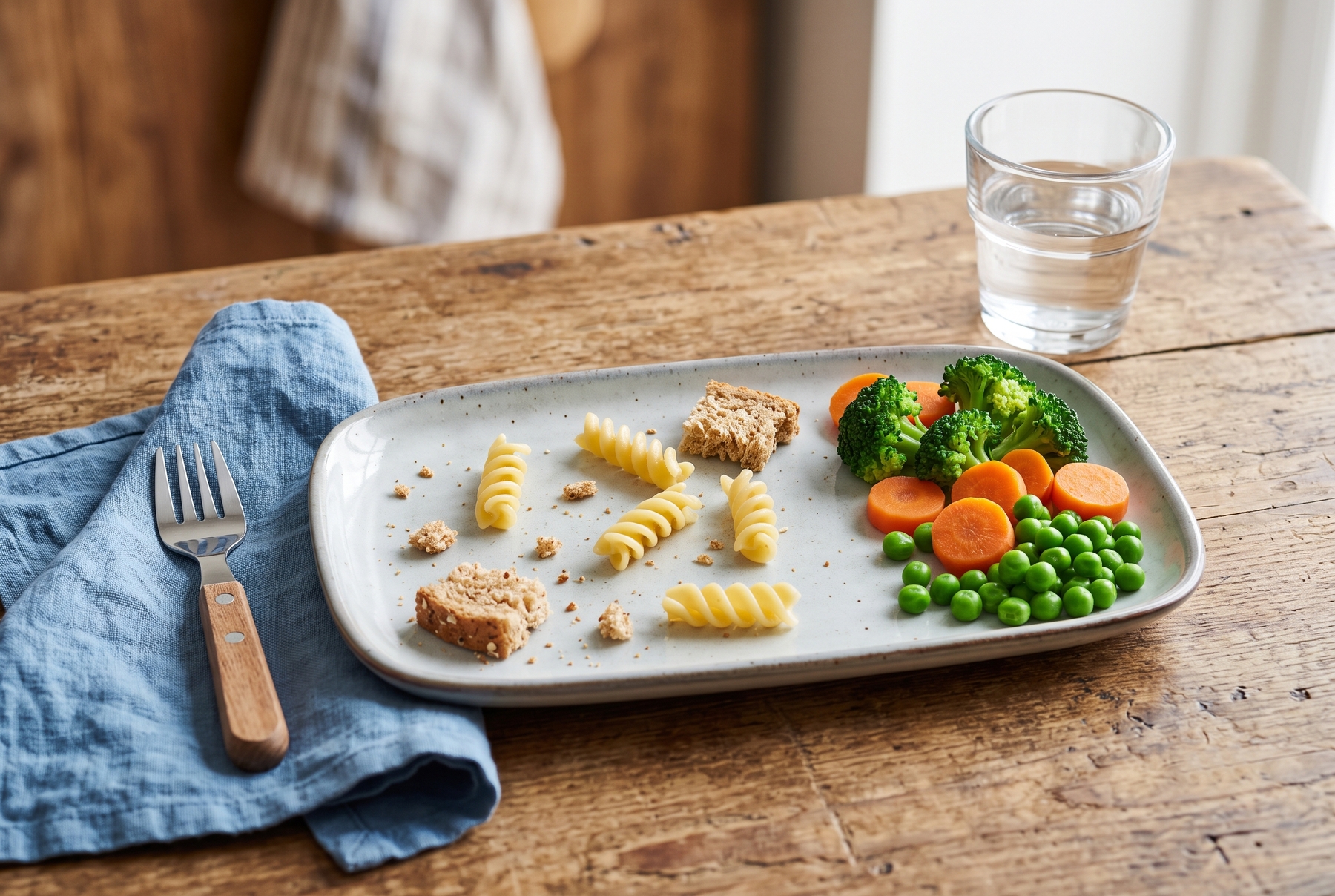
A child's appetite fluctuates, and that is perfectly normal. Avoid forcing a child to finish every last crumb to prevent mealtime pressure.
Where the Rule Stumbles in an Average Family
A picky eater is not going to consume five vegetable portions today, nor tomorrow, and applying pressure here works against you. The goal is different: expand the diet in tiny steps. A micro-portion of something new next to something familiar, repeated offerings without the drama, varying textures of a single vegetable. Raw carrots, carrots in soup, grated carrots in a meatball: for a picky child, these constitute three entirely different foods.
Illness, heat, stress, or starting a new kindergarten will break an appetite for days. The child drinks, looks fine, but eats less or chooses only the simplest foods. You do not need to compensate by hovering with a spoon at their mouth. Monitor their overall well-being, their hydration, and whether their appetite naturally returns.
The portions themselves can be deceptive. One child is active and perpetually hungry, another eats like a bird, and a third eats lunch at preschool, where only the teacher truly knows what was consumed. By the way, there is no need to duplicate the preschool menu at home: it is smarter to supplement whatever was missing during the day. Was there soup and porridge, but no fruit? An apple in the evening suffices without any dietary bookkeeping.
In Short: Where the Rule Helps and Where It Fails
Pros: It provides structure without complex calculations, reduces mental chaos, serves as a reminder for vegetables and protein, helps plan groceries, acts as a weekly checklist, and suits parents without specialized nutritional education.
Cons: It creates an illusion of universality, ignores age and medical diagnoses, fails to differentiate between whole grains and sugary cereals, can fuel parental control and anxiety, stalls with picky eaters, and remains silent on sugar, salt, and processed foods. Most importantly, it does not replace a doctor’s consultation, no matter how elegant it looks.
How to Use the Rule Without Fanaticism: 3 Approaches
Look at the Weekly Rhythm, Not a Single Day
Did vegetables barely make an appearance today? Tomorrow brings vegetable soup, berries in oatmeal, cucumber with a sandwich, and tomato sauce for pasta. Stay calm, without retaliation and without the phrase ‘you are not leaving the table until you finish’. The week naturally balances out what a single day ruins.
Check Your Grocery Cart, Not the Plate
This is the most convenient starting point. Before counting portions on a plate, look at your purchases. Do you have grains, vegetables, fruits, eggs, fish or meat, cottage cheese or yogurt without mountains of sugar, butter, and water at home? If your pantry is filled with cookies, sausages, and juice, your child cannot possibly assemble a balanced diet from them. The ingredients simply are not there. The ‘5532’ rule works brilliantly as a shopping list and a straightforward cheat sheet for a child’s diet: four food groups in the grocery cart almost automatically translate into four food groups on the dinner table.
Keep the Plate in Mind, Not Just the Numbers
The balanced plate principle (one part fruits and vegetables, one part grains, one part protein, a little fat) coexists perfectly with ‘5532’. One focuses on a single meal, the other looks at the entire day. They do not contradict each other.
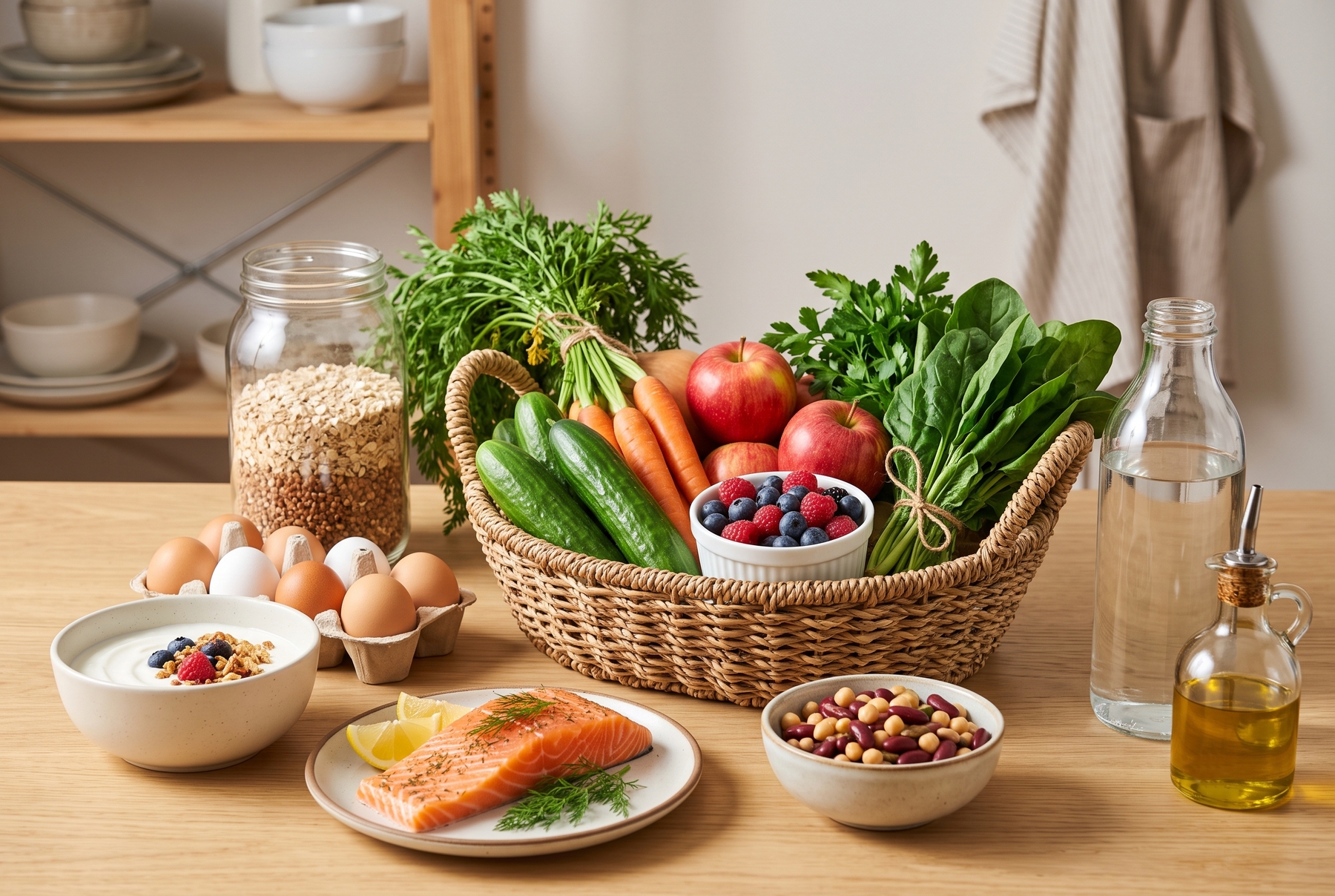
Instead of strictly counting grams on a plate, focus on the variety of ingredients in your grocery basket while shopping.
A Child Nutrition Cheat Sheet: 6 Questions Instead of Counting Grams
- Did the day include a proper source of protein?
- Did vegetables or fruits make an appearance several times?
- Was there a hearty nutritional base, rather than just snacks?
- Were dairy products or doctor-approved alternatives included?
- Did the child drink water?
- Did the day devolve into cookies, juice, and constant coaxing?
Run through this list in the evening, taking half a minute. Do it without treating it as an exam: it exists for self-reflection, not for guilt.
When It Is Time to Drop the Numbers and Talk to a Doctor
Rapid weight loss, persistent refusal to eat lasting more than a few days, frequent vomiting or abdominal pain, suspected allergies, chronic constipation, extreme pickiness (accepting fewer than 10–15 foods), anemia, stunted growth, significant excess weight, or the need for a therapeutic diet. None of these issues can be resolved with a four-number scheme. There is no need to panic, but portion counting will not help here: it is better to book an appointment with a pediatrician.
The Rule Is Good as Long as It Helps
The ‘5532’ rule is a convenient parental cheat sheet for child nutrition, but it makes a terrible warden. It displays the diet as a whole, highlights imbalances, and helps pack your grocery cart. However, it does not know your child: it cannot see how they are growing, what illnesses they have had, or why they have been turning their nose up at cottage cheese for three days straight. It is a success if, after adopting this scheme, your home gains a peaceful dinner where nobody forces anybody to eat, rather than a flawless chart on the refrigerator door. At our house yesterday, it looked like this: my youngest picked every single carrot out of the stew, piled them up on the edge of her plate, and then proceeded to eat that very pile first because ‘they are warm and sweet’.
0 comments