
‘You barely ate a thing.’ People rarely say this phrase because of actual hunger. More often, it masks something else: the host’s anxiety, a household habit, a way to say ‘you matter to me’ through a plate. A person set the table, invested half a day and a piece of themselves into it. When a guest sets their fork down, the host hears, ‘I do not really like it here.’
This is where the tension arises. The issue is not about the pie. Two honest needs collide at the table. The host needs to feel like a good provider. The guest needs to avoid betraying their own body: eating until they feel heavy, drinking when they do not want to, or sitting until midnight with an unbuckled belt and a forced smile. Both needs are normal. The problem is that the dispute is almost always resolved in one direction. The guest gives in.
A third path exists between ‘offending the hosts’ and ‘overeating as a guest.’ It is much broader than it seems.
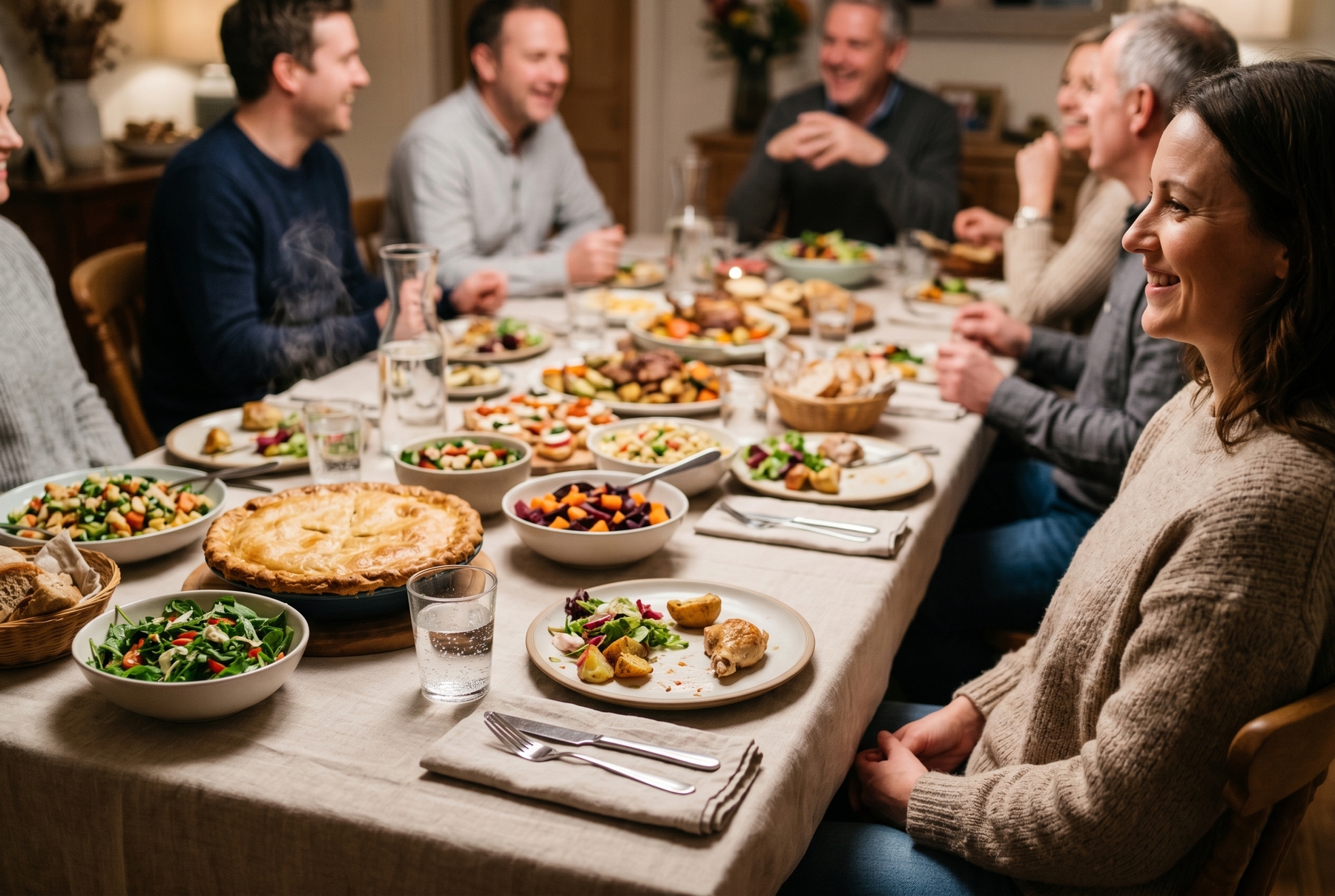
Sharing a dinner with loved ones is not just about food, but also warm conversation, where maintaining a balance between politeness and personal comfort is crucial.
Table of Contents
- Why Declining Food As a Guest Is So Difficult
- The Main Skill: Decline the Portion, Not the Person
- How to Avoid Overeating Out of Politeness
- How to Decline Alcohol As a Guest
- If the Hosts Continue to Persuade You
- How to Prepare in Advance
- What to Say in Typical Table Situations
- Gratitude Is Not Measured in Plates
- Why Declining Is Beneficial to the Hosts Themselves
Why Declining Food As a Guest Is So Difficult
Food functions as an unspoken agreement when visiting. A plate ceases to be merely food and becomes a cue in a conversation. Finishing a second helping signals, ‘I feel good with you.’ Pushing it away causes the host to involuntarily read it as an assessment of the evening, the family, and their own hands. This is why a refusal is taken personally: the guest meant ‘I am full,’ while the host received ‘they are rejecting me.’
The guest’s inner voice then kicks in, sounding similar for everyone. ‘They will be offended now.’ ‘I will ruin the evening.’ ‘Come on, I will endure it, I will not fall apart.’ This voice seems polite. In reality, it simply fears appearing rude, ungrateful, or ‘difficult.’
Setting a calm boundary here is worthwhile. Respect for the hosts and forcing oneself grow from different roots. One can be a warm guest while still listening to their satiety cues, remembering medications or sobriety, and holding personal limits. Politeness ends exactly where ‘I feel bad, but I stay silent so you feel good’ begins. This can no longer be called hospitality: the deal is not working in your favor.
The Main Skill: Decline the Portion, Not the Person
The key is simple. You say ‘enough’ to the second piece. Not to the host and not to their care. When this distinction exists in your head, it is also heard in your voice.
The Formula for a Polite Refusal
A calm refusal usually rests on four things: thanking, acknowledging the effort, gently setting a boundary, and briefly explaining, without excuses.
- Food: ‘Thank you, it was very delicious. I am already full.’
- Second helping: ‘You served a generous amount, I truly have had enough.’
- Dessert: ‘It looks excellent. I cannot manage it right now, I will take a piece a little later.’
- Alcohol: ‘I am skipping alcohol today. I will gladly sit with you with some water.’
Not a single phrase contains a cold ‘no.’ There is a warm ‘thank you’ and a calm period after it.
Why Long Excuses Work Against You
The longer the explanation, the more cracks there are for bargaining. Saying ‘I am on a diet, the doctor advised it, and it is heavy after six anyway’ will result in hearing: ‘well, one time will not hurt,’ ‘mine is very light,’ ‘just try a little.’ The host can dispute every argument you make. A short phrase leaves nothing to dispute.
Intonation makes the decision here. Words change almost nothing. A dry ‘no, thank you’ with pursed lips sounds like a reproach. The same ‘thank you, I am full,’ spoken with a smile and eye contact, sounds like a compliment to the table. The words are almost identical. The perceived meaning is the opposite.
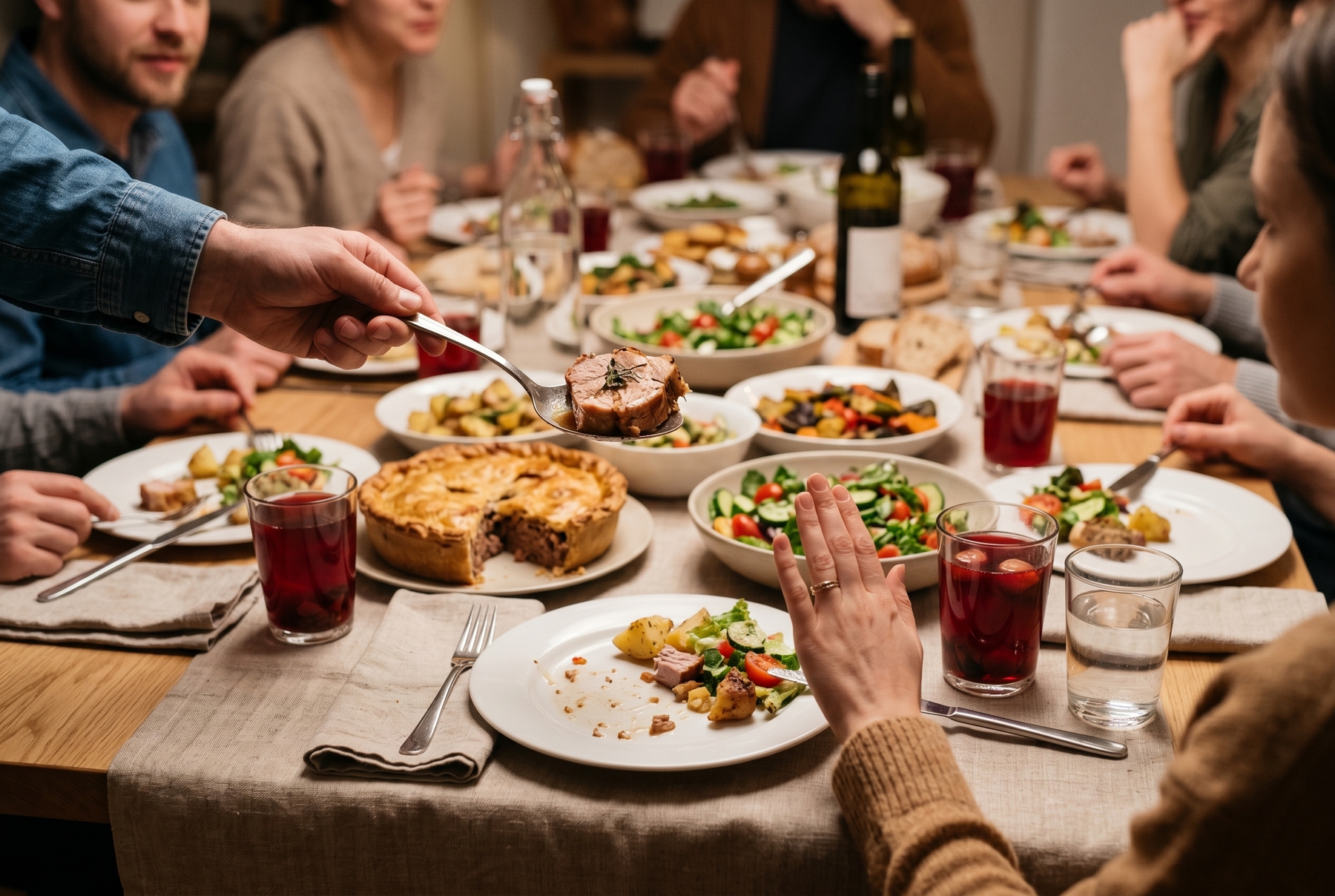
A polite gesture of refusal helps gently establish your boundaries at the table without offending the hosts.
How to Avoid Overeating Out of Politeness
Guests often overeat not out of hunger, but because stopping feels awkward. The body signaled long ago, but the hand reaches for a second helping for the sake of approval.
Checking in with oneself before feeling heavy is crucial. The guidelines exist, and they are physical. You start eating more slowly, and the bite is no longer as delicious as the first. The desire to continue stems either from taste or to please the host. If it is for the latter, you are full. The satiety signal reaches the brain on average 20 minutes after a meal begins, making it easy to miss this point during a fast feast and realize it only when the stomach is already bursting.
This leads to my favorite technique, which involves no esoteric practices. Taking a pause before a second helping works wonders. Taking a sip of water, breathing calmly a few times, making a remark in the general conversation, or changing the pace helps. A few seconds of internal silence return the choice to you: whether to take more or if you are done. Without this pause, the hand moves faster than the head.
The table setting also helps, provided you behave without making a show of it. Choosing a smaller plate works. Eating more slowly than your neighbor helps as well. Permitting yourself not to finish everything is important: a clean plate pleases the host, but it is not the law. A small piece left on the edge carries no offense.
How to Decline Alcohol As a Guest
With alcohol, the pressure is stronger than with salad, and the reason is clear. A shot glass often serves as a rite of belonging. ‘To our meeting.’ ‘To the hosts.’ ‘Well, just symbolically.’ Refusing food is read as ‘not hungry,’ while refusing a toast is sometimes read as ‘I am not with you.’
The phrases carry the same spirit: short, warm, without a lecture.
- ‘I am skipping alcohol today.’
- ‘I am driving.’
- ‘I feel more comfortable this way.’
- ‘I am with you, just with water in my hand.’
You are not obliged to explain the reason. Health, medications, plans for tomorrow, personal sobriety, or pregnancy remain your business unless you wish to share. No one needs a debate about benefits and harms at the table.
According to the current position of the World Health Organization, a safe level of alcohol consumption for health does not exist: the risk increases with any dose, rather than activating at a certain threshold. It interacts poorly with a number of medications, is not recommended during pregnancy, and is incompatible with driving. These are all real reasons why an adult might choose a glass of water. They are not obligated to lay any of them on the table next to the appetizers.
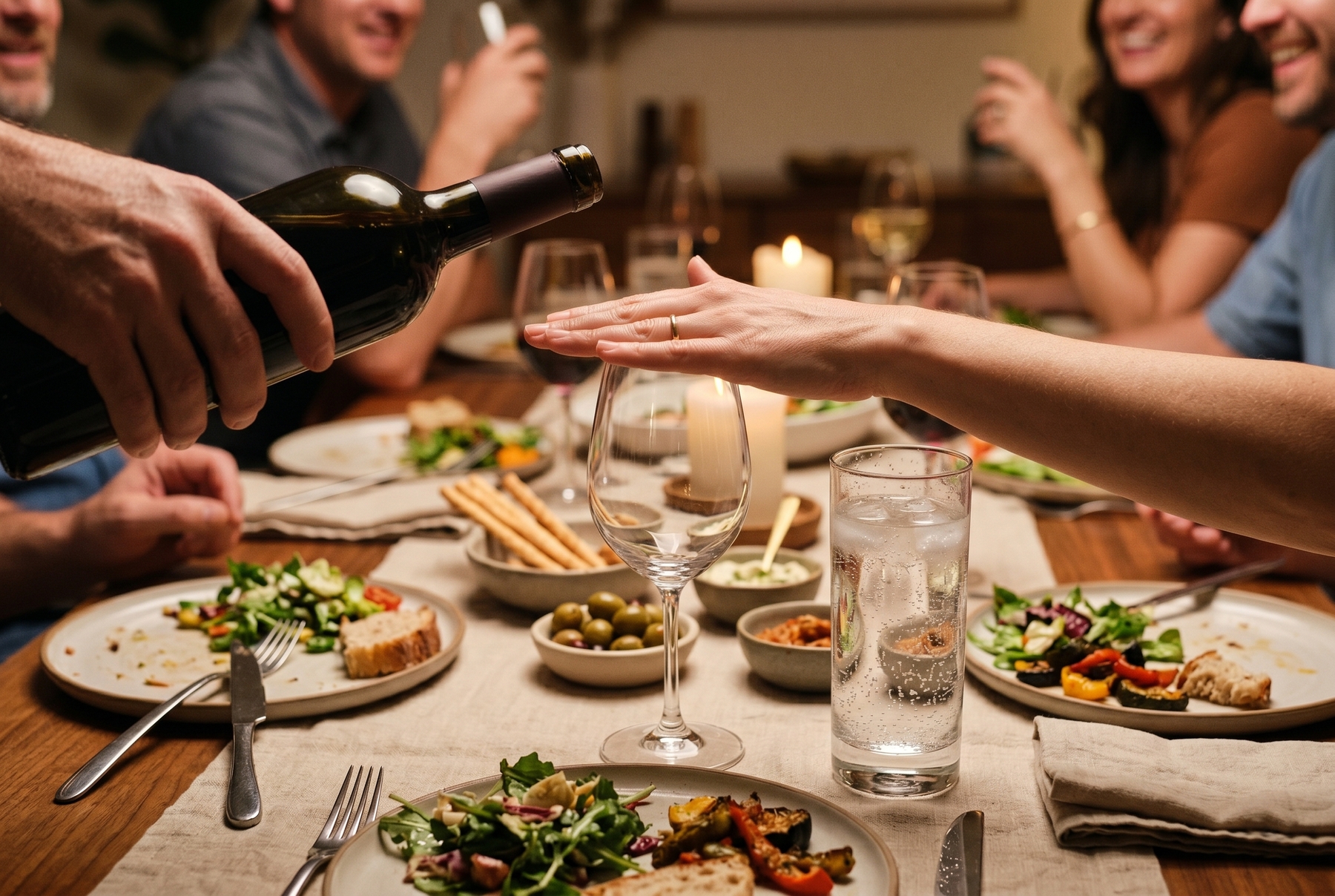
A simple gesture of covering the glass with your palm helps politely decline another serving of alcohol without unnecessary words.
If the Hosts Continue to Persuade You
Sometimes a soft refusal fails on the first try. The broken record method works then. You repeat the same calm phrase, without changing it or adding new arguments. ‘Thank you, I really have had enough.’ A minute later, again: ‘I truly have had enough, it is very delicious.’ Without irritation, in an even tone. There is nothing to argue with, and the pressure fades on its own.
Simultaneously shifting the focus to gratitude helps. Praising a specific dish, asking for a recipe, noting how cozy the table is, or offering to help clear the plates works beautifully. The host does not actually need you to burst. They need to feel like a good host. Giving them this feeling in another way solves the issue.
Special mention goes to cases where being firmer is appropriate. Persistent pushing of alcohol, medical restrictions, religious reasons, personal sobriety, or intrusive comments about your body and weight require boundaries. A direct ‘no, thank you’ without an apologetic smile is perfectly normal here. Warmth does not have to be endlessly accommodating.
How to Prepare in Advance
Half the battle is won before you cross the threshold.
- Arriving extremely hungry is a mistake. Self-control works worse under intense hunger: the body demands, and there is almost no capacity for calm choices. Having a light snack an hour before leaving reduces the risk of leaning on everything in sight.
- Devising a single refusal phrase in advance helps. A prepared formulation removes anxiety: there is no need to invent an answer the moment five people are looking at you.
- Warning about important matters prior to the visit is wise. Allergies, intolerances, pregnancy, medications, religious restrictions, or avoiding alcohol are easily communicated. One short message to the hostess the day before removes half the awkwardness at the table. Just the facts, without long excuses.
- Bringing something of your own, if appropriate, is a great strategy. Not as a statement that ‘your food does not suit me’ — simply as a contribution to the shared table. Additionally, you will have something on the table that you can eat with peace of mind.
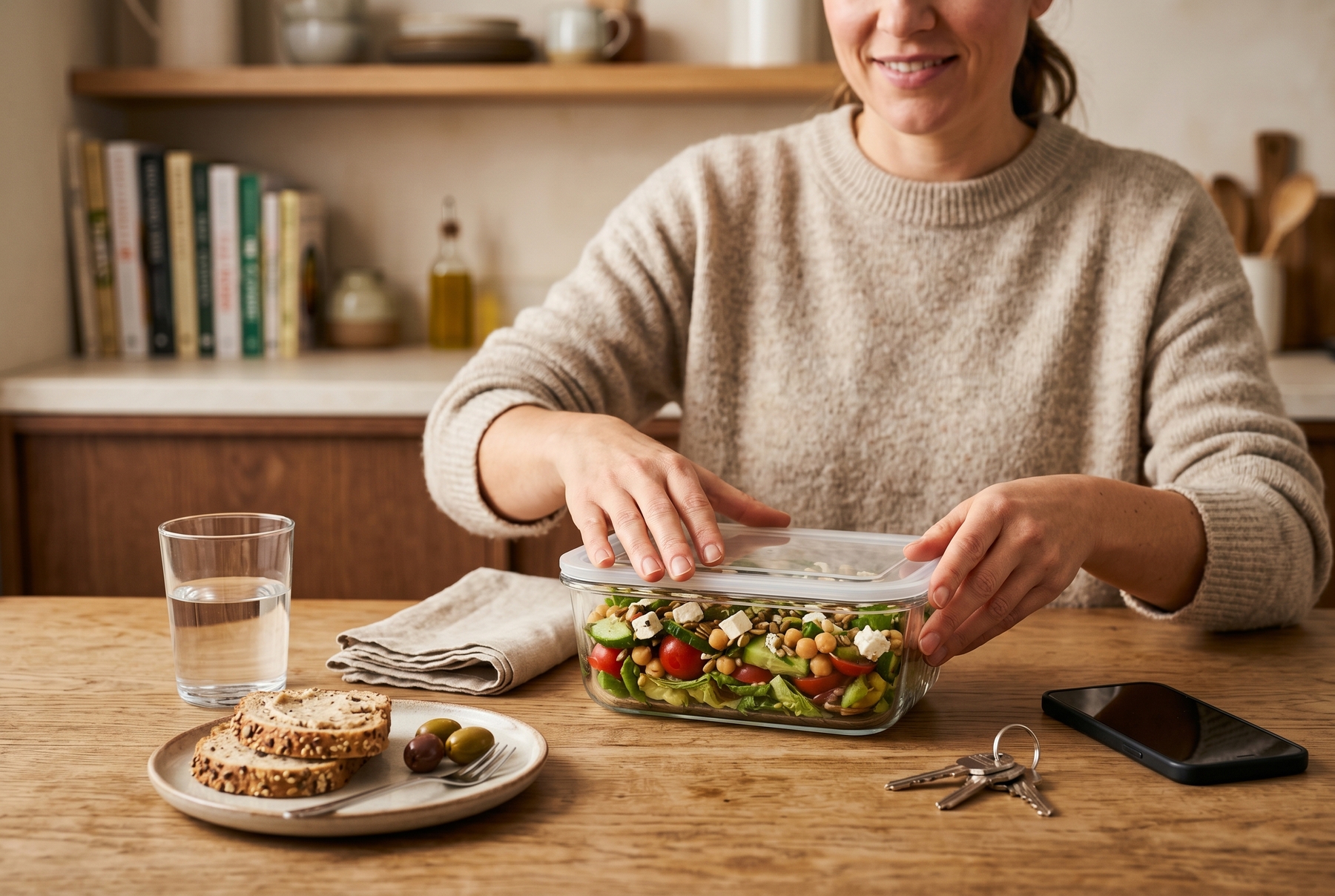
Having a light snack before heading out or preparing your own dish to bring along is an excellent way to avoid overeating at a shared table.
What to Say in Typical Table Situations
A cheat sheet for the most frequent table situations when your tongue sticks to the roof of your mouth.
- They offer a second portion. ‘It is very delicious, but I am already full. I will gladly just sit like this.’
- They insist on dessert. ‘It absolutely will not fit right now. Can I wrap it up to go? I will finish it at home with tea.’
- They pour without asking. Covering the glass with your palm exactly as they reach with the bottle and saying calmly: ‘Water for me, thank you.’ The gesture works faster than words.
- They say ‘I tried so hard, and you are not eating.’ Acknowledge the effort without giving in to the portion: ‘I see how much you invested, and it is truly delicious. I am simply full.’
- They joke about your refusal. Do not get drawn into an argument. Smile and redirect the topic: ‘But I am your conversationalist for the whole evening. Tell me about this sauce, what is in it?’
Gratitude Is Not Measured in Plates
One can be a warm, attentive, truly engaged guest without eating by force. These things are not connected.
Praising specifically makes a difference. ‘Everything is delicious’ sounds polite and empty. ‘This pie has a very tender filling,’ or ‘the sauce brought the whole dish together perfectly’ sounds like genuine attention, and the host hears it. Specific praise is more valuable than a third eaten portion.
Connection at the table is born in a look, a shared question, laughing at a joke, or readiness to help with the dishes. Food has almost nothing to do with it. A guest who talks animatedly over a half-empty plate is more pleasant for the host than a silent person who finishes a salad out of a sense of duty.
Why Declining Is Beneficial to the Hosts Themselves
Hospitality has a flip side that is rarely spoken out loud. A good host does not overfeed a guest to the point of immobility. A guest feels free with them: they can eat, not eat, pour water, and still belong. Your calm refusal subtly teaches this to both the table and the house.
Keeping the cultural background in mind with respect is important. In many families in Russia and CIS countries (Commonwealth of Independent States), a generous table is a long-standing language of love, partly grown from the memory of times when abundance on the table was a value and a source of pride in itself. Feeding meant caring. Therefore, persuasion at the table more often stems from sincere warmth rather than tactlessness. Understanding this makes it easier not to get angry at ‘you barely ate a thing’ and to answer gently. At the same time, the family habit of one house does not equal a rule for everyone: generalizing here is unnecessary.
One prepared phrase. A short pause before a second helping. A calm ‘thank you, I am already full,’ spoken while making eye contact and smiling. And next to the plate stands a glass of water, which no one is rushing to top up anymore.
0 comments