
After twelve years behind the stove, from Paris to Moscow, people often ask me about a chef’s ultimate secret. They seek a single hidden gesture that turns an ordinary chicken into a restaurant masterpiece. The truth is simple: a single secret ingredient does not exist.
Instead, there is the habit of paying close attention. Heston Blumenthal, Gordon Ramsay, and a dozen other television personalities became famous not because they invented culinary alchemy. They taught a massive audience how to look at food: noticing exactly how meat browns, understanding why a sauce coats the back of a spoon rather than spreading into a puddle, realizing why a plate needs acid, and discovering why salt works its magic long before a dish reaches the table. Below are 20 culinary principles that one can test by hand tonight, far removed from quotes or television memes about raw beef.
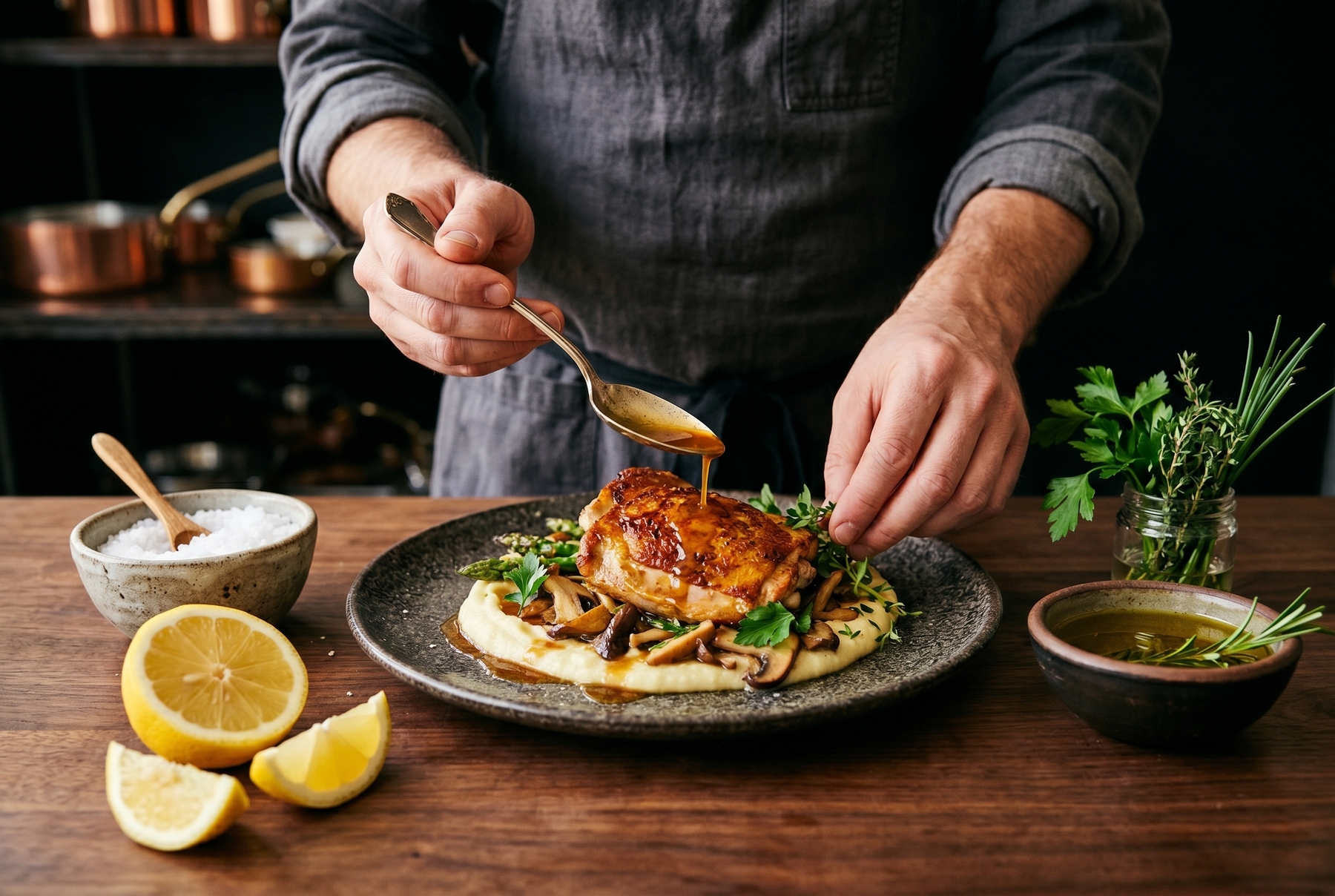
Professional plating combining rich sauce, silky puree, and a crispy crust transforms an ordinary dinner into a restaurant masterpiece.
Table of Contents
- Chefs Offer the Habit of Observation, Not Just Tricks
- Secret 1: Flavor Comes Together in Layers
- Secret 2: The Crust Is an Independent Flavor
- Secret 3: Salt Anchors the Flavor of the Entire Dish
- Secret 4: Acid Cuts Through Heaviness and Focuses Flavor
- Secret 5: Fat Carries the Aroma
- Secret 6: Texture Is as Important as Taste
- Secret 7: Cooking Temperature Is the Main Invisible Ingredient
- Secret 8: Resting After Cooking Is Part of the Cooking Process
- Secret 9: Fewer Ingredients Mean More Control
- Secret 10: Sauce Ties the Dish Together
- Secret 11: A Dish Is Assembled, Not Dumped
- Secret 12: Umami Gives a Dish Depth
- Secret 13: Vegetables Cannot Be Cooked Haphazardly
- Secret 14: The Knife Decides More Than It Seems
- Secret 15: A Recipe Is a Map, Not an Autopilot
- Secret 16: Mistakes Reveal What Happened to a Dish
- Secret 17: Temperature Contrasts Make Food More Expressive
- Secret 18: Simple Food Benefits From Precise Timing
- Secret 19: Take the Idea From the Restaurant, Not the Pretension
- Secret 20: The Main Lesson From These Chefs Is to Cook Mindfully
- Practical Cheat Sheet for the Home Kitchen: What to Do Tonight
- What Should Not Be Romanticized
Chefs Offer the Habit of Observation, Not Just Tricks
A chef’s advice almost always mutates in retelling. Television requires drama, which means an hour of quiet work gets edited down to shouting and flames. Social media demands “one trick that will change your cooking,” compressing complex techniques into fifteen seconds and losing all meaning along the way. Genuine kitchen work is boring for the camera. It relies on consistency: ensuring that yesterday’s sauce and tomorrow’s sauce turn out exactly the same. Behind every big name stands a system rather than a magic trick. This system is exactly what we are discussing.
Why I Will Not Attribute Every Technique to a Single Person
Honesty is necessary here. Most of the techniques currently associated with a specific chef existed in classical cuisine decades before the first television show. Low-temperature cooking was not invented yesterday, nor did it originate on British television. Therefore, I will avoid stating who popularized what or who made a technique visible to the general public. In most cases, establishing exactly who owns an idea is simply impossible. Your frying pan certainly does not care either way.
Secret 1: Flavor Comes Together in Layers
A frequent home cooking mistake happens when someone cooks for forty minutes but salts and seasons only once at the very end, when it is too late for a rescue. A professional chef seasons along the way. Salting onions at the start, tasting the broth after adding vegetables, and adjusting a stew before covering it with a lid all make a difference.
Salt incorporated early has time to penetrate the ingredient and distribute evenly. Salt tossed in at the finale sits on the surface and hits the tongue as an isolated, harsh spot. The difference in taste is enormous. The rule is straightforward: tasting should happen not only at the end but after every key step. Soup, stew, pasta, or sautéed vegetables each have two or three points where stopping to taste a spoonful makes perfect sense.
Secret 2: The Crust Is an Independent Flavor
When the surface of meat or vegetables browns, it triggers a reaction that gives birth to hundreds of new aromatic compounds. This creates that nutty, roasted, meaty depth that makes fried food so appealing. A gray, boiled piece of meat lacks this flavor entirely, no matter how much salt it receives.
Achieving this crust requires several conditions to align. A dry surface on the ingredient is essential (patting meat dry with a paper towel removes moisture that hinders searing). A thoroughly preheated pan is crucial (a drop of water should gather into a bead and race across the bottom rather than spreading). Overloading the pan ruins the process: placing three pieces instead of six prevents the temperature from plummeting and generating steam. Leaving the ingredient untouched for the first minute and a half allows the crust to form. Auditory and olfactory cues indicate readiness: a steady sizzle without screeching, a roasted aroma, and a color shifting from golden to amber. Gray steam rising above the pan means the food is boiling rather than frying.
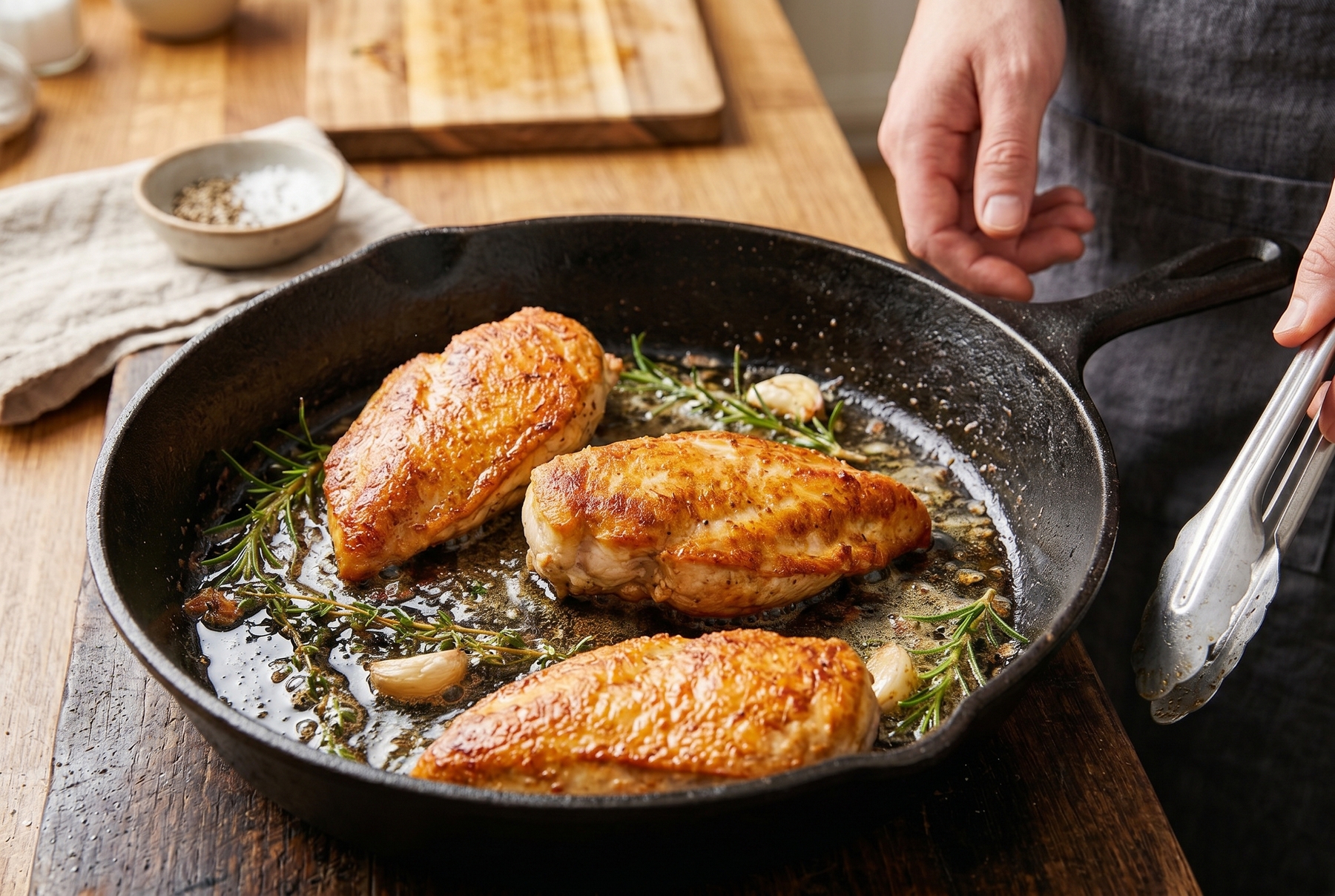
The Maillard reaction in action: achieving a golden crust requires not overcrowding the pan and giving the ingredient time to sear.
Secret 3: Salt Anchors the Flavor of the Entire Dish
An under-salted dish tastes flat, even if it contains a mountain of spices. This confuses many cooks: sensing that something is missing, a person might toss coriander, paprika, or oregano into the pot. What was actually missing was salt. Salt pulls sweetness out of a tomato, makes meat taste meatier, and enhances the aroma of spices that would otherwise just taste like dust.
Salting slightly at every stage is the right approach: seasoning meat before searing, salting vegetables during the process, and ensuring dough, pasta water (which must be noticeably salty, otherwise the pasta itself remains bland), and final sauces are well-seasoned. Trying to replace salt with soy sauce or bouillon cubes is a common mistake, often done without realizing that it changes the entire flavor balance rather than just the saltiness. Bringing the salt level up to par comes first. Thinking about the rest follows.
Secret 4: Acid Cuts Through Heaviness and Focuses Flavor
Taking a rich soup or a fatty stew that feels like it lacks something and adding a few drops of lemon juice or vinegar brings the dish to life. The fat becomes lighter, the flavor finds focus, and a flat picture suddenly gains dimension.
Lemon is not the only source of acidity. Vinegar, wine, tomatoes, sauerkraut, sour cream, and pickle brine all play this role. A spoonful of cucumber brine elevates a meat sauce, sauerkraut acts as a sour accent against fatty foods, sour cream carries the entire flavor profile of borscht (traditional beet soup), and a lemon wedge saves fried fish. Overpouring is the only danger. Good acidity does not shout or jump to the forefront. One barely notices it on its own, but without it, the dish immediately loses its luster.
Secret 5: Fat Carries the Aroma
Fat was labeled an enemy for decades, entirely without merit. In the kitchen, it acts as transportation for aroma. Dropping garlic into cold oil and heating it slowly allows the oil to absorb the garlic essence and distribute it throughout the dish later. The same principle applies to herbs, spices, and citrus zest.
Every fat speaks in its own way. Butter offers sweetness and that signature velvety texture to a sauce. Olive oil pulls a grassy bitterness. Chicken fat and ghee withstand high heat and deliver a deep, comforting aroma. The fat left over from rendering bacon or searing meat is never discarded; it is used for subsequent cooking steps as a free flavor concentrate. There is one caveat: fat does not fix bad technique. It merely amplifies what is already there. A spoonful of butter on overcooked meat will only result in greasy overcooked meat.
Secret 6: Texture Is as Important as Taste
Asking oneself why the exact same dish feels more interesting in a restaurant than at home often reveals that texture is the answer. A plate featuring crunch and creaminess, softness and chewiness, heat and coolness delights the tongue, and the brain registers this as deliciousness.
At home, contrast is achieved through inexpensive techniques. A handful of breadcrumbs toasted with herbs over a casserole works wonders. Chopped nuts in a salad, fresh greens added at the last second, quick-pickled vegetables paired with fatty meat, or crispy fried onions on mashed potatoes all elevate a meal. The core principle remains simple: if everything on the plate shares the same consistency (all soft or all smooth), introducing one contrasting element changes everything. Creamy puree next to a piece of meat with a crust always performs better than either component alone.
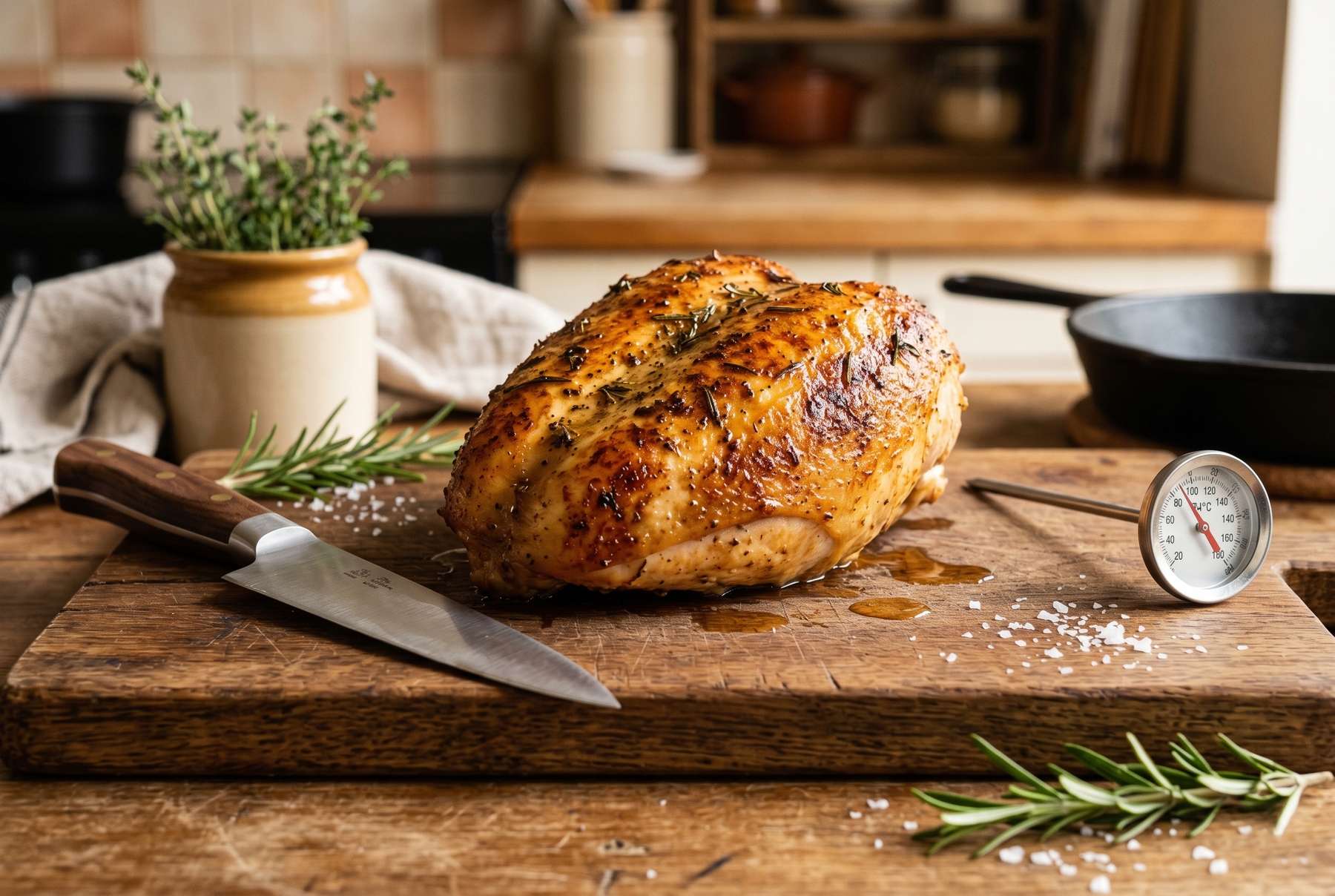
Using a meat thermometer and allowing a mandatory rest after cooking lets juices distribute evenly throughout the muscle fibers.
Secret 7: Cooking Temperature Is the Main Invisible Ingredient
A chef manages more than just the flame under a pan. They keep track of the ingredient’s internal temperature, the preheating of the cookware, and the residual heat that continues cooking the dish off the stove. A cold steak straight from the refrigerator thrown into a pan burns on the outside while remaining icy in the center. Fish sticks and tears on an underheated skillet. Eggs curdle into rubber when the heat is too fierce.
Over years of work, seeing excellent meat fail due to a cold pan and panic at the stove becomes a familiar sight. Rushing to place a piece of meat on barely warm metal causes it to leak water, resulting in stewing instead of searing. Pulling meat from the refrigerator thirty to forty minutes in advance, thoroughly heating the pan, and remembering that the internal temperature continues to rise after leaving the heat are essential practices.
Secret 8: Resting After Cooking Is Part of the Cooking Process
Removing meat from the heat does not mean it is finished. The juices inside the cut are concentrated in the overheated center at that moment. Slicing immediately causes those juices to bleed onto the cutting board, leaving the meat dry. Letting it rest for five to ten minutes allows the juices to redistribute throughout the muscle fibers.
This applies to more than just meat. Poultry out of the oven, casseroles, bread, and even syrniki (farmer cheese pancakes) appreciate a few minutes of rest to stabilize. Bread sliced while hot gets crushed and sticks to the knife because steam cooking is still happening inside. The indicators are simple: juices stop actively pooling, the crust stops sizzling, and the piece slices cleanly without being squashed.
Secret 9: Fewer Ingredients Mean More Control
Restaurant cooking often remains minimalistic by design. A great dish relies on three or four precise decisions rather than a long list of seasonings. Mashed potatoes need only potatoes, butter, salt, and a little warm milk, applied at the right time and in proper proportions. An omelet requires eggs, heat, butter, and a pinch of salt. Pasta and roasted chicken follow the exact same logic.
At home, the opposite frequently occurs. When a dish lacks something, the instinct is to add another spice, then another, and another. What is usually missing is one of three foundational elements: salt, acid, or a proper sear. Checking the base before dragging a new ingredient into the pot is crucial. Nine times out of ten, the problem lies right there.
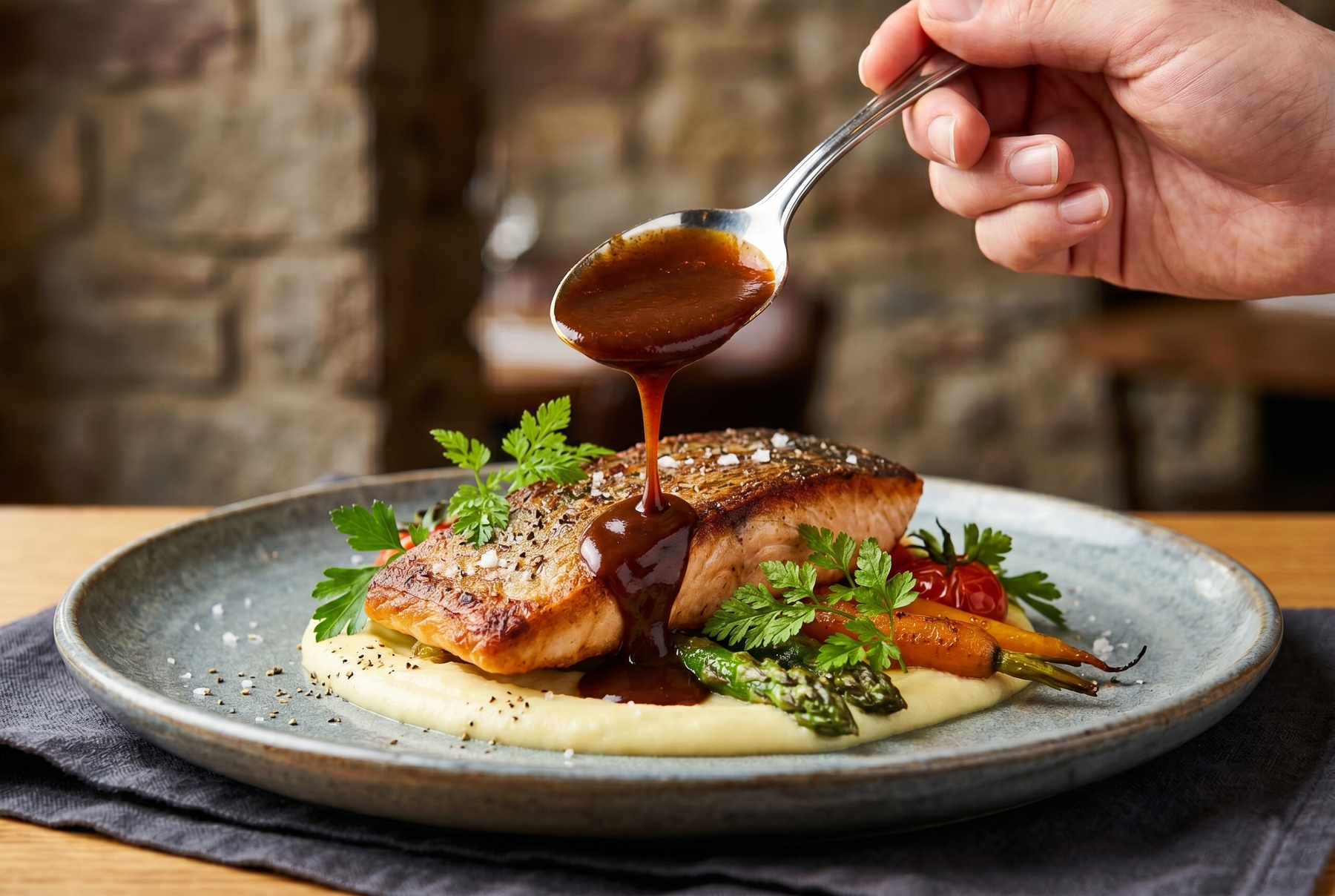
A proper sauce should possess the ideal thickness to coat the food beautifully without spreading into a watery puddle on the plate.
Secret 10: Sauce Ties the Dish Together
A sauce binds the main ingredient, the side dish, and the aroma into a cohesive whole. Any decent sauce comes together through a simple formula: base, fat, acid, salt, and aroma. The base provides body and density, the fat adds smoothness, and the acid brings freshness. Salt pulls everything together, while the final signature comes from aromatics like garlic, herbs, mustard, or pepper.
At home, this takes mere minutes to resolve. A yogurt sauce with garlic and lemon complements fried foods. A creamy mustard sauce pairs beautifully with chicken. A slow-simmered tomato sauce easily beats one quickly stirred with water. The best home sauces are born directly in the skillet where the meat was seared: splashing in a little liquid, scraping up all the browned bits from the bottom, and letting it thicken. A good sauce is never a watery puddle at the bottom of a plate, but a thin coating that clings to the food and slowly slides off a spoon.
Secret 11: A Dish Is Assembled, Not Dumped
The difference between preparing components and assembling a plate affects the taste, not just the aesthetics. Using a warm plate for a hot dish prevents cold porcelain from stealing the heat. The order of layers matters: puree on the bottom, meat on top, and sauce around the edges, rather than drowning everything. Fresh herbs, a drop of high-quality oil, a pinch of salt, and freshly ground pepper added at the very last second make all the difference.
It is easy to slip into snobbery here, but this is not about tweezers and microgreens. Assembly works on a physical level. Herbs placed on top smell closer to the nose, ensuring immediate impact. Sauce distributed thinly reaches every bite rather than just the first spoonful. Crunch added at the finale stays crisp instead of getting soggy. These steps often take less than a minute but noticeably transform the plate.
Secret 12: Umami Gives a Dish Depth
The word umami represents a simple concept: a meaty, rich depth of flavor. Aged cheeses, mushrooms, tomatoes, meat broth, soy sauce, fish, and fermented products provide it. When people say a dish “lacks richness,” umami is usually exactly what is missing.
Depth is easily achieved at home. Grating a little Parmesan into a vegetable soup stops it from tasting hollow. Tossing a handful of dried mushrooms into a sauce allows them to release their savory flavor. Toasting tomato paste in a dry pan or in oil for a couple of minutes before adding liquids transforms it (dissolving it raw yields a completely different, flat taste). A spoonful of toasted tomato paste elevates a stew much more noticeably than half a jar of assorted spices.
Secret 13: Vegetables Cannot Be Cooked Haphazardly
For a long time, home kitchens treated vegetables with a single scenario: throwing them into boiling water and cooking them to total mush. Restaurant cooking demonstrated that every vegetable has its own texture, sweetness, bitterness, water content, and starch, demanding varied approaches.
Roasting concentrates sweetness: carrots or cauliflower in the oven develop caramelized edges. Blanching (a brief boil followed by rapid chilling) preserves the color and crunch of green beans and broccoli. A quick sear over high heat keeps the vegetable firm inside rather than turning it to mush. Caramelizing onions requires patience: true golden onions take much longer than the five minutes often cited, cooking slowly until they smell sweet, almost like jam. The main mistake is reducing everything to the same characterless softness.
Secret 14: The Knife Decides More Than It Seems
This is not about expensive knives, though a few old carbon-steel blades often outperform any novelty. It is about the cut. Slicing affects cooking speed, juiciness, and even how a dish is perceived on the palate.
Diced onions melt into a sauce. The same onion sliced into half-rings holds its shape and provides texture in a roast. Large chunks of carrot in soup release sweetness slowly, while thin julienne cooks in minutes and behaves entirely differently. Herbs chopped with a sharp knife in a single motion fare much better than those bruised with a dull blade (bruised herbs leak their juices onto the board, darken, and lose their aroma before even reaching the plate). The exact same carrot, cut in two different ways, yields two different dishes.
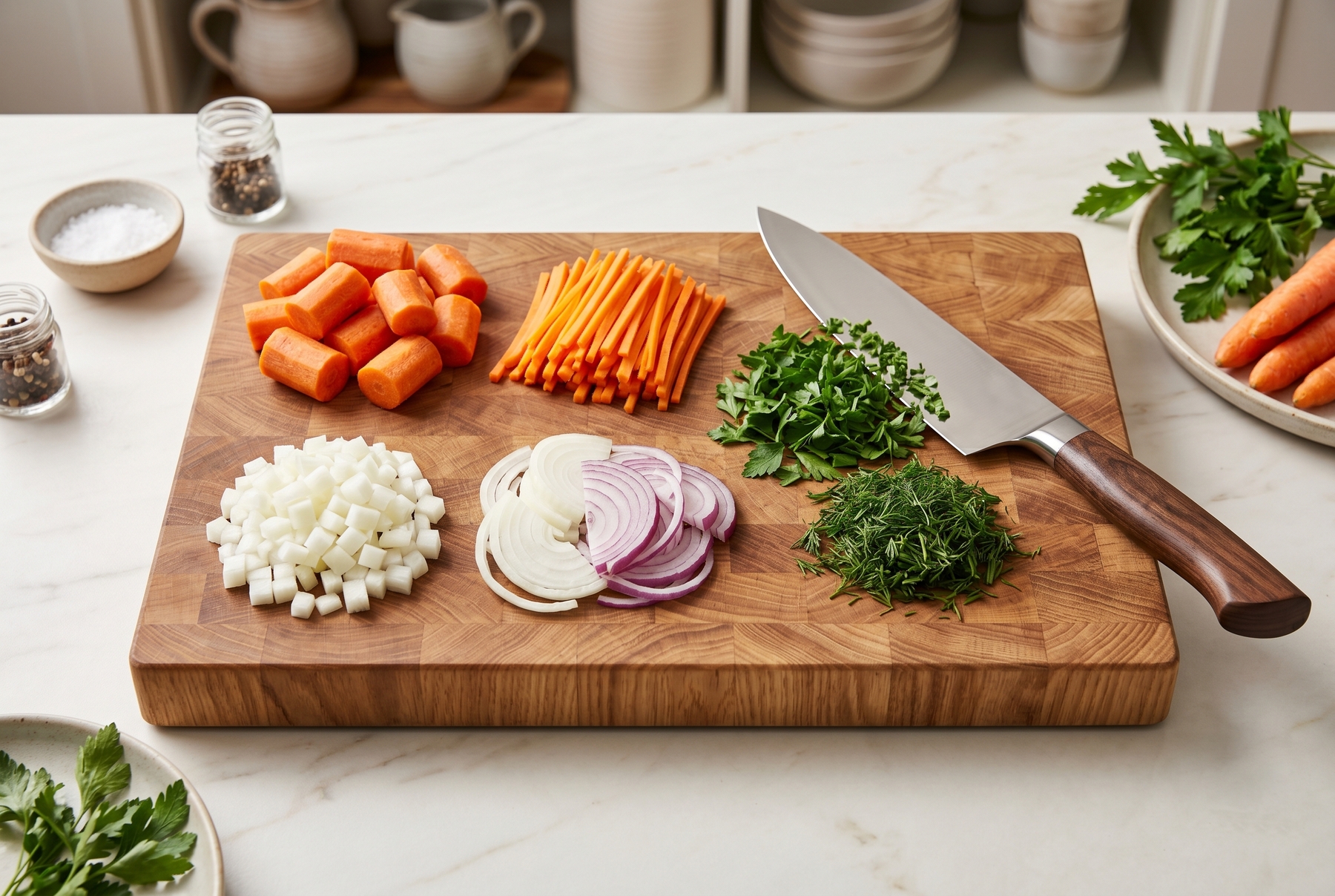
Mastering knife skills impacts aesthetics as well as cooking speed: uniformly chopped pieces cook evenly at the exact same time.
Secret 15: A Recipe Is a Map, Not an Autopilot
Great chefs do not stand with a stopwatch, blindly counting the minutes. They read the signs of readiness. This is the most useful skill a home kitchen can adopt from them.
The minutes in a recipe serve as a guideline, not a law. They were written for one specific stove, one particular pan, one size of meat, and one level of humidity. Everything in your kitchen is different. Learning to read the signals is vital: watching the color shift from golden to amber, smelling the roasted aroma over the raw, listening for a lively sizzle instead of a sluggish bubble, feeling the resistance when pressed with a finger, checking the thickness of a sauce on a spoon, and observing the behavior of bubbles in a pot. A recipe might say “boil for 20 minutes,” but the pot tells the truth in real time. Listening to the pot is always the better choice.
Secret 16: Mistakes Reveal What Happened to a Dish
A chef never panics over a flawed dish. They look for where the flavor broke down. Oversalted, overcooked, watery, acidic, flat, or greasy: every disaster has a cause and often a cure. Here is a brief cheat sheet for culinary emergencies:
- Flat and empty — Lacking salt or acid. Start with salt, then add a drop of lemon or vinegar.
- Too greasy or heavy — Introducing acid cuts right through the fat.
- Too acidic — Balancing it with a pinch of sugar or a spoonful of fat (cream, butter) works wonders.
- Watery — Reducing it over high heat without a lid or incorporating a thickener solves this.
- Oversalted — Diluting the volume (broth, water, more vegetables) helps, while potatoes in a soup absorb some of the salt.
- Overcooked and dry — Unfortunately, moisture cannot be returned, but rescuing the meat with a sauce or repurposing it into a filling, stew, or pâté is always an option.
Not every mistake can be reversed, but almost every failure can be turned into a different dish.
Secret 17: Temperature Contrasts Make Food More Expressive
Hot boiled potatoes pair beautifully with a spoonful of cold sour cream. A warm pie contrasts perfectly with a scoop of melting ice cream. A steaming bowl of soup benefits from a handful of cold fresh greens sprinkled on top. Fried fish finds balance next to a cool yogurt sauce.
The mechanics are simple. When hot meets cold, the contrast is immediately felt on the tongue: the warmth projects a stronger aroma, while the cold feels fresher. There is no need to overcomplicate things and delve into thermodynamics. Simply remembering that a monotonous dish instantly revives when a contrasting temperature is introduced is enough.
Secret 18: Simple Food Benefits From Precise Timing
The most chef-like results in a weekday kitchen start with the boring details: a timer, a resting bowl for finished items, pre-chopped and organized ingredients, and a clean workspace free of clutter.
Fried eggs, chicken breasts, rice, pasta, cutlets, and crepes are all dishes where seconds count more than intuition. A chicken breast dries out in a single extra minute. Pasta goes from al dente to mush in ninety seconds. Slightly overcooked rice loses its appeal entirely. Having a timer nearby, prepared ingredients ready, and a designated spot for finished items transforms chaotic rushing into controlled execution. Half of restaurant magic is simply maintaining an organized workspace.
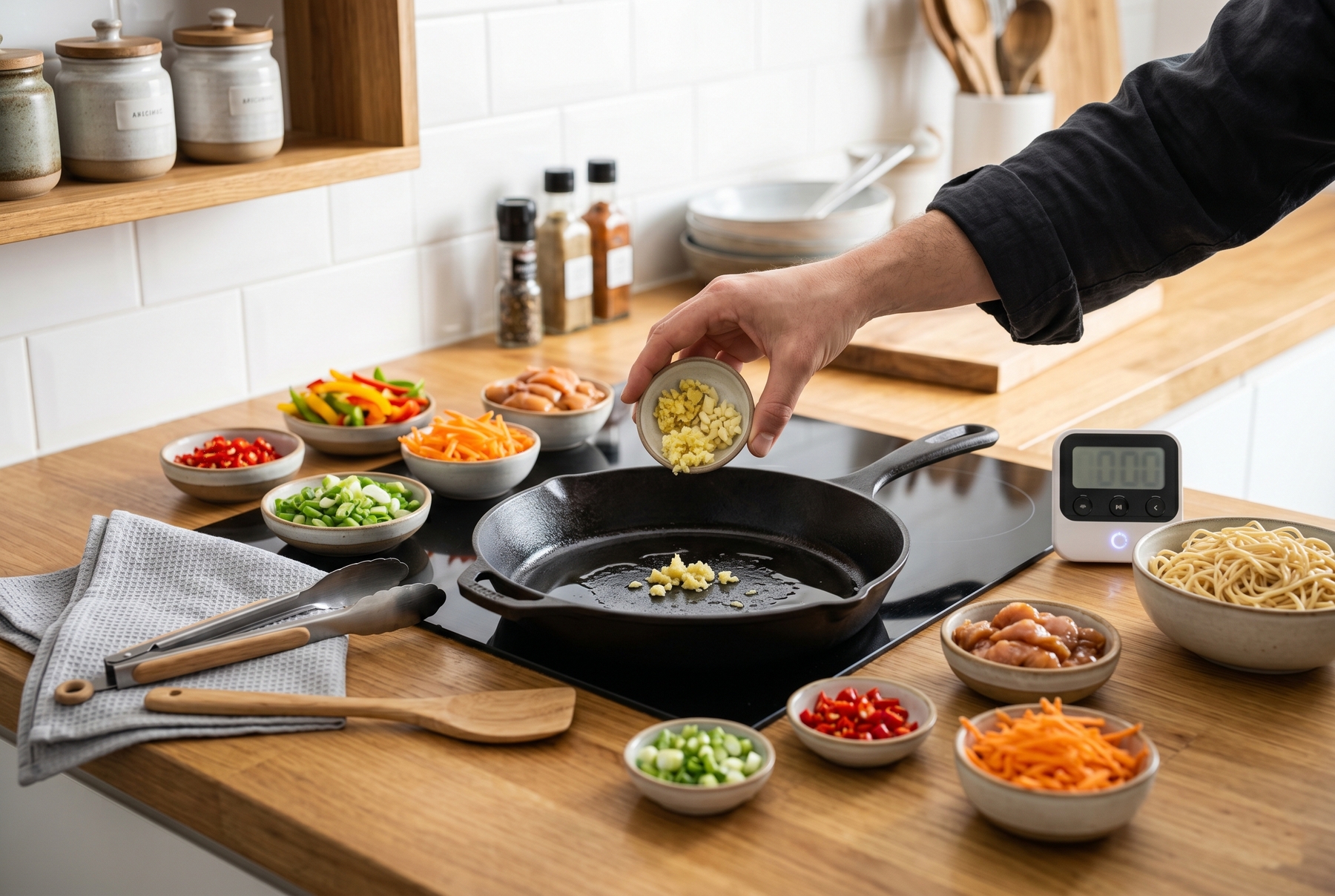
Mise en place is the secret to stress-free cooking. When ingredients are prepped in advance and a timer is handy, results are predictable.
Secret 19: Take the Idea From the Restaurant, Not the Pretension
There is no need to imitate foams, smoke escaping from under glass cloches, tweezer plating, or five-component towers at home. These elements either have zero impact on taste or require specialized equipment. What a home cook should adopt from restaurants are the underlying principles. Balancing salt and acid, concentrating flavors, playing with textures, managing precise timing, and keeping the presentation clean without unnecessary clutter matter most.
Honestly, food snobbery is exhausting. Great cuisine does not start with tweezers and microgreens. It starts with potatoes that are not watery, meat boasting a proper crust, and sauce that beautifully coats the back of a spoon. Mastering these fundamentals makes any microgreen an optional decoration rather than a desperate rescue for a mediocre dish.
Secret 20: The Main Lesson From These Chefs Is to Cook Mindfully
Boiling everything down to a single point, different masters taught the world various things. Some demonstrated that cooking has physics that can be understood rather than memorized. Others instilled a demand for speed and exacting standards, refusing to tolerate sloppy work. Still others simply taught respect for the ingredient and its origins.
In a home kitchen, this quickly turns into practical application. A good cook does not merely copy a culinary idol’s gestures. They understand the reason behind every step: why salt goes in now, why waiting for a crust is necessary, and why pulling a pan off the heat earlier than expected makes sense. Learning the “why” is far more valuable than mimicking a signature flick of the wrist.
Practical Cheat Sheet for the Home Kitchen: What to Do Tonight
Keeping all 20 principles from becoming mere theory is easy when categorized into three simple blocks.
Before Cooking
- Ensuring salt, acid, and fat are within reach.
- Taking meat out of the refrigerator in advance.
- Planning the texture: figuring out what will provide crunch or freshness.
- Deciding on the cut based on the dish.
- Preheating cookware thoroughly.
During Cooking
- Listening to the sound of searing and watching the color.
- Tasting in stages, not just at the finale.
- Avoiding overloading the pan.
- Leaving the food untouched to allow the crust to form.
- Relying on signs of readiness rather than minutes from a recipe.
Before Serving
- Adding freshness, crunch, or a touch of acid.
- Allowing meat, poultry, or baked goods to rest.
- Assembling the plate mindfully: using warm dishes, ordering layers correctly, and keeping sauce around the edges.
- Finishing with a pinch of salt and freshly ground pepper at the very last second.
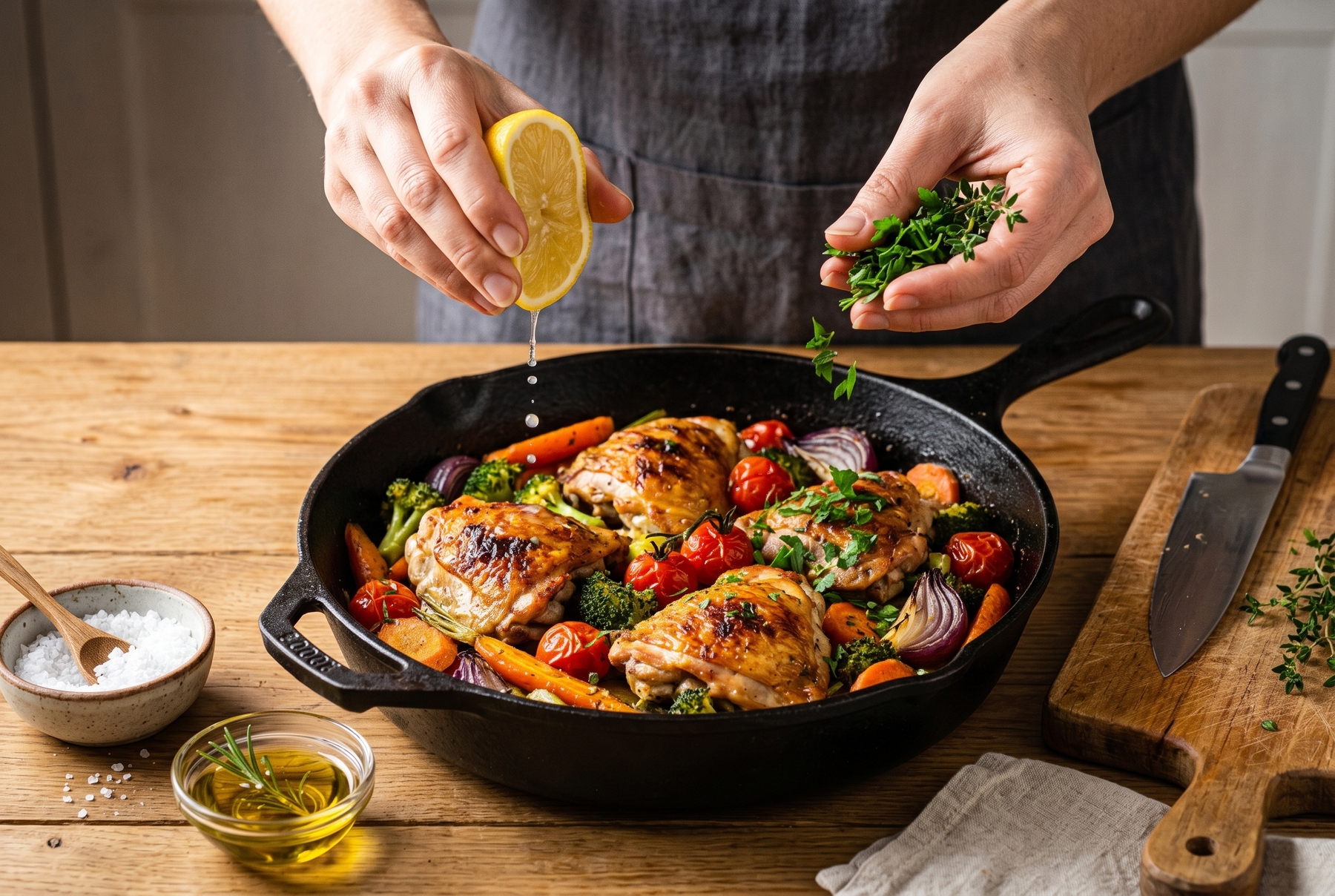
Adding a squeeze of lemon juice and fresh herbs at the last second is a simple way to brighten flavors and cut through heavy fats.
What Should Not Be Romanticized
Famous chefs are neither saints nor the sole source of culinary wisdom. Most of the techniques that brought them fame appeared long before television shows, restaurant empires, and cookbooks bearing their names. They gathered, polished, and explained these methods to the public in accessible language, which deserves gratitude. However, turning cooking into a cult of personality is unnecessary.
The secrets of great chefs cease to be secrets the moment they are translated into the language of one’s own kitchen. Cooking exactly like a three-star restaurant is not required. Simply understanding why a pan must be hot, why a sauce should coat a spoon, and why salt is needed throughout the process makes all the difference. Dropping a little water onto a heated skillet and watching it gather into a bead that races across the bottom signals that the meat is ready to hit the pan.
0 comments