
Opening the freezer and taking an honest look inside often reveals that half the contents resemble good intentions rather than food. ‘I will make broth someday.’ ‘These berries will be useful in winter.’ ‘It is a pity to throw away these herbs.’ Every single bag seemed like a rational decision at the time, but now it is simply frozen to the back wall, waiting for its turn in the trash bin.
Home freezing is justified only when the thawed product becomes food again, when it saves time, or when it adds depth of flavor to a quick meal. Failing all these criteria turns the freezer into a storage unit that costs money to power.
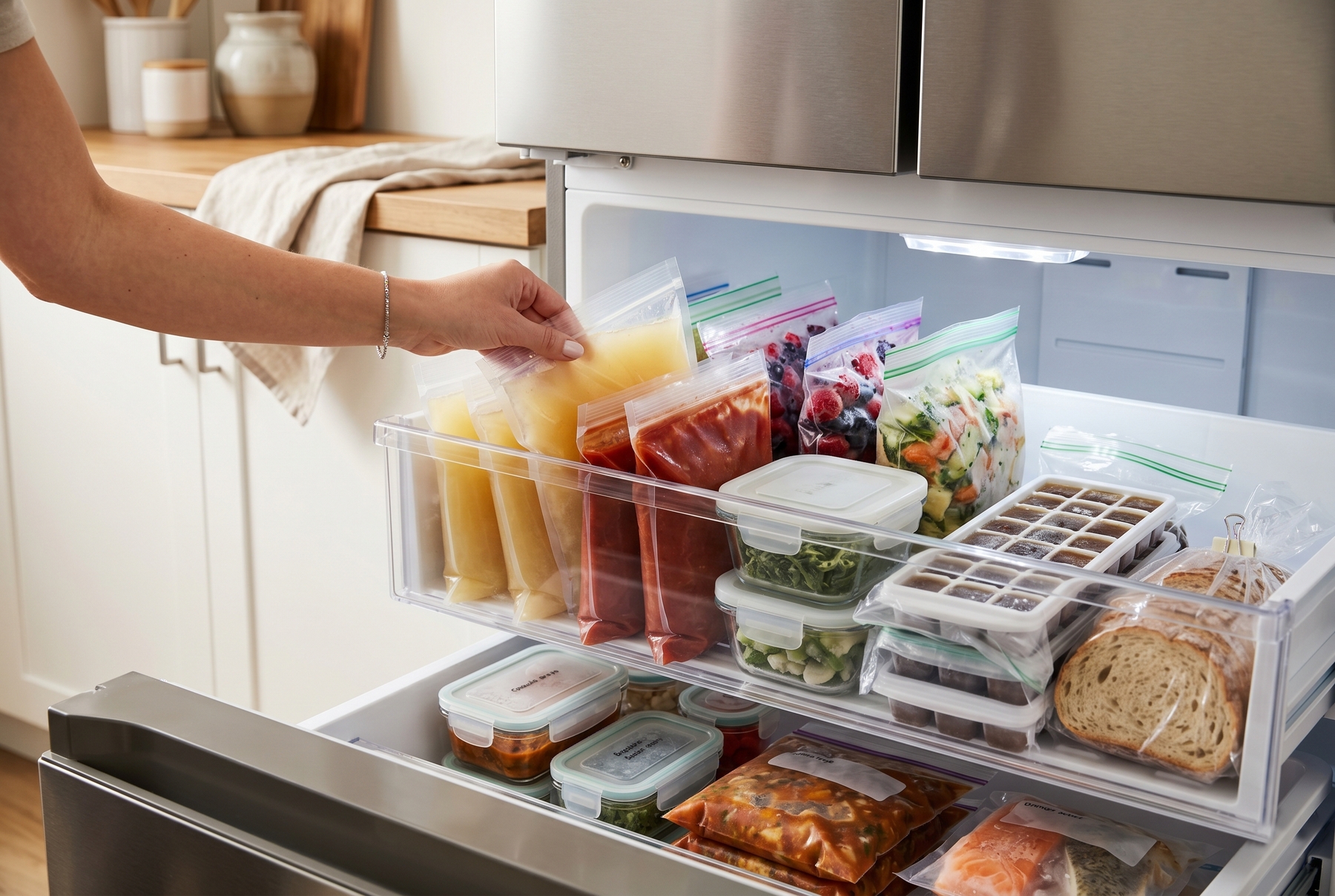
Proper space organization means utilizing flat bags for soups, sauces, and vegetables to minimize footprint while maximizing accessibility.
Table of Contents
- The Freezer Plans for You
- What You Can Freeze With Almost No Debate
- What Can Be Frozen, But Only With a Plan
- What Not to Freeze and What Wastes the Most Space
- How to Store Food in the Freezer: Count Space in Future Dinners
- How to Freeze Food Properly: Safety Without the Health Class Lecture
- The Kitchen Filter: Freeze It or Let It Go
- Ready-Made Kits for Different Cooking Styles
The Freezer Plans for You
The freezer serves as a planning tool. It functions poorly as a second refrigerator. It should only hold items that will save an evening of cooking in the future. Saving something just because ‘it is a pity to throw away’ is a terrible reason.
A great freezer candidate meets several criteria at once. It saves time when energy is low and cooking feels like a chore. It survives the cold without turning into a pale, mushy mess. Knowing exactly which dish it will end up in is crucial. Failing even one test means that the package is simply wasting space.
Self-deception begins when food is frozen ‘just in case’—without portioning, without labels, and without a single thought about its future use. A month later, pulling out a cloudy brick leaves one wondering if it is soup or sauce, and back it goes because figuring it out takes too much effort. This is exactly how freezers get cluttered.
What You Can Freeze With Almost No Debate
Liquid flavor is the best tenant for the freezer and one of the ultimate options for home freezing. Broth, concentrated meat stock, and vegetable bases thrive here. A single cube of golden broth, frozen to a jelly-like consistency, has the power to elevate bland grains or turn pan deglazings into a rich sauce in mere minutes. Freezing these in flat bags, ice cube trays, or small containers works best. A strong concentrate proves much more useful than a liter of watery broth, as it takes up less space and works faster.
Poultry carcasses, bones, and trimmings are also highly useful. Saving the carcass from a roasted chicken yields a beautifully clear broth. However, five unlabeled bags of bones just take up valuable real estate. Accumulating enough for a pot means it is time to make stock rather than storing bones for months.
Sauces, pastes, and prepared bases offer much more convenience than raw ingredients stored separately. Tomato sauce reduced to a thick consistency, pesto (made with less oil than usual, as oil freezes poorly), and curry paste are excellent choices. A sautéed base of onions and carrots—the very foundation of half your meals—is a lifesaver. Tossing it straight into the pan allows cooking to proceed as usual.
Bread, dough, crepes, syrniki (Eastern European cottage cheese pancakes), and vareniki (stuffed dumplings) transition back to the table faster than anything else. A slice of bread thaws on the counter in 10 minutes, or instantly in the toaster. Freezing syrniki and vareniki individually on a board before transferring them to a bag prevents them from sticking together. Portioning them according to a single meal’s realistic consumption makes life much easier.
Berries and fruits freeze best when there is a clear plan for them. A strawberry will not emerge from the freezer tasting fresh; it will weep, and raspberries will collapse. However, they remain perfectly functional for compotes, smoothies, sauces, fillings, or oatmeal. Freezing them loose on a baking sheet before transferring to a bag works perfectly. Deciding their fate immediately—a handful for porridge or a whole bag for a pie—ensures they actually get used.
Compound butter is a brilliant trick when its future use is already planned. Butter mashed with garlic, fresh herbs, and citrus zest, then portioned and frozen, does wonders. Dropping a piece onto hot fish, boiled potatoes, or freshly cooked pasta allows those vibrant green specks to melt across the plate, bringing the whole dish together effortlessly.
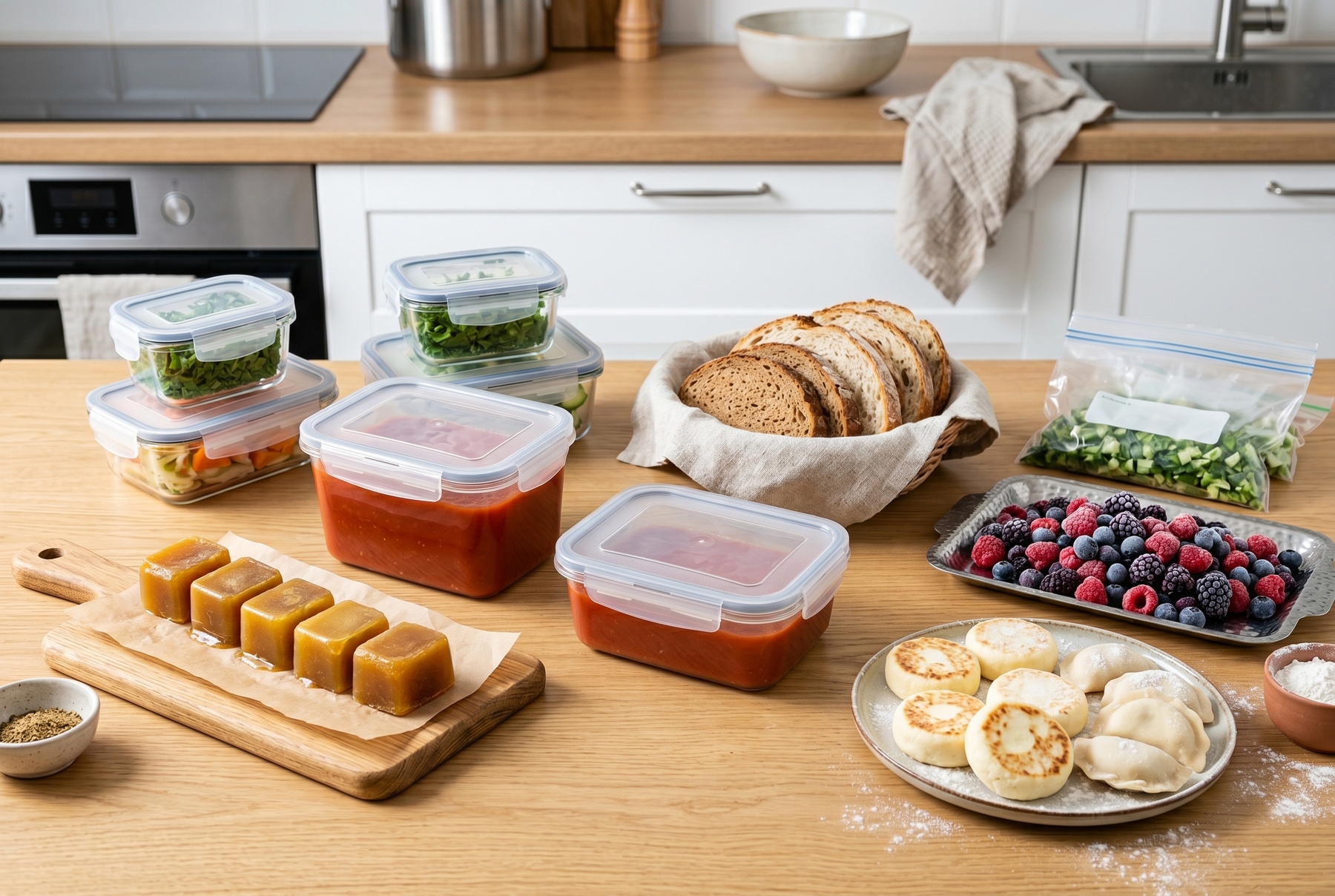
Time-saving prep items include portioned sauces, ready-to-cook syrniki, vareniki, berries for oatmeal, and highly concentrated broth.
What Can Be Frozen, But Only With a Plan
Vegetables destined for the freezer follow textural logic. Bell peppers, zucchini, cauliflower, tomatoes, and herbs easily transition into soups, stews, or sauces after thawing, as their structural integrity no longer matters. They will never return to a salad or act as a fresh side dish, because ice crystals tear their cell walls from the inside out, causing them to release all their water. Blanching (plunging into boiling water for a minute and cooling rapidly) benefits vegetables intended for long-term storage by helping them retain their vibrant color.
Fully cooked meals survive the freezer if they can survive being reheated. Stews, braised meats, stuffed peppers, meatballs, and thick sauces fare beautifully. Caution is necessary with certain items: potatoes in soup turn spongy, cream sauces often separate, mayonnaise-based salads perish completely, and anything crispy loses its crunch forever. Cooling the dish completely before freezing and avoiding reheating the same container twice preserves quality.
Meat and fish only make sense in the freezer when portioned for a future meal. An entire unportioned roast easily turns into a postponed problem. A whole chicken, however, acts as a culinary puzzle: the carcass goes into broth, the legs become a braise, and the breast turns into a quick weeknight dinner. Portions meant for soup, stir-frying, or grinding fit into a meal plan. A random hunk of meat will just sit there until spring.
What Not to Freeze and What Wastes the Most Space
The primary rule is strict: if a specific dish cannot be named for an ingredient right now, it does not deserve the space.
This category includes sad leftovers: two spoonfuls of sauce, half an onion, or a quarter cup of heavy cream. The line between ‘unlocking an ingredient’s potential’ and ‘storing something for three months because throwing it away felt wrong’ is drawn exactly here. A useful portion must be enough to contribute to at least one real meal.
This also applies to anything that loses its primary appeal in the cold: crunch, freshness, juiciness, the delicate emulsion of mayonnaise or hollandaise, or the creamy texture of a soft cheese. While no one forbids freezing them, the result will be entirely different, and it is best to acknowledge this in advance.
Another distinct category includes items that are simply easier to buy. Purchasing a bag of frozen mixed vegetables from the store often makes more sense than juggling three awkward containers of homemade scraps. Accounting for the physical space they consume is just as important as the food itself.
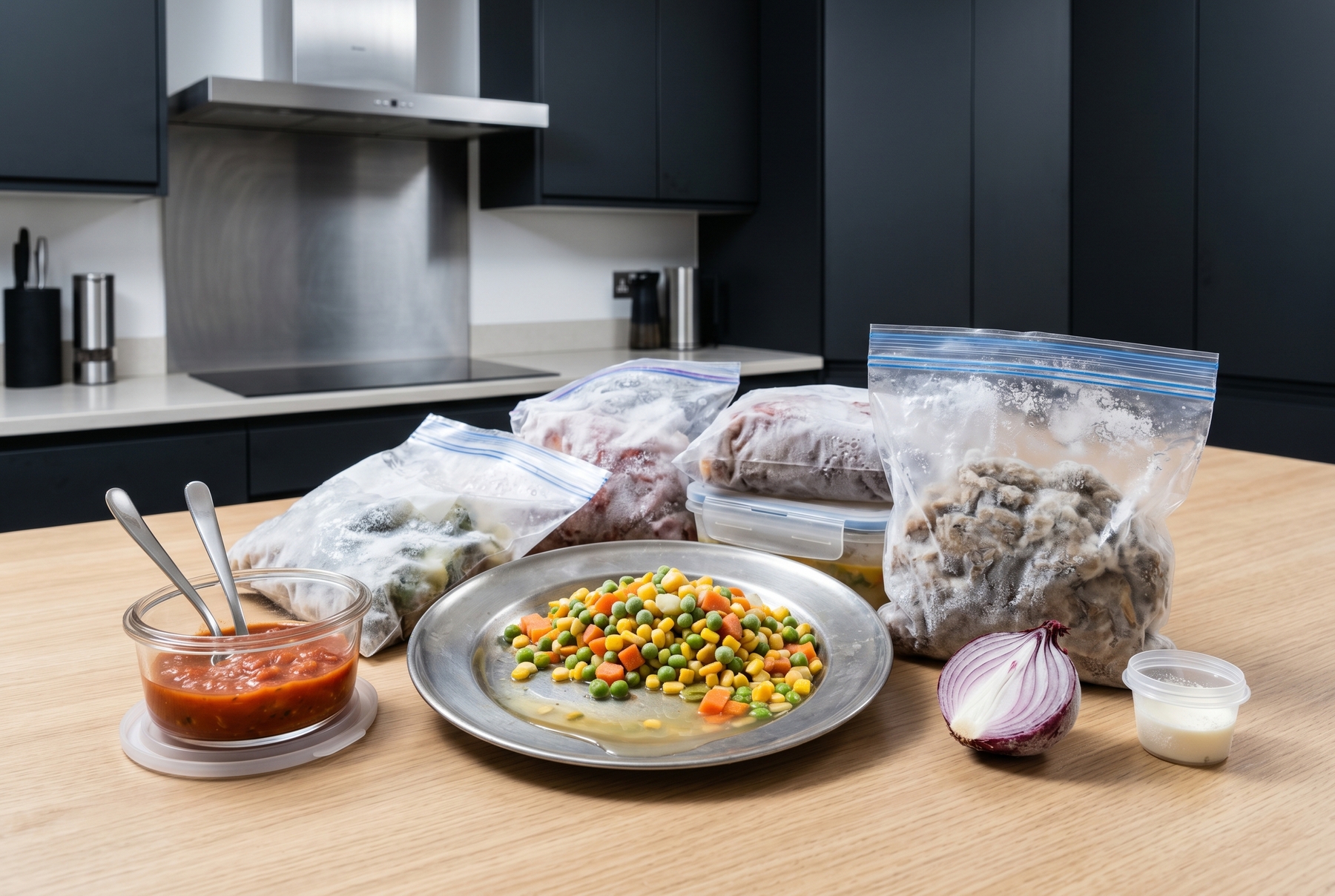
An example of irrational freezer use involves storing random vegetable scraps and unportioned ingredients without a clear meal plan.
How to Store Food in the Freezer: Count Space in Future Dinners
The ultimate frozen product answers one simple question: ‘What can I cook with this in 20 minutes on a busy weeknight?’ If there is no answer, the package is overrated.
One bag means one solution. ‘Ground beef for meatballs’ works better than ‘just meat.’ ‘Soup base’ is infinitely more useful than ‘random vegetables.’
Maintaining order in a small freezer requires a simple hierarchy. Flavor concentrates and quick bases go first, offering the most value per square inch. Next come proteins and semi-prepared items for weeknights, followed by seasonal berries. Only at the very end, if any space remains, is there room for experimental projects.
A flat bag always beats a mountain of containers for freezer storage. Food frozen in a thin layer chills faster, thaws quicker, and stands in the freezer like a book on a shelf rather than a cumbersome boulder. Labeling everything with its contents, freeze date, and intended use is essential. A lively label reads: ‘Chicken broth for risotto,’ ‘Tomatoes for sauce,’ or ‘Herb butter for fish.’ A month from now, that label will be a lifesaver.
Portions must align with actual meals. A literal block of frozen broth is incredibly inconvenient, as it requires thawing entirely even if only a cup is needed. Freezing in cubes or 250 ml (8.5 oz) portions works beautifully. Rotation without obsession keeps things fresh: new items go to the back, pushing the older ones forward. Hosting a ‘freezer dinner’ once a month is much more enjoyable than a guilt-ridden inventory check.
How to Freeze Food Properly: Safety Without the Health Class Lecture
A few things should never be left to chance, because health—not just flavor—is on the line.
Keeping the freezer at -18 °C (0 °F) or below ensures that food remains safe almost indefinitely, as bacteria do not multiply but enter a dormant state. Standard storage times (broths and soups for 2–3 months, ground meat for 3–4 months, bread for about 2–3 months, berries and many vegetables up to 8–12 months) relate to quality rather than safety. Beyond that point, the product will not become dangerous, but it will lose its flavor and texture. A home freezer, especially one attached to a refrigerator, often runs warmer than a standalone chest freezer and gets opened ten times a day, meaning quality degrades faster than textbook charts suggest.
Hot food should never go straight into the freezer. A large, warm pot raises the internal temperature, slightly thawing adjacent packages, while the food itself freezes slowly and loses its texture. Cooling it completely beforehand is crucial. Dividing the dish into flat containers helps it quickly bypass the danger zone (roughly 4 to 60 °C, or 40 to 140 °F, where bacteria multiply most rapidly). As a general rule, warm food should not sit out for longer than two hours.
Safe thawing happens in a few different ways. The refrigerator is the slowest but most reliable method (a large cut takes about 24 hours for every 2 to 2.5 kg, or 4.5 to 5.5 lbs). Cold water works well (keep the product in an airtight bag, change the water every 30 minutes, and cook immediately after thawing). The microwave is another option, provided the food goes straight to the stove afterward. Thawing meat, fish, or poultry on the counter at room temperature poses a risk, as the exterior enters the danger zone while the interior remains frozen solid.
Refreezing follows a strict logic. Anything thawed in the refrigerator can be refrozen raw (though quality will dip slightly due to moisture loss). Items thawed in cold water or the microwave must be cooked before refreezing. A fully cooked dish, once thawed, is best finished off and should never return to the freezer a second time.
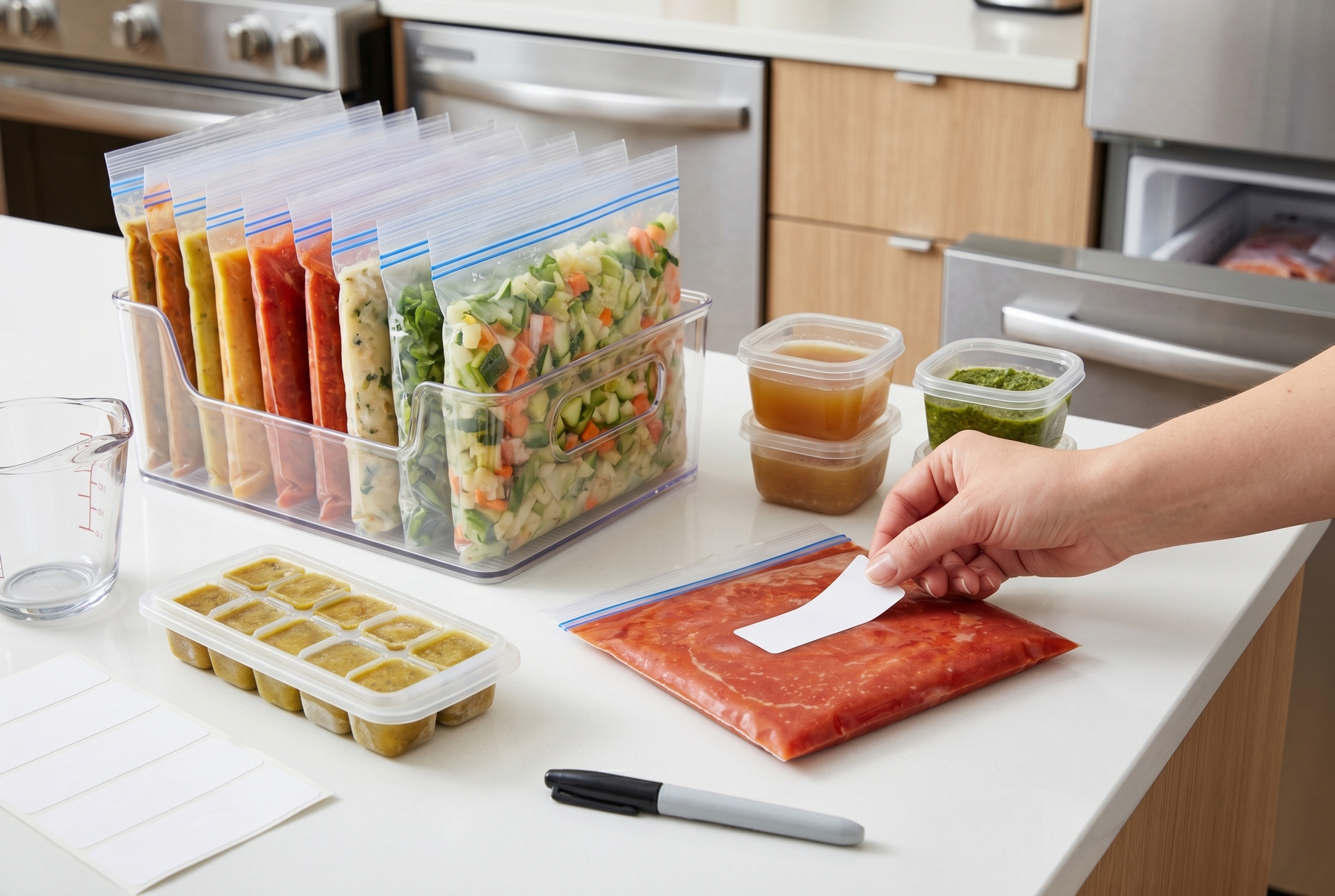
Flat freezing paired with mandatory labeling ensures that a quick glance reveals exactly what is inside the bag and when it was frozen.
The Kitchen Filter: Freeze It or Let It Go
Before stuffing a bag into the freezer, running the product through a few quick questions helps immensely:
- Will I use this in the next 1 to 2 months?
- Will the product retain its necessary texture after thawing?
- Do I have a specific dish in mind for it?
- Is it properly portioned and labeled?
- Is it worth more space than whatever else could take its place?
A single confident ‘no’ means it is honestly better to let it go now rather than throwing it away three months down the line.
Ready-Made Kits for Different Cooking Styles
Avid soup and sauce makers thrive by keeping portions of broth, vegetable bases, tomatoes, herbs, and meat. This forms a core from which almost any lunch can be assembled.
A family navigating busy weeknights benefits from a different kit: meatballs, syrniki (cottage cheese pancakes), crepes, thick sauces, pre-cut meat for specific dishes, and a couple of ready-made bases for a rapid dinner.
Those who love baking and leisurely breakfasts will find more value in berries, dough, bread, portioned fillings, and compound herb butter.
For an exceptionally small freezer, a minimalist five-item strategy works best: concentrated broth, a tomato base, bread, one protein prep, and one seasonal product. Nothing more is needed.
Opening it after a grueling day reveals a flat, beautifully labeled bag: ‘Broth for risotto, March.’ Twenty minutes is all it takes, and dinner is served.
0 comments