
Two home cooks buy meat at the same store from the same butcher. Both bring home an identical cut of pork shoulder. Both run it through a meat grinder, adding onion, egg, and salt. The first cook’s patties hold their shape, remain juicy, and stay soft but not crumbly inside. The second cook’s result looks decent on the outside with a proper crust and shape, but the inside is a dry, dense mass that requires more chewing than anyone desires.
Both will claim their recipes are identical, and they will be right. The issue does not lie in the recipe, but rather in how the meat was ground.
Grinding meat physically alters its structure by breaking or preserving fibers, distributing or smearing fat, and determining how much moisture stays inside the patty versus how much leaks into the pan. Even two identical meat grinders yield different results, as grinding speed, meat temperature, blade sharpness, and the number of passes all play crucial roles.
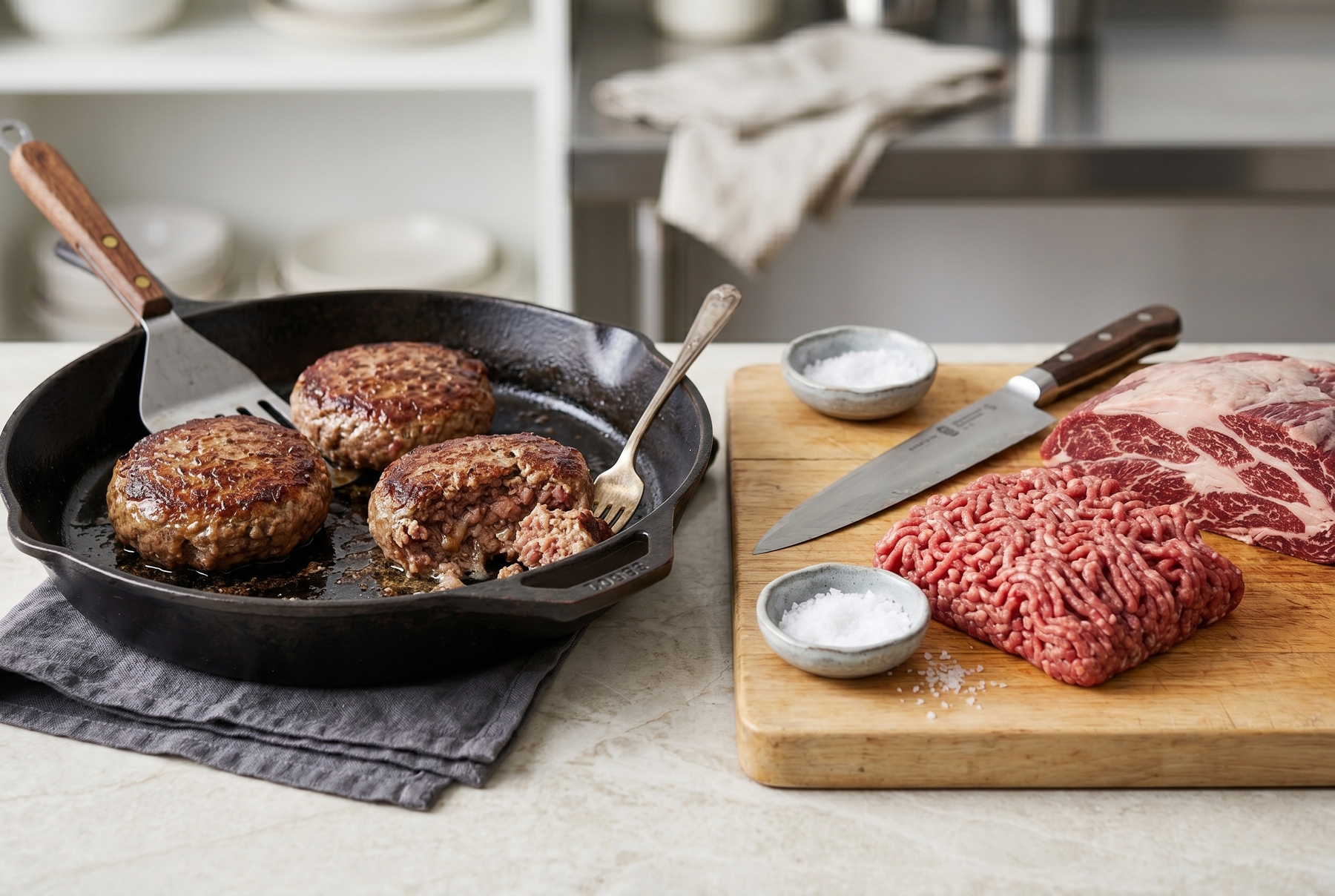
The quality of the final dish depends directly on the grinding method. Properly ground meat retains its juices inside the patty during cooking.
Table of Contents
- What Happens to Meat During Grinding
- The Meat Grinder: Why It Presses More Than It Cuts
- Hand-Chopped Meat: The Purpose of Using a Knife
- Blenders and Food Processors: When There Is No Other Choice
- Choosing the Right Grinding Method for Different Dishes
- Temperature and Fat Content: The Core of Great Ground Meat
- Why Ground Meat Loses Juiciness Before Reaching the Stove
What Happens to Meat During Grinding
Meat consists of muscle fibers, fat layers, and connective tissue. During the grinding process, these elements behave differently depending on whether the meat is cut, pressed, or pulled through a grinding plate.
When cutting, the blade slices across or along the fibers with almost no pressure. The fibers tear minimally, cells remain intact, and moisture stays trapped inside. This technique produces chopped minced meat, which is textured, slightly coarse, and features distinct pieces.
Applying pressure changes everything. Under pressure, cell walls break down, releasing their juices. Warm and soft fat smears throughout the mixture rather than remaining in distinct pockets. The minced meat becomes highly uniform but loses its ability to retain moisture upon heating.
Recipes rarely mention meat temperature, which is a significant oversight. The fat must remain solid, allowing tiny pockets to melt during cooking and provide internal juiciness. If the meat is warm or sits at room temperature for hours, the fat softens. During grinding, this soft fat smears across the meat fibers, creating a sticky, dense mixture. Such a patty struggles to hold its juices and dries out quickly.
Properly ground meat is neither whitish nor gray. It boasts a pinkish-red hue without any murky undertones. It holds its shape under light pressure, feels slightly bouncy, and does not leak liquid at the slightest touch.
The Meat Grinder: Why It Presses More Than It Cuts
A meat grinder possesses a frustrating quirk, as it pushes the meat through the plate rather than cleanly cutting it. The auger presses the meat against the blade before forcing the mass through the holes. A sharp blade provides something resembling a clean cut. However, if the blade is dull (a common issue in home kitchens), the meat mashes and drags through the plate, causing precious juices to leak out before the meat even reaches the skillet.
Grinding plates vary in size. A coarse plate, featuring holes around 8 mm (about 1/3 inch), yields ground meat with distinct chunks. This texture works perfectly for pelmeni (traditional Russian meat dumplings), manti (Central Asian steamed dumplings), and chebureki (deep-fried meat pastries), where the filling benefits from a dense, grainy bite. A medium plate, measuring 4–5 mm (about 1/5 inch), suits homemade patties, meatballs, and casserole fillings. A fine plate, at 3 mm (about 1/8 inch) or less, is necessary for pâtés, baby food, and sausages, where smooth uniformity is crucial.
A double pass is often recommended for a tenderer texture or when dealing with tough sinews and membranes on the first go. However, a second pass heats the meat further, subjects it to more pressure from the auger, and squeezes out additional juices. While this sometimes works for dumpling fillings, it ultimately ruins the structure of burger patties.
The primary mistakes when using a meat grinder include using a dull blade, grinding warm meat, overloading the hopper, and running the machine too slowly. A dull blade mashes the meat, warm temperatures cause fat to smear, an overloaded hopper makes the auger stall, and slow processing allows the meat to linger and heat up inside.
Interestingly, a manual vintage meat grinder clamped to a table sometimes outperforms an expensive electrical appliance. It operates at a slower pace, meaning the motor does not heat the meat, and the grinding process remains consistent. This is not about nostalgia; the meat simply stays cooler and pushes through the plate more evenly.
A meat grinder is optimal for dishes requiring a dense, uniform structure, such as pelmeni, manti, homemade patties, meatballs in sauce, and savory pie fillings.
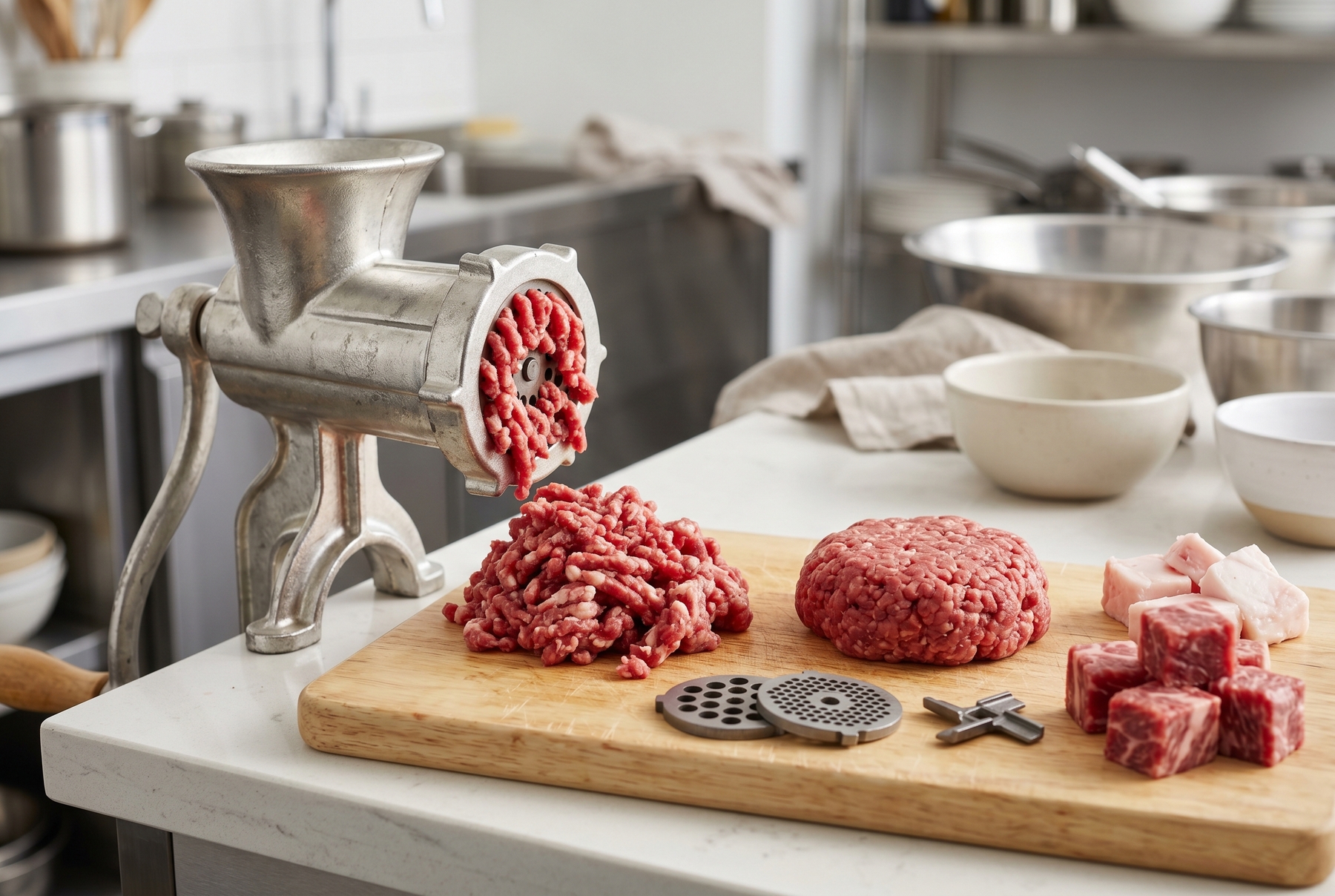
Using a manual meat grinder prevents the meat from overheating, which is essential for preserving the structure of the fat pockets.
Hand-Chopped Meat: The Purpose of Using a Knife
In burger joints where texture is paramount, chefs frequently start with a knife rather than a grinder. This represents proper culinary technique rather than sheer snobbery.
Hand-chopping allows the knife to slice through the fibers without intense pressure, preventing the meat from tearing and the juices from squeezing out. The cell walls remain intact or tear only minimally. Fat stays in distinct pieces instead of turning into a smear, keeping the juices within the meat rather than in the mixing bowl. Hand-chopped meat boasts a coarse, uneven texture with visible fat inclusions, ensuring it does not become a sticky, paste-like mass.
This hand-chopped method gives burger patties a porous structure, allowing the crust to sear beautifully while the center remains incredibly juicy. Machine-ground meat compacts during shaping, losing air and moisture, which results in a denser, drier patty. Chopped meat retains a loose texture with small gaps between the pieces, allowing the fat to render differently during cooking.
This coarse structure shines in burger patties, beef tartare, lyulya-kebab (Middle Eastern grilled minced meat skewers), grilled kebabs, and rustic chebureki fillings. It suits any dish where the individual meat pieces should be distinct on the palate.
At home, this technique requires a heavy, wide knife like a chef’s knife or a cleaver. The meat is first sliced into thin strips along the grain, then cut crosswise into cubes measuring 1.5–2 cm (about 0.5–0.8 inches). Using both hands, the cook chops the meat on a large wooden board, occasionally folding the mass over itself. The process takes about 10–12 minutes for half a kilogram (about 1 lb) of meat. While not instantaneous, it is quite simple. The chopped meat is ready when the pieces are uniformly small and the mass begins to bind together from its own proteins, eliminating the need for added water or eggs.
Burger establishments prioritizing texture often rely on this chopping method. Some use special grinder attachments with an extra-coarse plate for a single pass, acting as a functional compromise that works much better than a double pass through a fine plate. Still, a knife delivers a distinctly uneven, meaty texture that mechanical attachments can only partially replicate.
Blenders and Food Processors: When There Is No Other Choice
Making ground meat in a blender is almost universally a poor decision. The blade in the bowl spins too rapidly, striking the meat chaotically from different angles. Some pieces get cut, others tear, and many simply mash against the walls, while friction quickly heats the meat. The result is a dark, sticky paste that resembles a soufflé more than proper minced meat.
A blender works well for pâtés, mousses, baby food, and specific fillings requiring a dense, creamy consistency. That is its limit. It serves no purpose for patties, lyulya-kebabs, or burgers.
If no other options exist, using a pulse setting with very short bursts, starting with nearly frozen meat, working in small batches, and frequently checking the texture helps mitigate the damage. While this approach minimizes structural destruction, it still fails to produce high-quality ground meat.
Meat processed in a food processor usually looks darker, bordering on gray, and lacks any discernible structure. It begins leaking moisture while still in the bowl and feels sticky and soft to the touch, failing to hold its shape. Cooks must transfer these patties to the skillet with extreme caution to prevent them from falling apart.
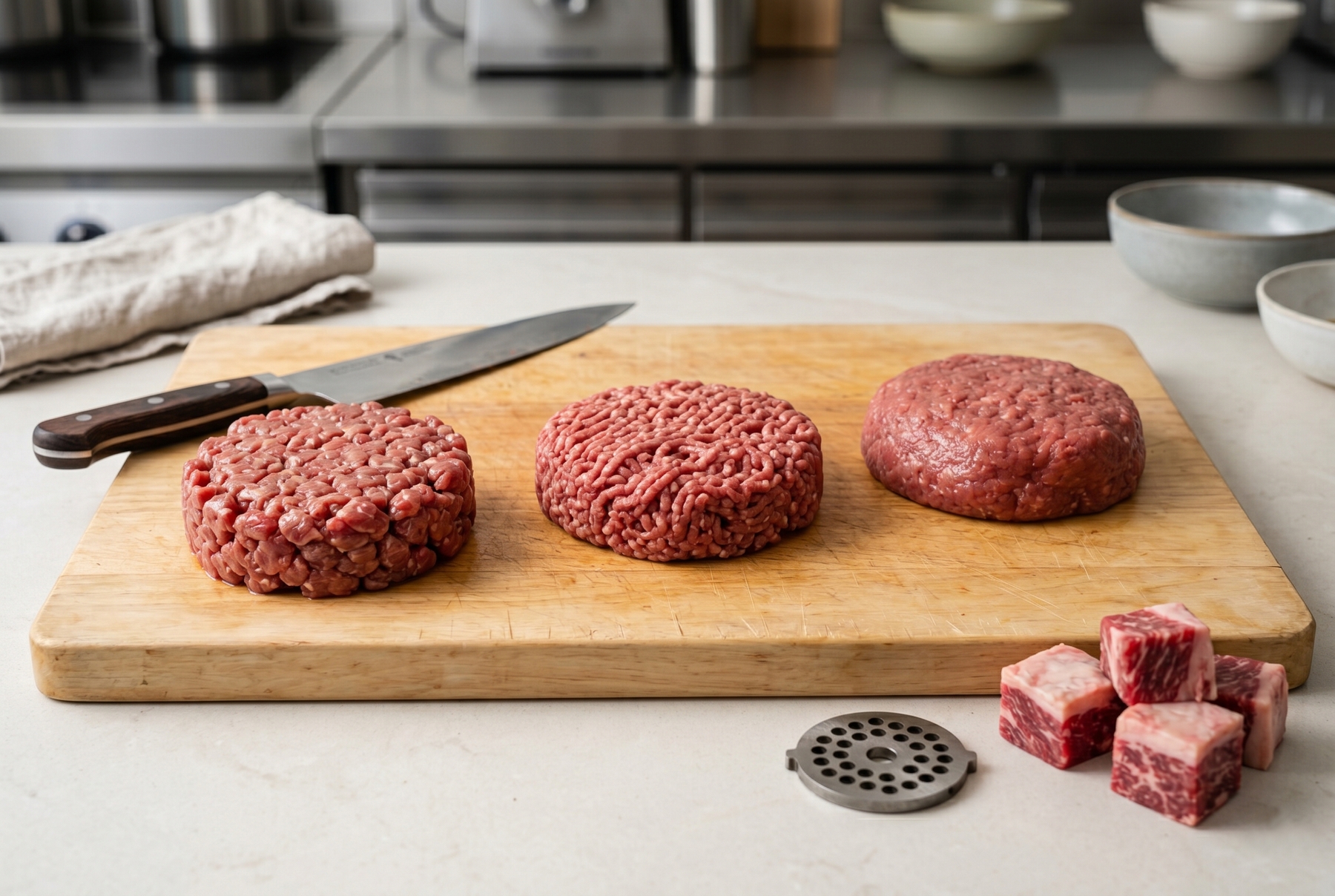
Ground meat textures range from a coarse hand-chop for burgers to a very fine grind suitable for delicate meatballs or creamy pâtés.
Choosing the Right Grinding Method for Different Dishes
| Dish | Method | Reason |
|---|---|---|
| Homemade Patties | Meat grinder, medium plate | Requires a uniform, dense texture |
| Burger Patties | Hand-chopped or coarse plate, single pass | Provides a loose, juicy structure |
| Lyulya-kebab | Hand-chopped | Meat must stick to the skewer without additives |
| Pelmeni and Manti | Meat grinder, coarse plate | Creates a dense filling that releases juice when boiled |
| Meatballs in Sauce | Meat grinder, medium/fine plate | Delivers a tender texture that absorbs sauce |
| Savory Pie Filling | Meat grinder or food processor | Texture is less critical |
| Beef Tartare | Knife only | Meat must remain in distinct pieces |
| Pâté | Blender or food processor | Requires a smooth, creamy consistency |
Temperature and Fat Content: The Core of Great Ground Meat
Meat requires thorough chilling before grinding. It should not just come straight from the refrigerator, but ideally spend an hour in the freezer until the surface frosts over, while the inside remains unfrozen. In this state, the fat solidifies, allowing the blade or grinding plate to cut it cleanly so the pieces stay separate.
Fat content serves as the second critical factor. Lean meat produces dry results, so juicy burger or meatball mixtures need at least 20% fat by weight to prevent drying out. Beef often lacks this natural richness, which is why top burger spots use fatty trimmings or incorporate extra beef tallow. Homemade patties traditionally rely on a mix of pork and beef, precisely because pork supplies the necessary fat.
The best cuts for grinding include the shoulder (which offers a great balance of muscle and fat), the belly (highly fatty and excellent for blending with leaner meats), and the neck (juicy and well-marbled). Tenderloin and loin cuts look beautiful but lack moisture. Buying them specifically for grinding means spending more money for less juiciness.
When shopping at a market, buyers should ask to inspect the cut. The fat layers must be white or light yellow rather than gray, and the meat should display a bright red or pinkish-red color with no dark edges. Purchasing pre-ground meat always involves a gamble, as the exact cuts and the time spent sitting in the display case remain a mystery.
Supermarket ground meat presents even more issues. While it may boast an even color, neat packaging, and a clean label, industrial grinders process massive volumes at high speeds. This generates excessive heat, causing fat to smear and juices to bleed out during production. The specific cuts used are also ambiguous, often consisting of unsellable trimmings with a high connective tissue content.
Industrial facilities sometimes introduce moisture-retaining additives to make the ground meat appear heavier and juicier, but the excess liquid inevitably leaks into the pan. Patties made from this meat end up stewing in their own juices rather than searing. Grinding a high-quality cut at home provides a noticeable difference in the skillet, where the meat actually fries instead of boiling in a pool of gray liquid.
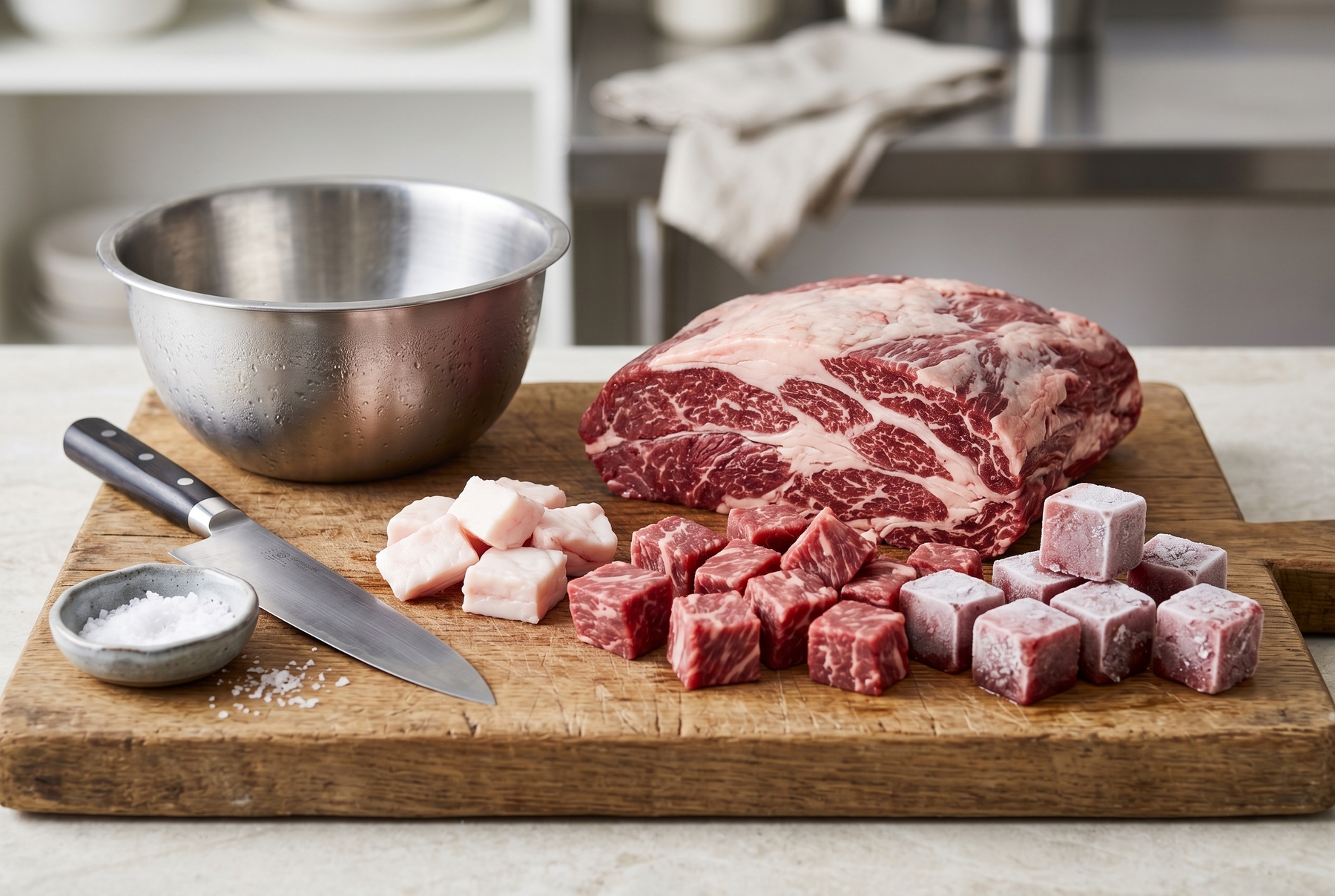
To achieve the perfect ground meat, it is crucial to use thoroughly chilled cuts and maintain the correct fat proportions to prevent a dry dish.
Why Ground Meat Loses Juiciness Before Reaching the Stove
Dull Grinder Blades. This stands as the most common issue. A grinder blade is a consumable part that eventually dulls, and when it does, it crushes the meat instead of cutting it. If a dark mass with whitish streaks emerges from the grinder and immediately leaks juice into the bowl, the blade is dull. Replacement blades cost very little and can also be sharpened on a standard whetstone.
Warm Meat. Resting the meat in the freezer for an hour before grinding is not paranoia, especially during the summer. Warm meat turns into mush inside the grinder faster than a cook can realize something has gone wrong.
Double Grinding Everything. Some sources suggest grinding twice for extra tenderness. While occasionally justified for dumpling fillings, if the meat reaches the desired texture after the first pass, a second round simply destroys the structure and squeezes out the remaining juices. Checking the texture after the first pass often reveals that it is already perfect.
Incorrect Meat-to-Fat Ratio. Adding an egg does not magically make lean meat juicy. Eggs act as a binder, not a moisture source. If the meat lacks fat, the patties will be dry, and an egg cannot fix that. The necessary fat must be incorporated right at the butcher counter when selecting the cut.
Improper Storage. Ground meat lasts no longer than 24 hours in the refrigerator. This is not an overabundance of caution; ground meat oxidizes quickly, and bacteria multiply much faster in it than in a whole cut. Ground meat sitting for two days loses its flavor and becomes potentially unsafe. Cooks dealing with large quantities should freeze portions immediately.
There is no single correct way to grind meat. Instead, there is the right method for a specific dish, driven by an understanding of the underlying science. Machine-ground meat for pelmeni and hand-chopped meat for burgers are not matters of tradition or subjective taste; they are physically distinct materials that behave differently in a hot skillet.
Chopping meat by hand for burger patties just once reveals a dramatic difference, making it incredibly difficult to ever justify returning to the mechanical grinder for this particular dish.
0 comments