
Over twelve years in professional and private kitchens, I have often witnessed the same scenario: someone cooks carefully, without cutting corners, yet the final plate still lacks something. Experience or intuition is rarely the issue. The right kitchen tool is simply missing.
Proper equipment acts as an extension of the chef’s hand. Without it, certain techniques are nearly impossible to replicate at home. Here are ten essential kitchen tools that save the day at crucial moments and are immediately missed when absent.
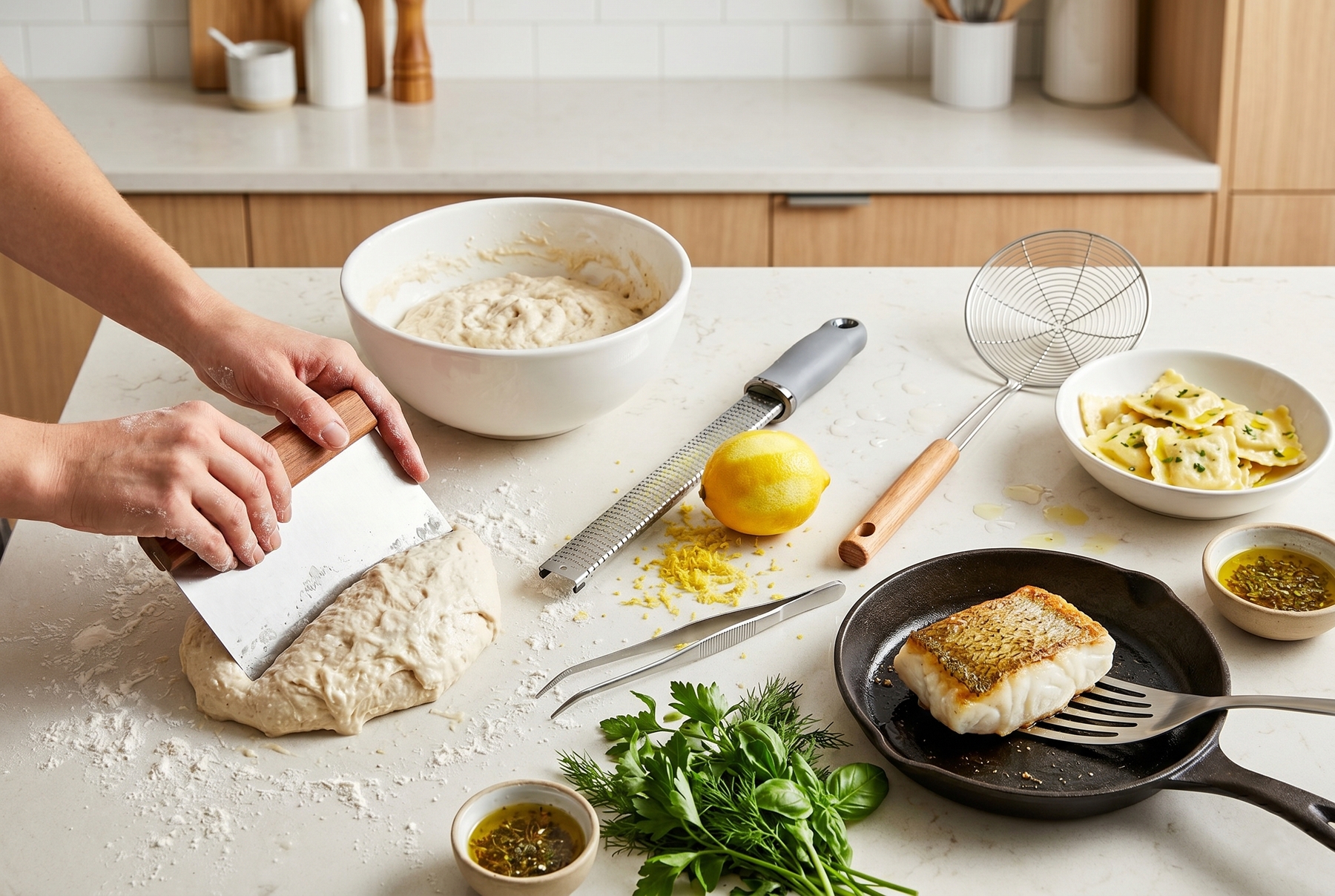
Choosing the right kitchen equipment helps achieve restaurant-quality dishes at home.
Table of Contents
1. Bench Scraper
It looks unassuming: a rectangular metal or plastic blade with a handle, or just a comfortable edge to grip. It is a simple device. Using it ensures that dough sticks to your hands less, significantly reducing kitchen frustration.
When kneading dough without a scraper, it begins to spread across the table, stick, and tear when lifted after just five minutes. You scrape it with your hands, add more flour, it sticks again, and the scraping continues. You might be doing everything perfectly, but you are simply missing a bench scraper to effortlessly lift the dough from beneath.
The scraper picks up the dough in a single, fluid motion. Sliding it underneath allows you to fold and transfer the dough without any tearing. It also cleans the work surface in a few quick strokes while the dough is resting.
I only realized its true value when I tried kneading without one after three years of constant use. The sensation is akin to writing in dust with a finger instead of using a proper pen.
Two details matter when choosing one. A metal scraper is rigid, making it better for dividing dough and scraping dried residue off the table. A plastic scraper is softer and flexes to fit the curve of a bowl, which is perfect for extracting every last drop of a mixture. Ideally, owning both is best, as they are inexpensive and serve different purposes. A wet hand should not slip off the grip, while everything else is secondary.
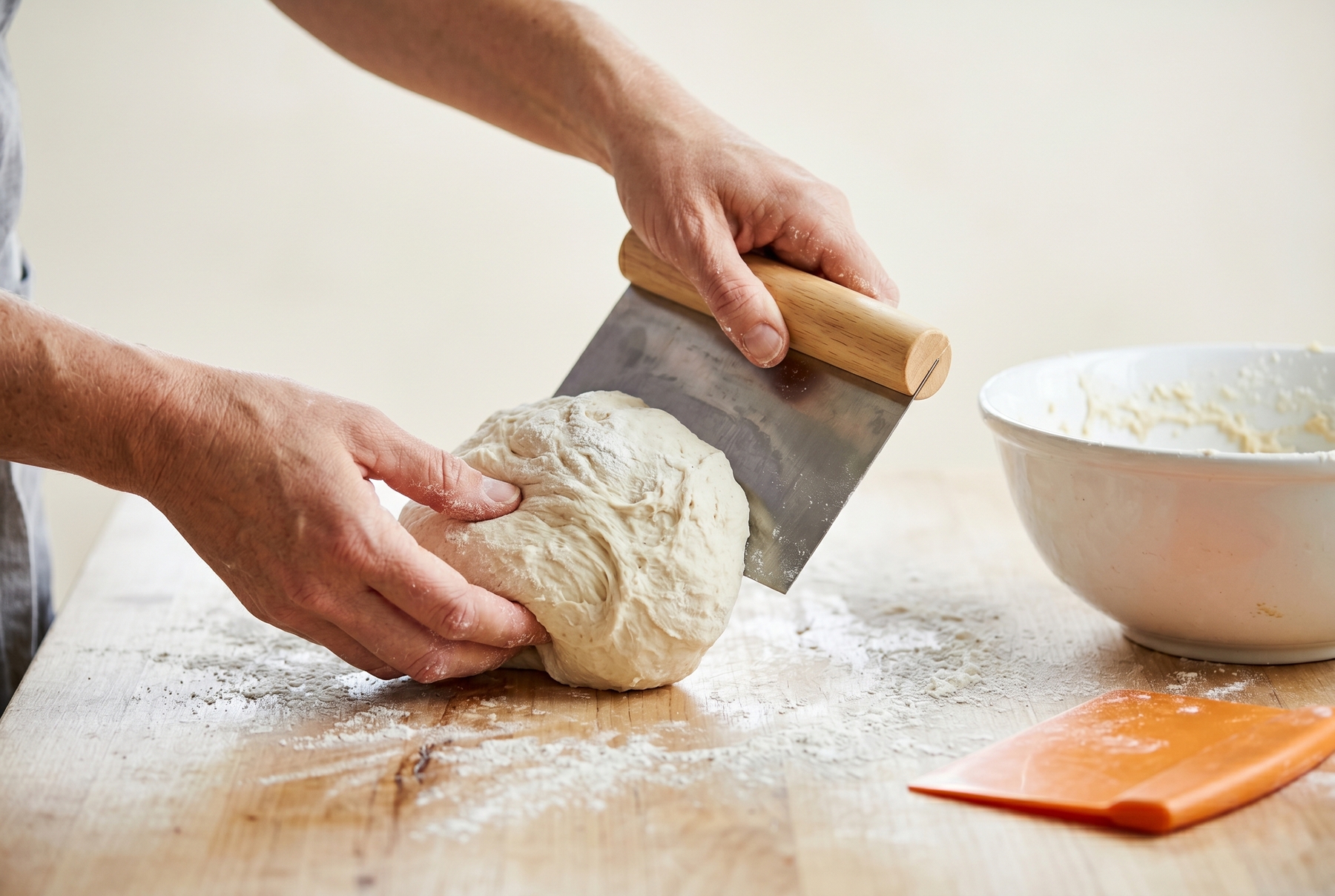
A bench scraper is a simple yet effective tool for handling sticky dough and quickly cleaning the work surface.
2. Danish Dough Whisk
It looks unusual, lacking the traditional bundle of wires, and instead featuring a wide loop twisted into a flat spiral. It is easily overlooked in a store because its purpose is not immediately obvious.
The Danish dough whisk excels with thick batters: pancakes, muffins, soda bread, rye, and whole grain mixtures. It does not aerate like a standard whisk, nor does it replace a mixer’s dough hook for dense yeast dough. Its true strength lies in quickly combining flour with liquid and breaking up lumps where a regular whisk would get clogged.
To be honest, a planetary mixer usually handles thick dough in a restaurant rather than a Danish whisk. Commercial kitchens use bowls that hold dozens of liters, and no one stands over them with a small wire loop. However, this whisk is an absolute lifesaver at home.
A standard whisk is excellent for egg whites, light creams, and liquid-based sauces. In thick dough, it mostly just drags lumps around the bowl. The Danish whisk engages the dough differently, as its wide loop stretches the mixture outward with every stroke. Lumps break down within the dough rather than getting trapped in the wires. The dough mixes rapidly, and the whisk cleans easily with a single tap against the edge of the bowl.
Danish whisks are available in pastry supply stores and online marketplaces. Searching for “Danish dough whisk” or “Danish bread whisk” yields the best results. Selecting a simple stainless steel model without hinges or overly decorative handles is the most practical choice.
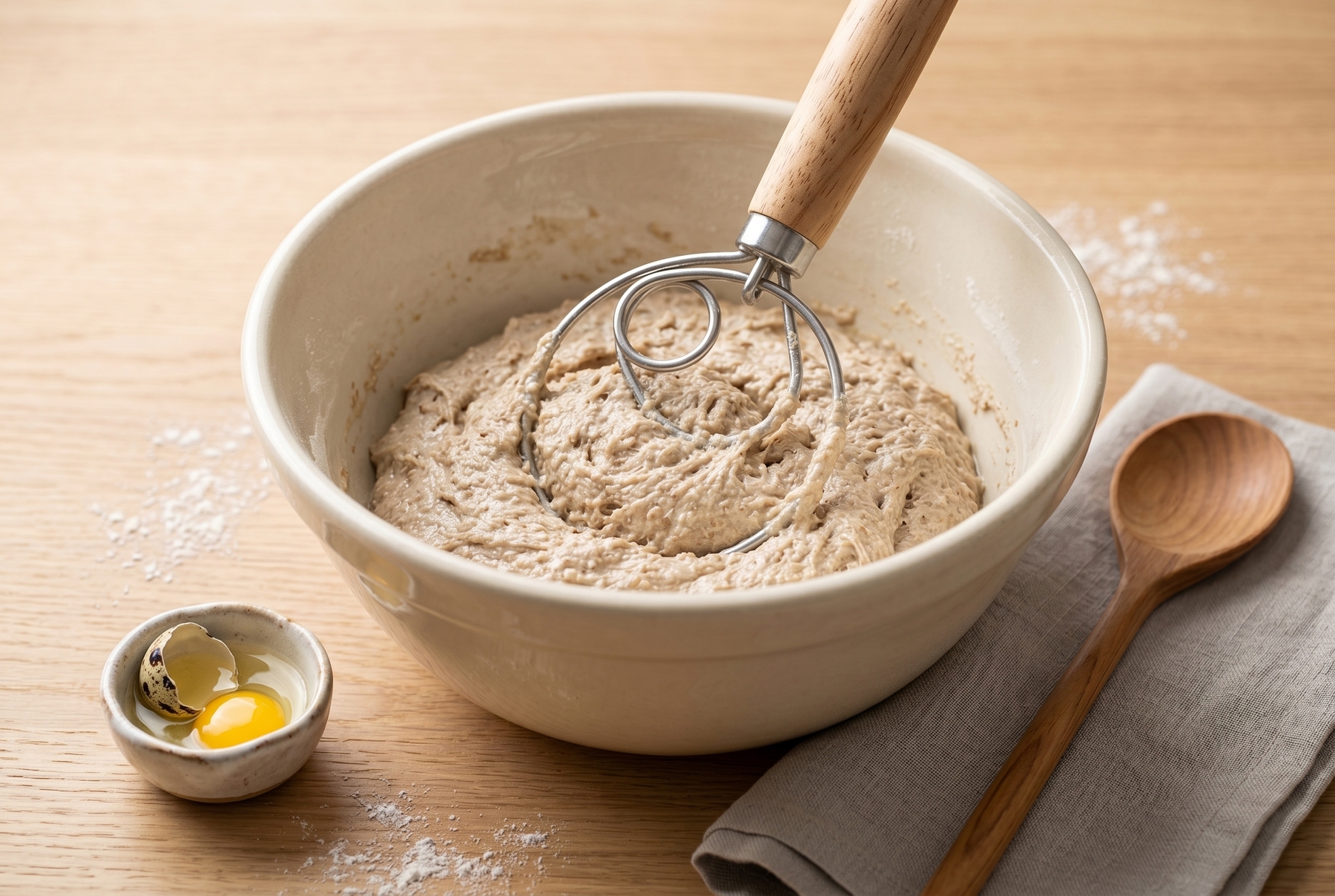
The unique design of the Danish dough whisk allows for easy mixing of dense dough without lumps or clogged wires.
3. Microplane Grater
A standard box grater often tears the ingredient instead of removing a delicate layer. Citrus zest brings the bitter white pith along with it, while garlic turns into an inconsistent mix of mush and chunks rather than a smooth paste.
A Microplane features razor-sharp, photo-etched teeth that shave off a fine layer without requiring excess pressure. Citrus zest falls away in delicate ribbons, capturing only the colorful, flavorful oils and leaving the pith behind. Parmesan cheese drifts down in fluffy clouds, melting instantly into hot dishes. Ginger grates cleanly without stringy fibers. Garlic transforms into a fine puree without the need for a press, sparing your hands from an odor that lingers for hours.
A single Microplane grater perfectly handles citrus zest, hard cheeses, ginger, garlic, and whole nutmeg.
The most common mistake is applying too much pressure. After using a standard grater, the natural instinct is to press down hard, which actually hinders the Microplane. The natural weight of the ingredient is sufficient. Gliding smoothly and effortlessly allows the sharp teeth to shave the perfect layer on their own.
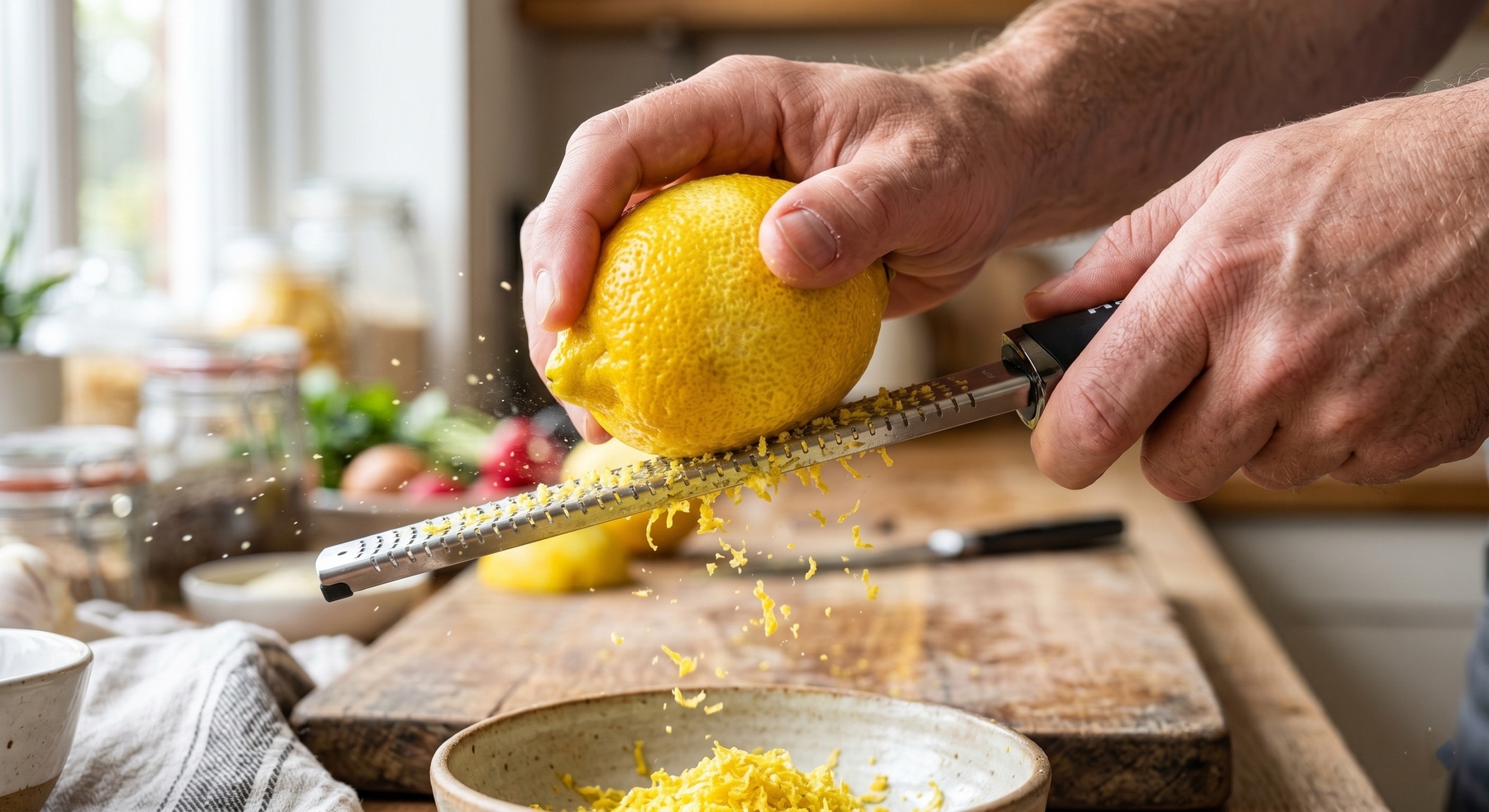
The Microplane grater removes the thinnest layer of zest, providing maximum aroma without the bitter white pith.
4. Spider Skimmer
The reason it is called a spider is obvious at first glance: a round wire basket on a long handle, featuring a web-like mesh. This precise mesh is what makes it indispensable in situations where a colander or a slotted spoon falls short.
Using a colander requires carrying a heavy pot to the sink and pouring boiling water away without getting burned. A slotted spoon only partially solves this problem, as its surface area is small and liquid drains slowly. Large or delicate pieces are easily bruised or broken with a spoon. A spider skimmer works differently: the wide mesh scoops underneath the ingredients, quickly drains the water or hot oil, and transfers everything directly to a plate, bowl, or ice bath.
Dumplings go straight from the boiling water to the plate without losing their internal broth. Blanched asparagus moves from the pot to an ice bath in seconds, preventing overcooking. A poached egg can be lifted delicately without disturbing the fragile white. When deep-frying, the spider scoops up the crispy pieces while allowing excess oil to drain rapidly.
Checking the mesh size is important when purchasing one. A tight mesh is necessary for small ingredients, while almost any size works for pasta and larger items. The handle length must be sufficient to keep your hand away from the bubbling oil. The handle’s material is less crucial, as long as it offers a secure, non-slip grip.
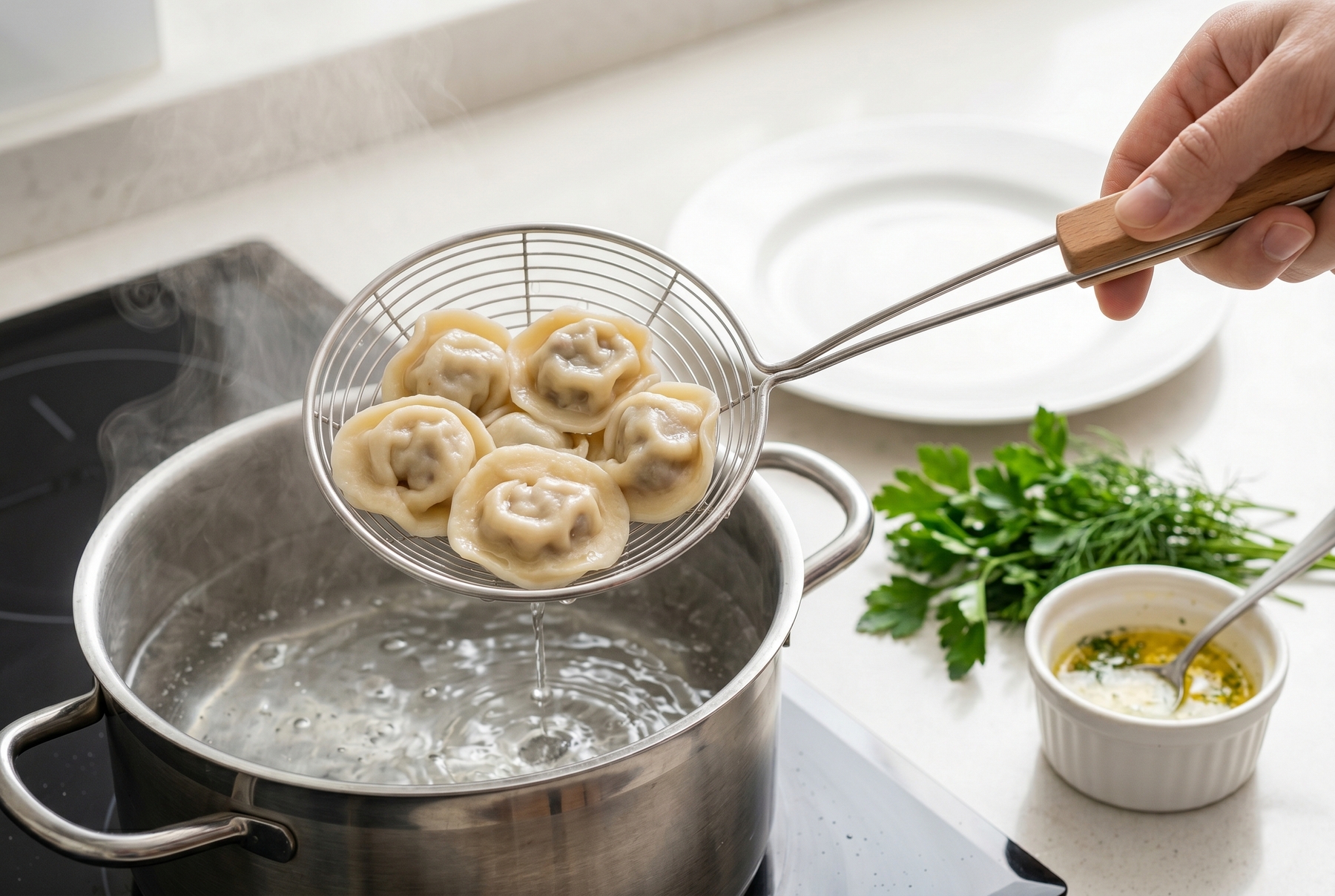
The wide mesh of the spider skimmer allows you to quickly and carefully remove food from boiling water while keeping it intact.
5. Probe Thermometer
A kitchen thermometer is not just for show. Precision cooking is difficult without one, even with vast experience. Professional chefs use thermometers without any blow to their egos, simply because the internal temperature of a roast cannot be gauged by sight.
Two types of kitchen thermometers are frequently confused. An instant-read thermometer, featuring a probe and a small display, is inserted into the finished dish. It provides a reading in seconds and is ideal for steaks, bread, chocolate, and caramel.
A leave-in probe thermometer serves a different purpose. The probe remains inside the ingredient throughout the cooking process, allowing you to monitor the temperature externally without opening the oven door. This tool is essential for large cuts of meat, whole poultry, and baked hams.
Dry roasted pork and undercooked turkey are most often the result of guessing the internal temperature.
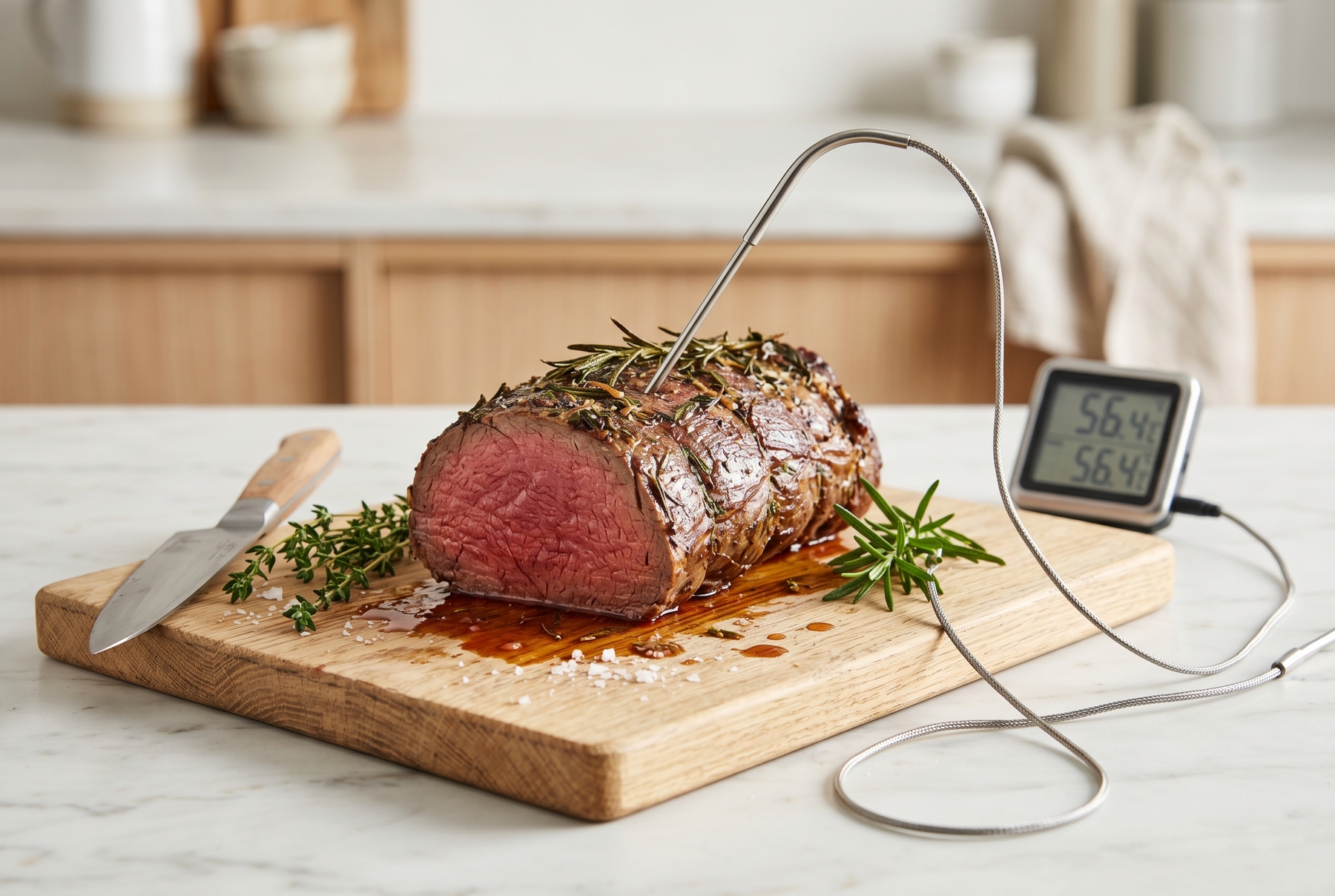
Using a meat thermometer guarantees the perfect level of doneness and eliminates the risk of drying out the roast.
6. Culinary Tweezers
Culinary tweezers are essential when a spatula is too wide, a spoon is too clumsy, and the heat is too intense for bare fingers.
They allow you to flip a delicate slice of fish without tearing it. Microgreens can be placed precisely without sliding into the sauce. Small, fragile items can be removed from a hot pan without burning your fingertips. Plating a tartlet or canapé becomes effortless when every element stands upright instead of toppling over.
During the first seminar where I used tweezers professionally, I felt as though I had spent my entire previous culinary life trying to feed people with a fork when specialized tools were required. It is an exaggeration, of course, but only a slight one.
Looking for stainless steel tweezers measuring 20–25 cm (8–10 inches) with serrated tips is the best approach, as they provide a secure grip on slippery ingredients. Tweezers that are too long lack precision, while those that are too short bring your fingers uncomfortably close to the heat.
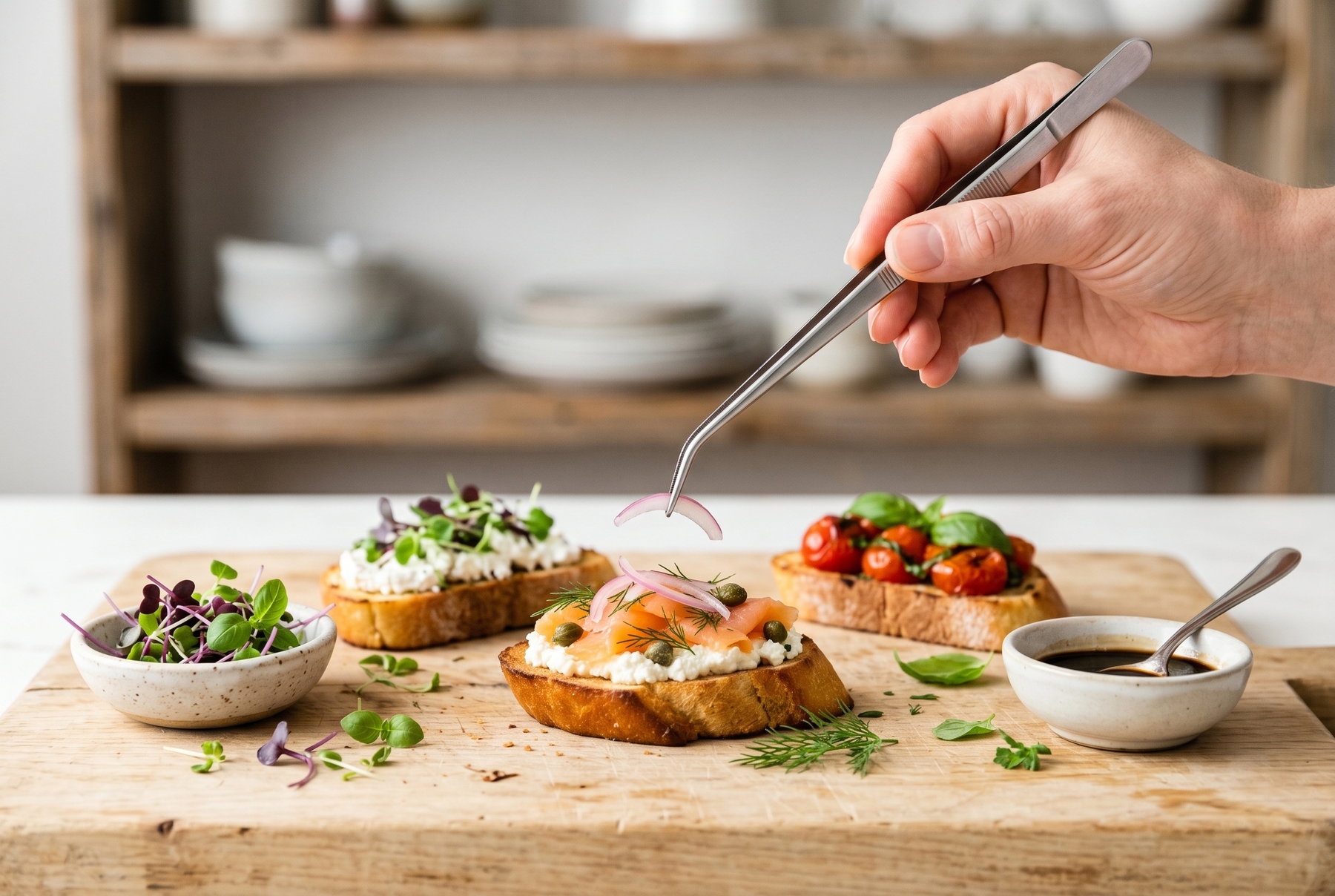
Culinary tweezers are indispensable for precise work with small ingredients and creating an aesthetically pleasing presentation.
7. Fish Spatula
Fish often falls apart during plating because of the spatula used. A standard spatula is generally too thick and rigid to slide under delicate skin without disturbing the layers of flesh. Attempting to lift the fish causes the blade to hit the pan at a harsh angle, breaking the fillet and leaving you with a mangled piece instead of a perfect portion.
A fish spatula is designed quite differently. The blade is thin, flexible, and features a sharp, angled edge. It glides seamlessly between the crispy skin and the bottom of the pan, lifting the food from below without unnecessary pressure. The fish remains pristine, keeping the skin intact and the delicate flakes perfectly together.
It is particularly indispensable in a few specific scenarios: pan-frying salmon skin-side down, transferring a whole roasted carp from the oven, or grilling delicate fish steaks where one awkward movement leaves half the portion stuck to the grates.
Checking the blade flex is crucial when shopping. It should bend under light pressure but not feel flimsy. A width of about 10–12 cm (4–5 inches) comfortably supports a standard portion. Delicate fillets are best handled by a wide blade with generous slots. The handle material matters less, provided it offers a secure grip when wet.
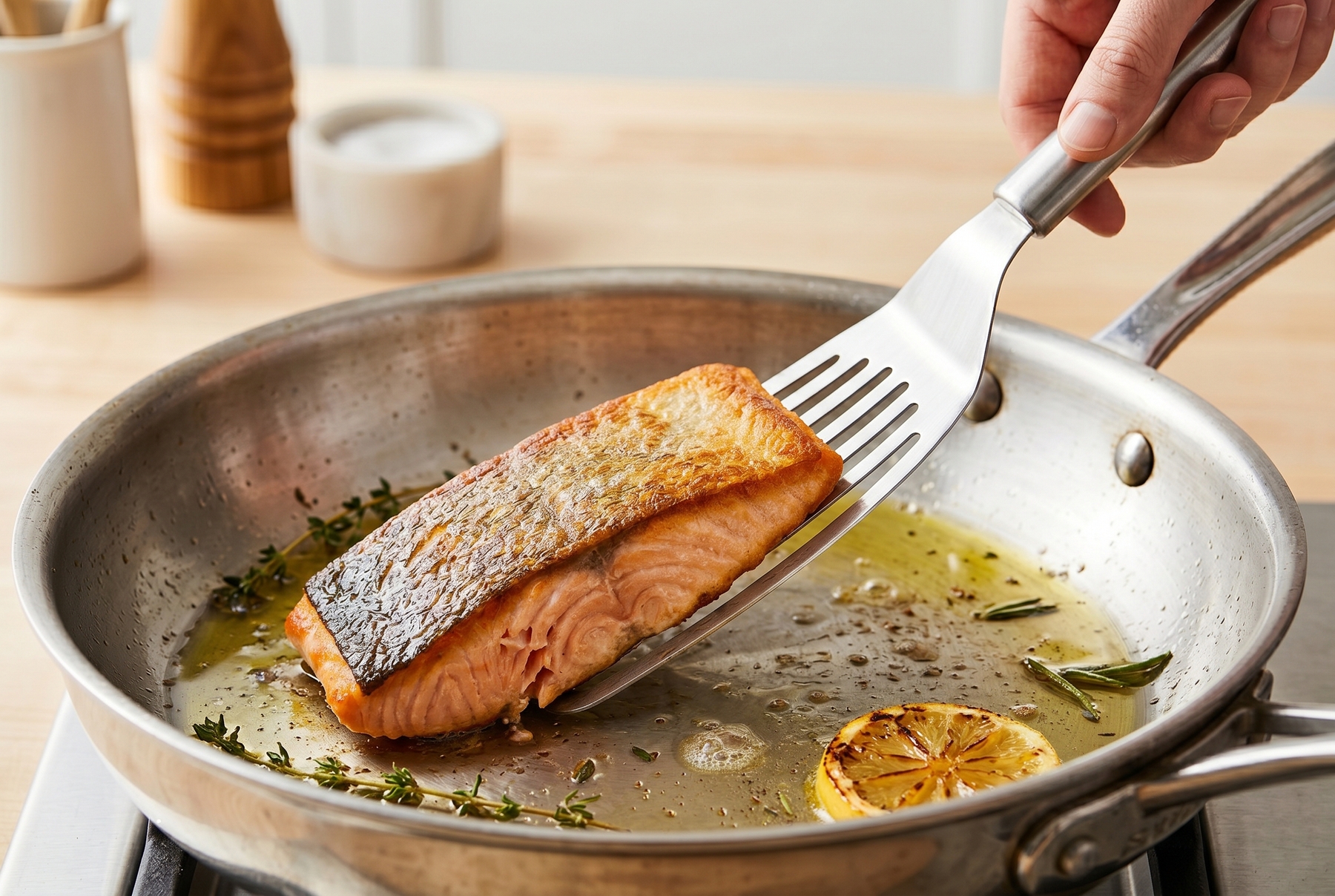
The thin and flexible blade of the fish spatula allows you to carefully flip even the most delicate fish without tearing the skin.
8. Potato Ricer
Mashed potatoes are easily turned into a gluey paste in two ways: blending them with a food processor or aggressively mashing them with a standard perforated masher. Both methods rupture the potato cells, releasing excess starch. The resulting puree becomes gummy and unappetizing.
A potato ricer operates much more gently. The potatoes are pressed through small holes under even pressure, avoiding prolonged mixing and friction. Significantly less starch is released. The puree emerges light and fluffy, eagerly absorbing butter and milk rather than separating them into a greasy puddle at the bottom of the bowl.
The same ricer is brilliant for making gnocchi, processing the potato base to the ideal texture without excessive force. It is also excellent for dumplings and savory pie fillings that require a smooth, fiber-free consistency.
A simple ricer frequently rescues mashed potatoes, whereas a poor-quality masher easily ruins them. Examining the hole size is important when selecting one, as smaller perforations yield a silkier texture. Checking the structural stability is also wise, since flimsy ricers tend to bend under pressure and quickly lose their shape.
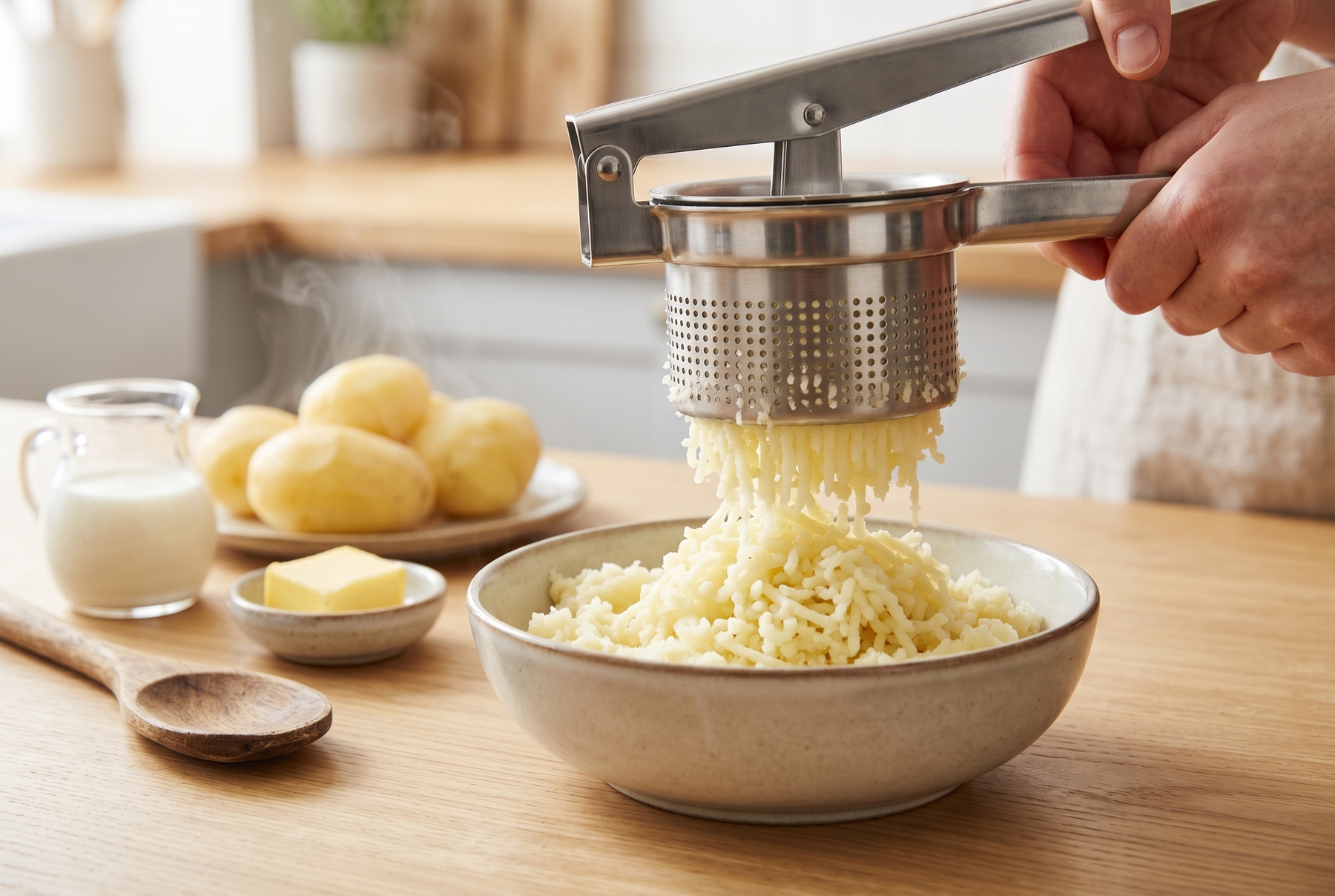
A potato ricer creates a fluffy puree texture without releasing excess starch, which otherwise makes potatoes gummy.
9. Culinary Blowtorch
An oven struggles to deliver intense, focused heat to a single spot. This exact type of heat is precisely what crème brûlée requires, allowing a thin layer of caramel to form instantly over the chilled custard. Meringue benefits similarly, keeping its soft interior while achieving a beautifully toasted exterior. A blowtorch quickly sears a sous-vide steak, forming a crust without overcooking the center.
The blowtorch accomplishes these tasks in mere seconds. It toasts onions on a finished dish, chars peppers for effortless peeling, and selectively melts cheese without unnecessarily reheating an entire gratin.
Guessing with gas canisters is never recommended. Most household kitchen torches run on butane. Verifying the compatibility of the torch and the canister—checking the connection type, pressure, and gas mixture—ensures safety. Working in an enclosed kitchen means opening a window or turning on the exhaust fan. Keeping the torch in constant motion is essential, as sugar burns into bitter carbon faster than you might notice if the flame rests in one spot.
A mistake on a crème brûlée is immediately visible: the sugar turns into a scorched black spot.
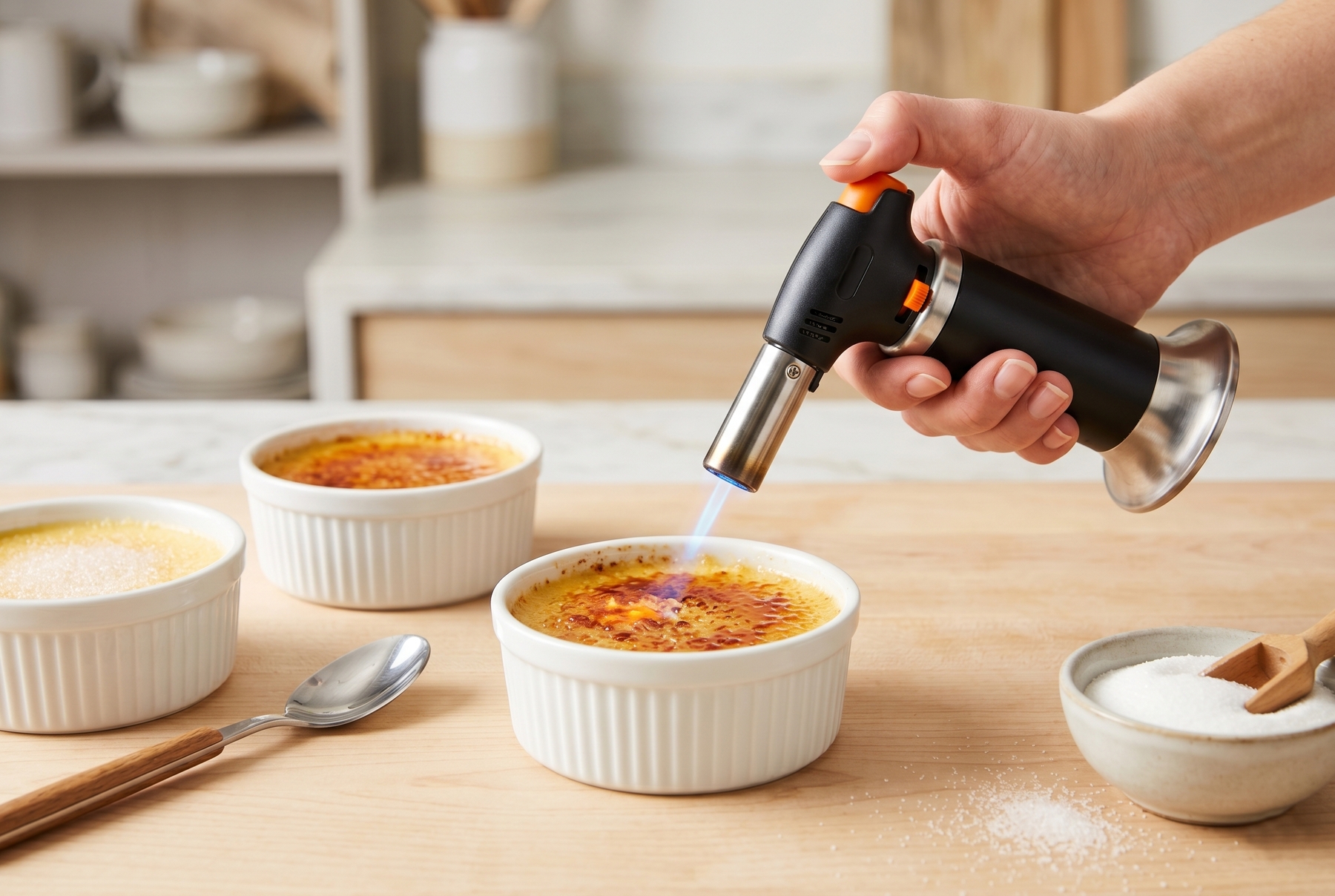
A gas blowtorch provides instant heat for creating a perfect crust on desserts or quickly searing meat.
10. Salad Spinner
A wet salad is unappealing and refuses to hold a dressing properly. Oil and water repel each other, causing the vinaigrette to slide off the leaves and form a puddle at the bottom of the bowl. The greens lose their crispness and turn soggy under their own weight.
A salad spinner effectively removes water from the leaves with minimal bruising. Washed greens are placed into the rotating basket, and a few spins render them perfectly dry. Using paper towels inevitably crushes the delicate leaves and tears their edges, whereas the spinner utilizes centrifugal force to expel moisture while leaving the surface pristine.
The dressing elegantly clings to the dry leaves instead of pooling at the bottom, and the crisp texture is preserved significantly longer.
It also offers a distinct storage advantage. Keeping washed greens directly in the spinner inside the refrigerator prolongs their freshness. The enclosed environment retains beneficial humidity, yet the leaves do not sit in stagnant water.
A bowl capacity of at least 3 liters (about 3 quarts) is the most convenient size for family meals. Pull-cord mechanisms require manual effort, while push-button models operate faster. The inner basket should be fully removable for easy cleaning.
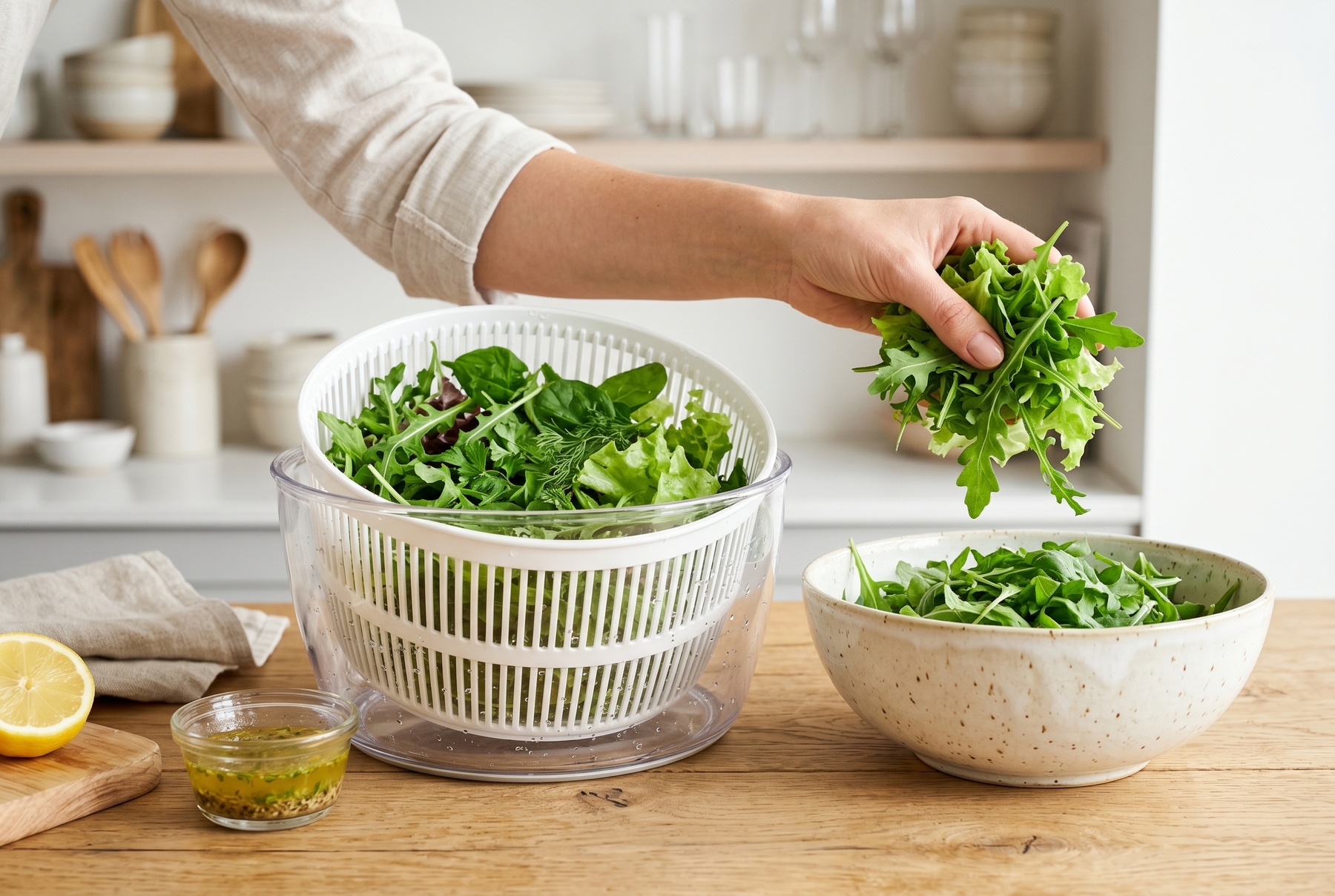
Dry greens hold sauces and dressings better, maintaining an appetizing crunch in your salad.
Ten More Tools In Brief
There are other specialized tools designed for specific tasks. They are often remembered too late: when the dough is already sticking, the broth is cooling, or the grease is floating on top.
- Micro Scale: Essential for yeast, salt, spices, and baking additives, where an extra gram drastically alters the outcome.
- Mezzaluna Knife: A curved rocking blade with two handles, primarily used for herbs. It chops quickly and evenly, bruising the leaves far less than a standard chef’s knife.
- Silicone Baking Mat With Measurements: This helps roll out a perfectly round pie crust or a rectangular sheet of cookie dough without requiring a ruler on the counter.
- Oil Sprayer: Delivers a fine, even mist of oil over a skillet or baking sheet, completely eliminating greasy puddles.
- Julienne Peeler: A Y-shaped peeler featuring serrated teeth. It transforms a carrot or zucchini into perfect matchsticks in just a minute instead of fifteen.
- Ceramic Ginger Grater: The fine ceramic teeth produce a smooth ginger paste, leaving behind the tough fibers that usually clog metal graters.
- Chainmail Scrubber: A small metal mesh sponge made of interlocking rings, specifically for cast iron skillets. It removes burnt-on food without stripping the precious seasoning layer.
- Frozen Butter Grater: Grating cold fat allows it to blend into pastry flour much faster and more evenly than chopping it with a knife.
- Offset Spatula: Smooths out frosting flawlessly while keeping your knuckles safely away from the sides of the cake.
- Fat Separator: A pitcher with a spout originating near the bottom. The fat rises to the surface, allowing the clear broth to be poured out from underneath, resulting in beautifully clean sauces.
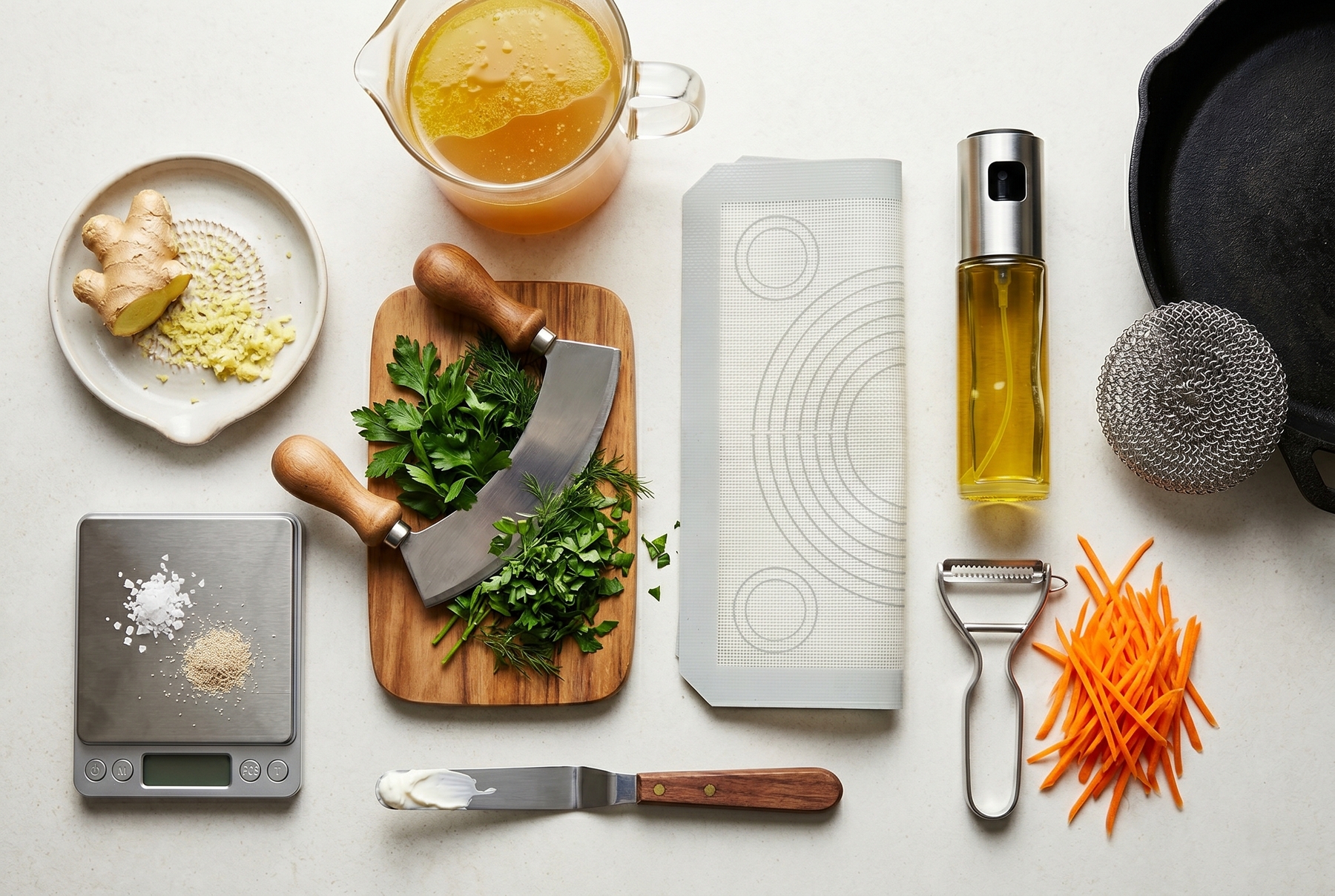
Specialized equipment, such as micro scales or a julienne peeler, significantly simplifies specific culinary tasks.
Purchasing every piece of kitchen equipment at once is unnecessary. Acquiring one or two items tailored to your most frequent cooking habits is a better strategy. If baking bread is common, a bench scraper and a Danish whisk are wise investments. Frequently roasting meat calls for a quality probe thermometer. Washing greens regularly makes a salad spinner essential.
Kitchen work is simply more enjoyable when dough effortlessly releases from the counter, fish reaches the plate intact, and salads do not swim in water. The transformation begins with having the right tool within arm’s reach the moment a culinary challenge arises.
0 comments