
During my first kitchen internship, I was handed a crate of onions. Not meat, not sauces—just a crate of onions and a knife. The chef mumbled something along the lines of ‘we’ll see’ and vanished. Forty minutes later, several things became clear simultaneously. My knife work was chaotic: half the dice were 5 mm (0.2 in), the other half were 15 mm (0.6 in), and some were just vague triangular shapes. In the skillet, the small pieces burned by the time the larger ones barely started to soften. The chef returned, took one look, and said, ‘You are cooking completely different dishes at the same time. You are just doing it in one pan.’
At home, the same exact principle applies—it is just less noticeable. You chop potatoes for soup ‘roughly the same size,’ and some pieces fall apart while others remain raw. In an Olivier salad (a traditional Russian potato salad with meat, pickles, and mayo), you might have a 15 mm (0.6 in) cucumber cube mixed with an 8 mm (0.3 in) egg cube, resulting in a disconnected jumble that falls off the fork instead of a cohesive dish. In a base flavor sauté, some carrots burn on the outside while remaining tough inside because pieces of varying sizes heat up at completely different rates.
Properly cutting vegetables and meat is not about aesthetics or restaurant-level perfectionism. The size and shape of a piece dictate the rate of heat penetration, the amount of juice released, the texture against the teeth, and how the ingredient feels on the spoon. It acts as the fine-tuning of a dish, just as crucial as pan temperature or cooking time.
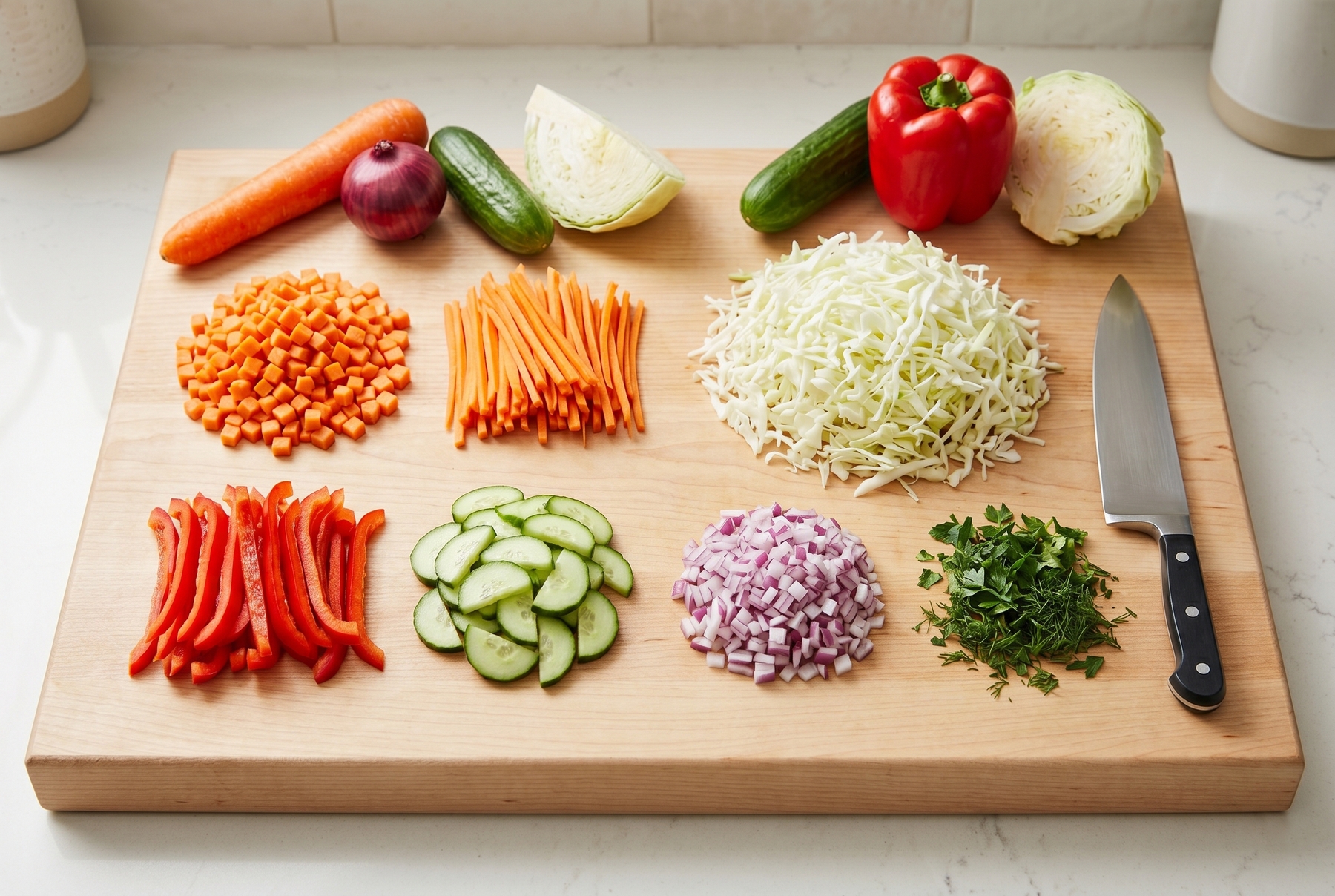
The correct cutting shape is not merely about aesthetics, but a guarantee of even cooking and harmonious flavor in your dish.
Table of Contents
- Why the Shape of a Cut Matters More Than Spices
- Three Rules for Comfortable Cutting and Basic Knife Techniques
- The Dice: The Most Frequent and Versatile Cut
- Julienne: When an Ingredient Needs to Stand Out
- Shredding and Shaving: Why Cut So Thinly
- How to Choose Cutting Techniques for Specific Dishes
- The Most Common Vegetable Cutting Mistakes
- Three Exercises to Put the Theory to the Test
- How to Salvage a Chopping Mistake
Why the Shape of a Cut Matters More Than Spices
It all begins with physics.
The smaller the piece, the greater its surface area exposed to heat. Finely diced onions in a sauté become soft and sweet within five to six minutes, as their sugars caramelize quickly and evenly. Their aroma shifts from sharp to warm and subtly caramel-like. A coarsely chopped onion cooked for the exact same duration will be browned on the outside but harsh and raw on the inside, as the center simply lacks the time to heat through.
Large chunks of carrot work beautifully in a slow-simmered soup, as they cook for a long time, retain their shape, and remain distinct in the bowl. However, those same large carrot chunks thrown into a quick sauté for risotto will stay dense and raw, simply failing to cook through during the short heating time.
Texture plays a vital role as well. A dice provides the sensation of a standalone, distinct bite in the mouth. A julienne cut is springy, holds its shape, catches sauce beautifully on its surface, and offers a satisfying crunch against the teeth. Fine shredding, on the other hand, softens rapidly, absorbs dressings, and seemingly melts into the dish.
This dynamic is most apparent in an onion salad. Thin half-moons deliver a pleasant piquancy, quickly shedding their harsh bite and softening under the influence of salt or acid within ten minutes. Thick chunks of the very same onion in that same salad are off-putting. They dominate the palate, overpower every other flavor, and chew as a completely separate entity. The recipe remains unchanged, but the geometry shifts, and the flavor profile inevitably follows.
Three Rules for Comfortable Cutting and Basic Knife Techniques
There are three fundamental conditions: without them, even the most diligent effort will not save the dish.
A Sharp Knife. A dull knife does not cut—it crushes. It slips off tomato skins, bruises delicate herb leaves, and squeezes the juice out of a cucumber before it even reaches the salad bowl. Using a dull blade requires applying far more physical pressure, which makes it infinitely more dangerous than a sharp one, as slipping with forceful pressure is a recipe for disaster.
For a home kitchen, one reliable 18-20 cm (7-8 in) chef’s knife and a small paring knife are perfectly sufficient. Add a honing steel or an inexpensive sharpener for regular edge maintenance. Running a good sharpener over the blade once a week does more for your cutting quality than buying an exorbitant new knife. Though admittedly, a well-crafted knife simply feels better in the hand—there is no pretending that is entirely irrelevant.
A Stable Cutting Board. A sliding cutting board guarantees uneven cuts and a serious risk to your fingers. Placing a damp kitchen towel or a silicone mat underneath stops the board from moving, instantly making the work safer and easier.
Hand Positioning. The technique is known as the ‘claw grip’: the fingers are curled inward so the knuckles guide the blade while the fingertips remain safely tucked away. The knife glides against the knuckles rather than chopping blindly through the air. The tip of the knife stays close to the board, and the motion follows a forward-and-down trajectory rather than a simple up-and-down chop. The hand experiences less fatigue, cut control improves drastically, and fingertips remain perfectly safe. Trying this method even once on a carrot reveals a palpable difference from the very first slice.
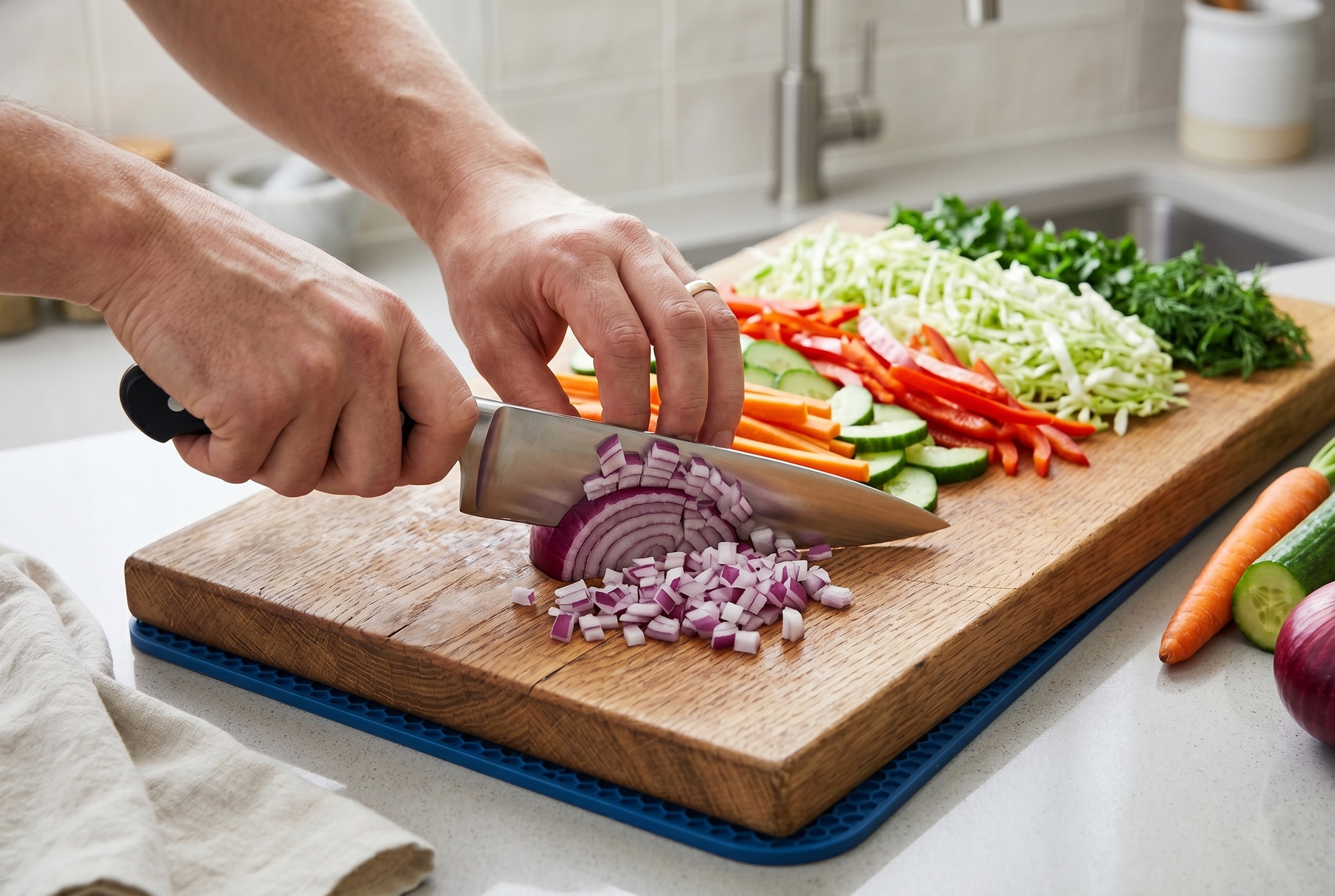
The claw grip technique protects fingertips and allows for better control over the thickness of each slice.
The Dice: The Most Frequent and Versatile Cut
Dicing is the most universal vegetable cut. Soups, sautés, stews, Olivier, vinaigrette (a traditional Russian beet and potato salad), and crab salads rely on it entirely. It appears everywhere.
There is no need for a ruler in a home kitchen. The guideline is much simpler: pieces must cook at roughly the same time and comfortably fit onto a spoon or fork. This is the sole requirement that truly matters.
Three distinct sizes are necessary for everyday cooking:
- A fine dice, 3-5 mm (0.1-0.2 in): onions, carrots, and celery for base sautés, sauces, and fillings;
- A medium dice, 8-12 mm (0.3-0.5 in): potatoes, carrots, and cucumbers for soups and dressed salads;
- A large dice, 2-3 cm (0.8-1.2 in): stews, braises, and long-roasting applications.
The logic of dicing remains identical for any firm vegetable. The first step involves creating a stable base: slicing off one rounded side so the ingredient stops rolling on the board. The vegetable is then sliced into planks of the desired thickness. The planks are cut into batons. Finally, the batons are cut crosswise into cubes.
Onions require a slightly different approach. The onion is halved through the root and placed flat-side down. Several horizontal and vertical cuts are made without slicing entirely through the root end, which holds the layers together so the onion does not disintegrate during the process. A final series of crosswise cuts produces perfect dice.
The reason the dice is irreplaceable in specific dishes becomes clear upon closer inspection:
In an Olivier or vinaigrette salad, a medium dice unifies the ingredients, making the salad cohesive. If the potatoes are cut to 15 mm (0.6 in) while the peas remain tiny and the eggs are in massive chunks, it is no longer a composed salad, but rather separated ingredients coexisting in a single bowl.
In soups, potatoes diced to 10-12 mm (0.4-0.5 in) alongside finely diced or thinly sliced carrots finish cooking at roughly the same time. They end up on the spoon together, making the soup feel like an integrated dish rather than a random assortment of boiled produce.
In a flavor base or sauté, finely diced onions and carrots prevent the vegetables from competing with the main dish. The sauté is meant to melt into the soup or sauce, acting as a flavor foundation rather than floating like chunky porridge on top of the broth. Large onion pieces in a base will aggressively fight for attention in every spoonful.
For stews and braised dishes, a larger dice is essential: 2-3 cm (0.8-1.2 in) potatoes and chunky carrots endure the prolonged braising process and remain intact for serving. A fine dice in a long-simmered stew simply vanishes by the end, leaving behind nothing but starch in the sauce.
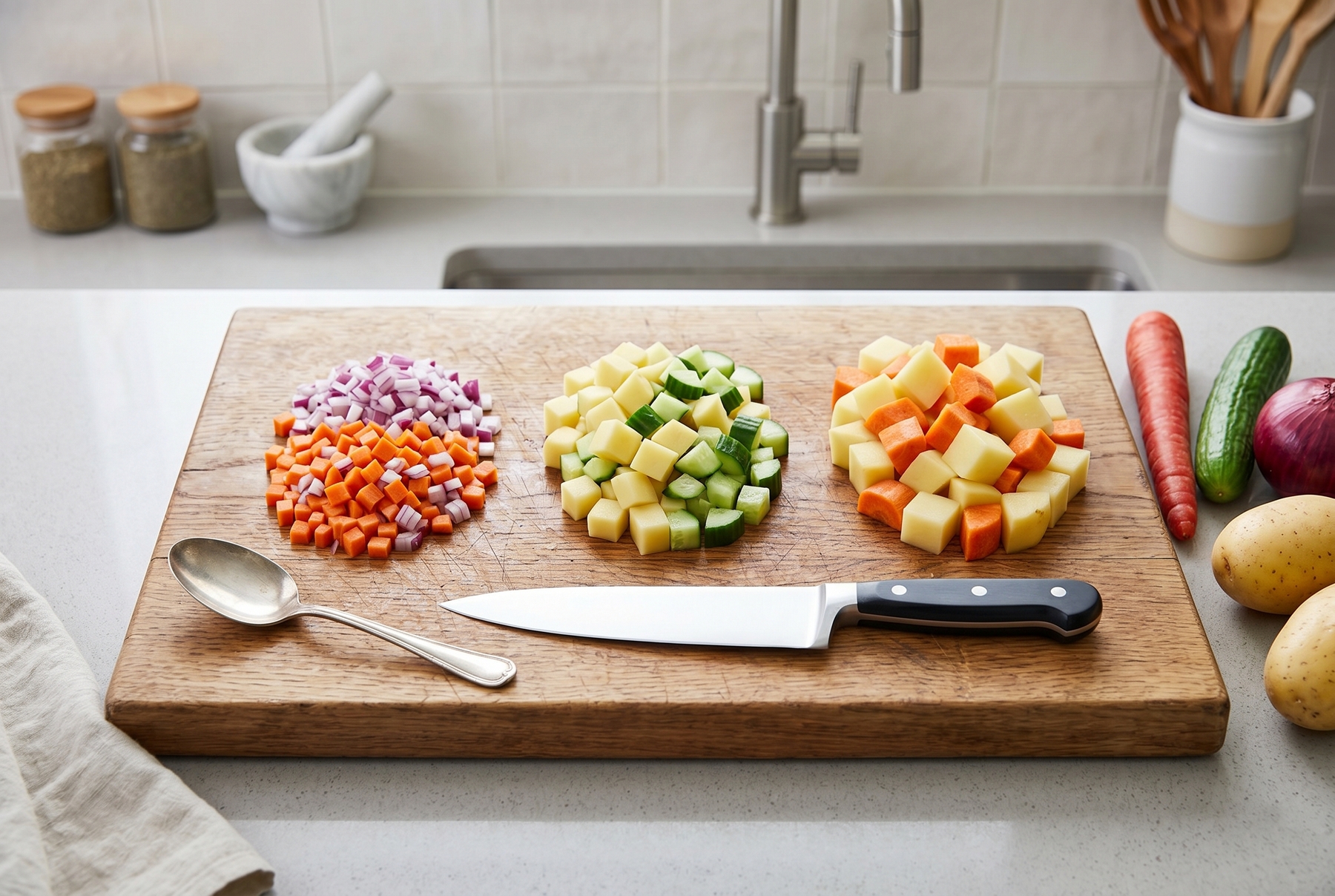
From a fine dice for delicate sauces to large chunks for long braises, size matters.
Julienne: When an Ingredient Needs to Stand Out
The julienne cut consists of thin strips measuring 4-7 cm (1.5-2.7 in) in length and 2-5 mm (0.1-0.2 in) in thickness. These are not matchsticks: that is a fine julienne, a different technique with different culinary goals. Nor are they French fry batons, which feature a thicker profile and yield a different result. True julienne is long, even, and slender.
This cut excels where crunch and structural integrity are paramount. It shines in Korean-style carrots (a popular post-Soviet marinated carrot salad), fresh salads with Asian-style dressings, and high-heat wok stir-fries. A julienne heats through rapidly without falling apart. It suspends sauce on its surface rather than drowning in it.
Julienned carrots in a rapid, high-heat stir-fry finish cooking in two to three minutes, maintaining a slight springiness and a delicate caramelized crust on the exterior. The same carrot, diced, would demand twice the cooking time, yielding a softer texture entirely devoid of that signature crunch.
Julienned cucumber in an Asian-style salad dressed with sesame oil and rice vinegar delivers a profoundly different experience compared to thick half-moons. Thick slices crunch aggressively and feel disconnected from the dressing. The slender julienne absorbs the vinaigrette beautifully, becoming an integrated part of the dish.
When tossing bell peppers into a wok, a julienne sears in about a minute, retaining a light crispness while its skin slightly blisters, deepening into a vibrant red or orange hue. Half-rings subjected to the same heat time develop a mushy, overcooked center alongside tough edges. This is not a matter of flavor, but pure physics.
Beets and carrots destined for Korean-style marinated appetizers also require a julienne cut. Raw julienned beets, tossed with oil and vinegar, possess a completely different character than those grated on a box grater or chopped into cubes: they crunch differently, hold their shape, and present beautifully.
To execute a proper julienne without a mandoline, the vegetable is first sliced into thin 2-3 mm (0.1 in) planks. These planks are stacked two or three high and sliced lengthwise into even strips. For large volumes of Korean-style carrots, a Börner mandoline or a specialized julienne peeler is infinitely more efficient, as achieving consistent thinness with a knife at high speed is challenging. However, attempting it with a knife at least once is highly recommended: it immediately clarifies why thickness dictates everything and exactly where the boundary lies between a precise julienne and arbitrary thin slices.
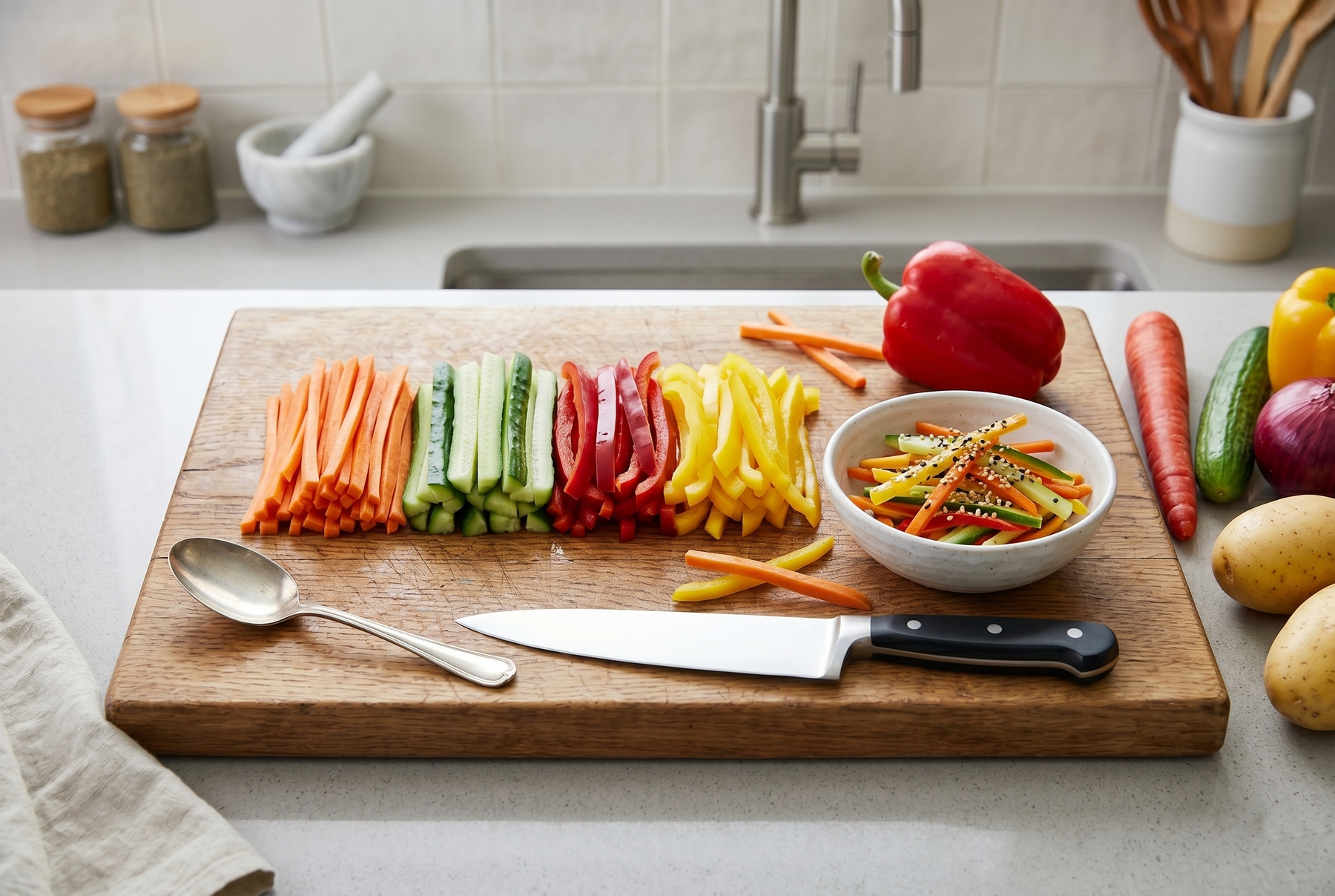
The julienne cut is perfect for quick stir-fries, maintaining crunch and holding sauces beautifully.
Shredding and Shaving: Why Cut So Thinly
Shredding or fine slicing involves a razor-thin, uniform, repetitive cut. This technique is most commonly applied to cabbage, onions, and herbs, and occasionally to radishes, napa cabbage, or cucumbers sliced into paper-thin rounds.
The objective of shredding is to produce a multitude of delicate pieces that rapidly absorb salt, marinate, or soften upon heating. The thinner and more uniform the cut, the more predictable the culinary outcome.
Cabbage. Different recipes demand distinct shredding thicknesses.
A fresh slaw requires a fine 1-2 mm (0.04-0.08 in) shred. The cabbage is subsequently massaged with salt to release its juices and tenderize. A thick cut for a raw salad fails to yield the necessary tenderness, leaving the cabbage tough, aggressively crunchy, and devoid of pleasant juiciness.
For shchi (traditional Russian cabbage soup), a medium 3-5 mm (0.1-0.2 in) shred is optimal: the cabbage must maintain its structural integrity after boiling and provide a distinct presence on the spoon. An overly fine shred in soup simply disintegrates, leaving flavor without any textural substance.
For braising, a wider cut is permissible. The cabbage will inevitably soften during a long cooking process, and a thicker cut gives it a fighting chance to retain some character by the end.
Fermenting sauerkraut requires an even, fine shred. The greater the uniformity, the more consistently the cabbage releases moisture, leading to an even fermentation process. Irregular cuts produce inconsistent results, with some pieces over-fermenting while others fail to sour properly.
Reducing cabbage to a fine, damp dust is entirely unnecessary. A fresh slaw must maintain a satisfying crunch rather than resembling wet blotting paper.
Onions. The onion provides the clearest demonstration of how a cut’s shape alters a dish’s flavor.
A fine dice for sautés and minced meat mixtures allows the onion to swiftly surrender its moisture and sweetness, turning soft and melting into the dish. It becomes visually undetectable, working quietly to elevate the surrounding flavors.
Thin half-moons for salads, pickled onions accompanying kebabs, or paired with cured herring ensure the onion remains a visible component. Its harsh bite dissipates quickly, particularly when exposed to an acidic marinade or a brief blanching in boiling water.
Slicing pole-to-pole into strips (often called julienned onions or feathers) works brilliantly for plov (rice pilaf), roasts, and hearty stews. These strips caramelize differently than a dice, providing an appealing visual pattern and remaining recognizable in the final dish.
Regarding pungency: the thinner the onion is sliced, the faster it releases the volatile sulfur compounds responsible for its harshness. Paper-thin half-moons in a salad mellow out gracefully under salt or acid in just 10 to 15 minutes. Thick slabs of that identical onion will retain an aggressive bite twice as long, simply because the acid requires more time to penetrate the layers.
Fresh Herbs. The cardinal sin is chopping with a dull blade and running over the pile multiple times. The herbs are not being cut; they are being crushed. The cell walls rupture, juices bleed out onto the board, and parsley or dill begins to smell not of vibrant freshness, but of damp decay, as if left rotting in a plastic bag for two days.
The proper protocol involves washing and thoroughly drying the herbs, as wet greens stubbornly resist a clean cut and clump together instantly. Gather them into a loose bunch and slice cleanly with a razor-sharp knife in one or two deliberate passes. If the blade is honed, a single downward motion yields a pristine cut with zero juice loss. Herbs are stirred in at the very end, strictly off the heat, with no lid trapping the steam. They must remain vibrantly green, avoiding the sad fate of becoming grey, soggy mulch.
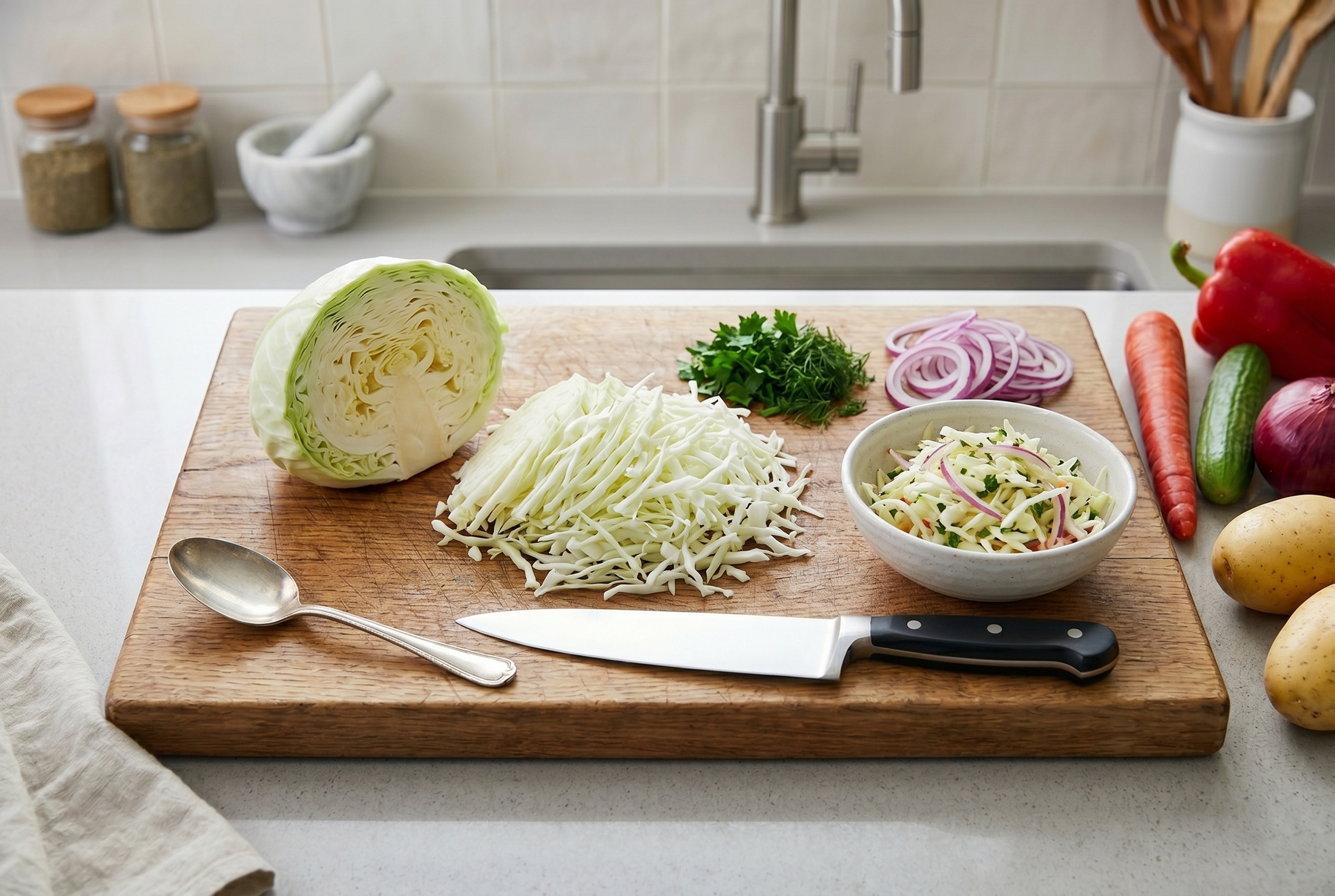
A fine, even shred allows cabbage to release its juices faster and helps fresh herbs retain their aroma without becoming mushy.
How to Choose Cutting Techniques for Specific Dishes
Soups. Every element must comfortably fit onto a spoon and finish cooking simultaneously. Use a medium dice for potatoes (10-12 mm / 0.4-0.5 in), a fine dice or thin rounds for carrots, and a fine dice for onions. Cabbage benefits from a medium shred, as an ultra-fine cut will dissolve completely in shchi. Herbs require a fine chop and are added only at the very end, directly into the serving bowl or immediately after removing the pot from the heat.
Salads. The pieces must be proportionate and easily forkable. In an Olivier or vinaigrette, uniformly dicing the root vegetables allows the diner to capture a bit of everything in a single bite. For fresh salads, cucumbers and radishes shine as thin slices or half-moons, while cabbage requires a delicate, fine shred. Raw carrots and beets deliver superior crunch and a far more vibrant aesthetic when julienned.
High-Heat Stir-Frying. The shorter the cooking duration, the thinner the cut. Opt for pole-to-pole onion strips or a fine dice, julienned or finely diced carrots, and thin bell pepper strips. Every ingredient must heat through rapidly without compromising its structural shape.
Braising and Roasting. Cut larger than intuitively seems necessary. Quarter potatoes or chop them into substantial 2-3 cm (0.8-1.2 in) chunks, and leave carrots in large segments. Zucchini and eggplants demand special attention: they lose volume aggressively during braising, and a small cut will inevitably disintegrate into a homogenous mush utterly devoid of texture by the end of the cooking process.
The Most Common Vegetable Cutting Mistakes
The most frequent and frustrating error involves wildly inconsistent sizing. Small and large chunks simmering in the same pot cook at entirely different speeds. By the time a large piece of potato achieves tenderness, the smaller pieces have already dissolved into paste. This flaw is glaringly obvious in soups and stews, where it single-handedly ruins the final result.
Going too small for long cooking times is another common pitfall. A finely diced zucchini simmering in a ragout for thirty minutes devolves into a slush: the original shape might be faintly recognizable, but the texture is entirely gone. Finely diced potatoes subjected to a prolonged braise vanish entirely into the sauce, leaving behind nothing but a starchy residue.
Conversely, cutting too large for a rapid cook spells disaster. A thick carrot chunk sautéed over medium heat will sear beautifully on the outside while remaining stubbornly raw and tough inside, crunching as if entirely uncooked. Large onion pieces folded into a three-minute omelet will fail to soften, aggressively overpowering every bite with their sharp bite.
One final crucial detail: excess moisture. Fresh herbs, mushrooms, and any freshly washed vegetables must be thoroughly dried before the knife touches them. A wet surface dangerously slips under the blade, and soggy mushrooms hitting a scorching skillet refuse to sear. Instead, they steam in their own released moisture, entirely forfeiting any chance of developing a satisfying crunch or a deep, golden-brown crust. The aroma shifts dramatically as well: rather than smelling roasted and intensely savory, they smell flat and boiled.
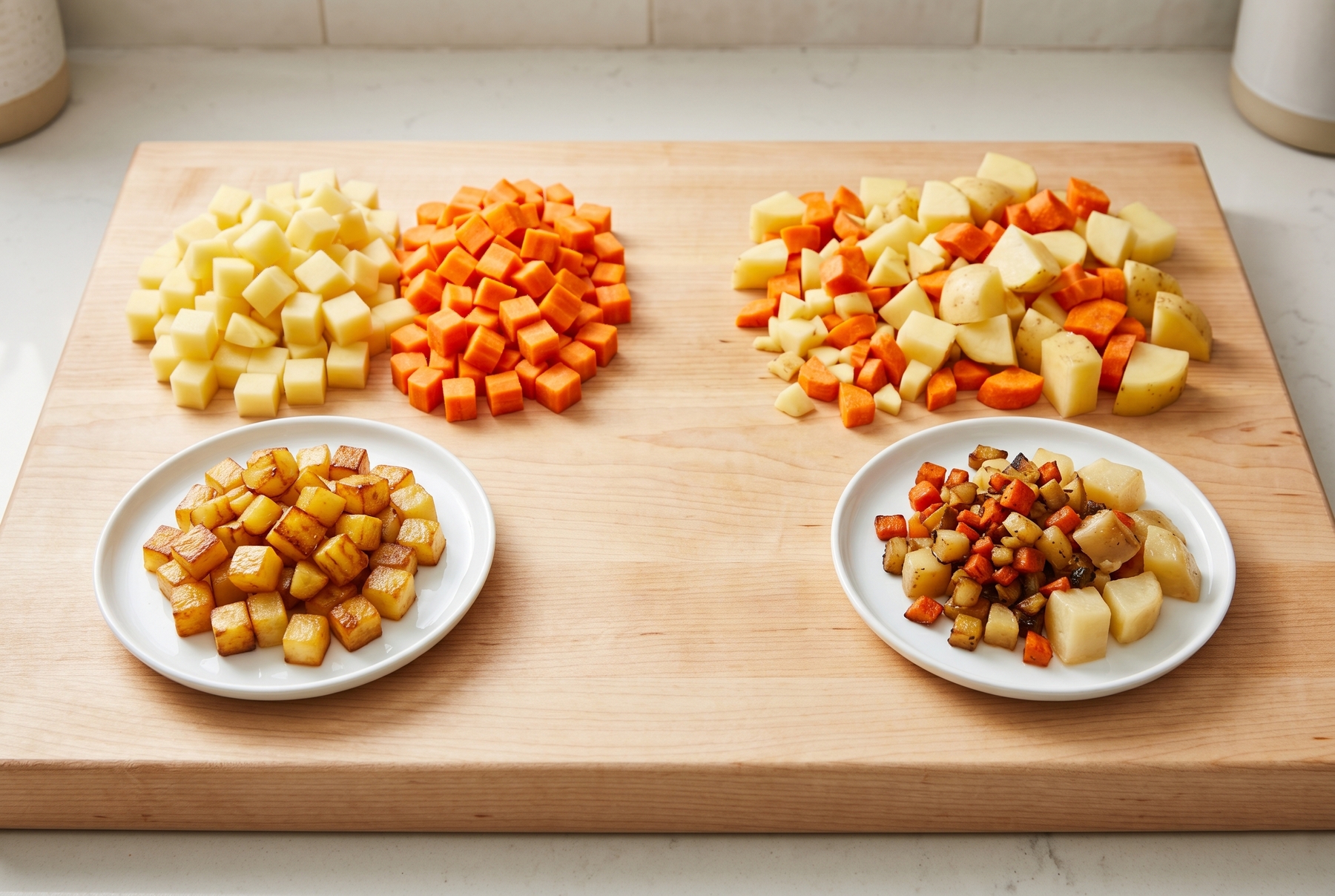
A clear demonstration: unevenly sized chunks cook at different rates, ruining the texture and flavor of the entire dish.
Three Exercises to Put the Theory to the Test
This is not an academic manual. These three straightforward experiments firmly translate abstract discussions regarding knife cuts into undeniable culinary reality.
One Carrot, Three Shapes. Take a medium carrot and cut it three distinct ways: a portion into 8-10 mm (0.3-0.4 in) dice, another into a julienne, and the rest into paper-thin 2-3 mm (0.1 in) rounds. Sauté each batch separately in the same skillet, maintaining identical heat levels and oil quantities. Time the process and taste each batch. The thin, slightly blistered rounds will finish cooking first, exuding a profound sweetness. The julienned strips will remain beautifully springy. The diced portion will demand an additional minute and a half to two minutes. Tasting them side-by-side clarifies the textural and flavor differences instantly.
One Onion, Three Cuts. Slice a single onion using three methods: drop a fine dice into a medium-heat oil sauté; marinate paper-thin half-moons with a pinch of salt, a spoonful of vinegar, and sugar for ten minutes; and rapidly sear pole-to-pole strips over high heat. Taste every variation. A single onion yields three fundamentally distinct ingredients: the dice is soft and sweet, the half-moons are bright, crunchy, and tart, while the strips offer a robust, roasted flavor with deeply caramelized edges.
Cabbage for Two Occasions. Finely shred one half of a cabbage and massage it gently with salt. Within five minutes, it transforms into a soft, weeping, tender base perfectly suited for a fresh slaw. Slice the remaining half substantially thicker and drop it into a simmering soup. In the broth, it retains its bold character, refusing to dissolve and offering a satisfying bite on the spoon. There is no such thing as a universally ‘correct’ thickness. There is only the right thickness for a specific culinary application.
How to Salvage a Chopping Mistake
If the vegetables are cut too large, initiate their cooking process earlier than the remaining ingredients. Introduce a splash of liquid and let them gently braise on their own. If roasting, extend the oven time, or simply pull them out, chop them down to size, and return them to the pan.
If cut too small, those finely minced vegetables effortlessly melt into sauces, puréed soups, or savory fillings for patties and fritters. Avoid subjecting them to prolonged high-heat searing, as they will degrade into a bitter, blackened paste much faster than anticipated.
If an onion proves too aggressive for a raw salad, rinse it thoroughly under cold running water, blanch it briefly with boiling water, or submerge it for ten to fifteen minutes in a mixture of cold water, a splash of vinegar, and a pinch of salt and sugar. The sharp bite vanishes rapidly as heat and acidity break down the pungent sulfur compounds, while the onion masterfully retains its refreshing crunch.
Approaching knife work with intent ultimately saves time compared to haphazardly chopping and struggling to fix the resulting mess. When the desired size and shape are clearly understood, the knife moves with absolute confidence, hand fatigue plummets, and the dish behaves predictably in the pan. A finely diced carrot in a base sauté turns tender and sweet in just three minutes, releasing a subtle, slightly smoky aroma of burnt sugar. The exact same carrot, chopped into massive chunks, will spend that same three minutes developing a charred exterior while remaining stubbornly raw inside. The recipe and the pot may be identical, but the cut changes absolutely everything.
0 comments